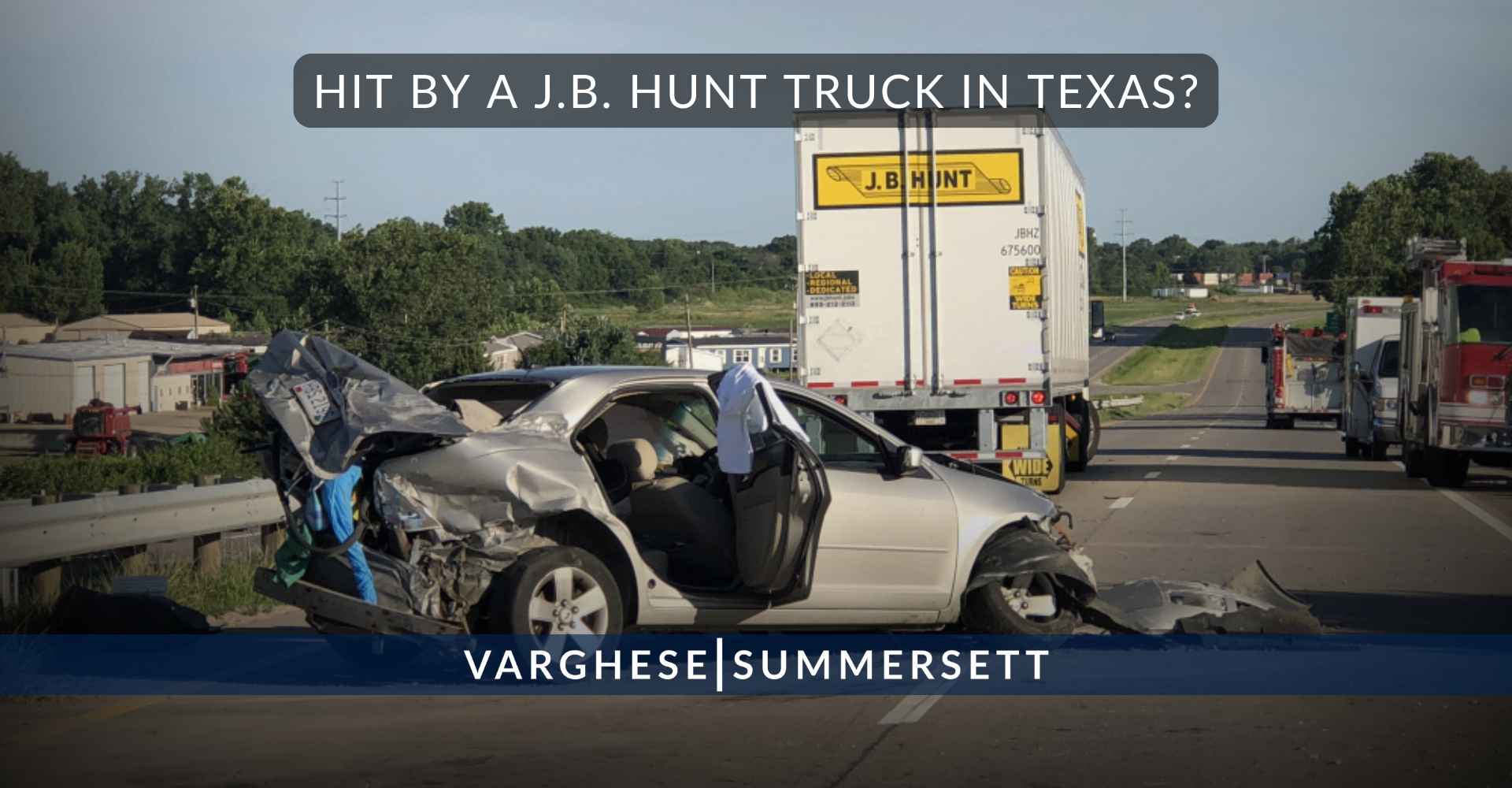
If a J.B. Hunt tractor-trailer hit you or someone you love, you are not dealing with a driver who forgot to renew his insurance. You are dealing with one of the largest trucking and logistics companies in the country, one with its own legal and claims department that is likely already reviewing your case.
J.B. Hunt trucks generate hours-of-service logs, GPS and telematics data, and often camera footage that can prove exactly what happened, but that evidence can be lost or overwritten within days if no one moves to preserve it. Below, we explain who J.B. Hunt actually is, what evidence matters most in a claim against a carrier this size, and how our trucking accident attorneys build these cases from the first phone call.
You may still be in a hospital bed, or sitting in a body shop parking lot staring at what used to be your car. Either way, your phone has probably already rung once. It was not a friend. It was an insurance adjuster, and they were polite, and they asked if you could just give a quick recorded statement about what happened. That call is not a coincidence. Large trucking companies and their insurers move fast after a wreck because the first 48 hours decide who controls the evidence.

J.B. Hunt Transport Services, Inc. is a publicly traded transportation and logistics company headquartered in Lowell, Arkansas, founded in 1961 by Johnnie Bryan and Johnelle Hunt. It trades on the Nasdaq under the ticker JBHT and is a component of the S&P 500 and the Dow Jones Transportation Average. The company operates a fleet of more than 12,000 trucks and roughly 145,000 trailers and containers across intermodal rail service, dedicated fleets, over-the-road truckload freight, and a brokerage arm that matches shippers with third-party carriers. That last detail matters more than it sounds like it should, and we will come back to it.
At Varghese Summersett, our Personal Injury Division has represented people hurt in car wrecks, 18-wheeler crashes, and other commercial vehicle collisions across Texas. The division is led by Partner Ty Stimpson, a former Dallas County and Tarrant County prosecutor who now represents clients injured in 18-wheeler accidents and other serious vehicle collisions. Partner Damian Williams, based in our Dallas office, focuses on catastrophic injury and wrongful death cases arising from trucking and auto collisions, and has secured multiple seven-figure verdicts and settlements in trucking fatality cases. (Past results do not guarantee future outcomes.) Damian also worked in insurance defense before representing injured people, giving him direct insight into how carriers like J.B. Hunt and their insurers evaluate and try to minimize a claim.
Varghese Summersett operates four offices across Texas, in Fort Worth, Dallas, Southlake, and Houston.
You've Seen Us On


Who Is Actually Liable When a J.B. Hunt Truck Causes a Wreck?
Under Texas law, a person injured by another’s negligence must prove four things: that the other party owed a duty of care, that they breached that duty, that the breach caused the injury, and that the injury resulted in damages. This is the standard negligence framework under the Texas Civil Practice & Remedies Code, and the burden of proving each element falls on the injured person, by a preponderance of the evidence, meaning it is more likely than not that the wreck happened the way you say it did.
Texas also follows modified comparative fault. Under Civil Practice & Remedies Code § 33.001, you can still recover damages even if you were partly at fault for the crash, as long as your share of the fault is 50 percent or less. If a jury finds you were 51 percent or more responsible, you recover nothing. This is exactly why large carriers and their insurers spend so much time and money trying to shift blame onto the injured person, sometimes before that person has even seen a doctor.
Interstate trucking is one of the few areas where federal law properly governs a Texas crash. J.B. Hunt drivers and equipment are subject to the Federal Motor Carrier Safety Regulations, and the Texas Department of Public Safety has separately adopted those same standards for motor carriers operating in Texas. 37 TAC §4.11(a). That means hours-of-service limits, post-crash drug and alcohol testing in specified circumstances, driver qualification requirements, and vehicle maintenance standards are not optional guidelines. A violation of a specific safety rule can be important evidence in proving negligence, which is why identifying the regulation that was broken often matters so much in a truck crash case.
Why a J.B. Hunt Case Is Different From an Ordinary Car Wreck
J.B. Hunt is not just one truck and one driver. It is a corporate transportation company with multiple operating entities, so depending on how the load was handled, your case may involve more than one potential defendant. J.B. Hunt Transport Services, Inc. is the public parent company, and J.B. Hunt Transport, Inc. is one of its operating subsidiaries that appears in federal carrier records.
The company’s business includes intermodal service, dedicated fleets, truckload freight, and logistics or brokerage operations. If the truck that caused the crash was owned and dispatched by a J.B. Hunt operating entity and driven by its employee, Texas law may allow claims based on the driver’s negligence and the company’s responsibility for that conduct. If J.B. Hunt brokered the load to an outside carrier, the analysis may also include whether it was negligent in selecting or vetting that carrier, along with claims against the carrier that actually operated the truck.
On insurance, federal law sets a minimum floor, not a ceiling. For most interstate general-freight motor carriers, federal rules require at least $750,000 in liability coverage, with higher minimums for hazardous materials. The exact insurance structure for a specific crash usually has to be obtained through discovery.
The Evidence That Disappears Fast
A crash involving a company as large as J.B. Hunt leaves behind far more evidence than a typical two-car accident, but almost all of it has a shelf life.
- Electronic logging device (ELD) and hours-of-service data. Federal rules require carriers to retain these records for only six months under 49 CFR § 395.8. This data shows whether the driver was fatigued or over their legal driving hours.
- Telematics and GPS data. J.B. Hunt’s dispatch and tracking systems record speed, braking, and location in real time, and are typically stored on a rolling basis that can overwrite itself.
- Forward and driver-facing camera footage. Many commercial fleets record continuously and only save footage tied to a triggering event, meaning footage of the actual moment of impact can be automatically deleted if no one requests it.
- The driver qualification file. This includes the driver’s employment history, prior violations, and training records.
- Post-accident drug and alcohol testing. Under 49 CFR § 382.303, certain crashes trigger mandatory testing of the driver, and the results and chain-of-custody records matter.
- Vehicle maintenance and inspection records, and the truck’s electronic control module (black box) data, which can show speed and braking at the moment of the crash.
Because most of this evidence sits with the trucking company or its insurer, an experienced attorney sends a spoliation letter, formally demanding that all of it be preserved, within days of being retained. Waiting even a few weeks can mean some of it is already gone.
What an Experienced Trucking Attorney Does in the First 48 Hours
The first two days after a crash like this set the direction of the entire case. A lawyer who handles trucking claims regularly will typically move to identify and secure the specific truck, driver, and carrier information from the crash report and FMCSA registration, send a written spoliation and evidence-preservation letter to J.B. Hunt and its insurer covering ELD data, telematics, camera footage, and the driver qualification file, and open an independent investigation, including photographs of the scene, skid marks, and vehicle damage, before the roadway is cleared and evidence is lost.
In the first two weeks, that work typically expands to identifying every witness and obtaining recorded statements while memories are fresh, requesting the police crash report and any citations issued, and beginning to document the full scope of medical treatment so the value of the claim is not underestimated early on. Before a lawsuit is ever filed, a thorough attorney will also determine the correct corporate defendant or defendants, whether the load was owned equipment or brokered freight, and calculate every available source of recovery rather than settling quickly with whichever adjuster calls first.
Every Source of Recovery, Not Just the Truck’s Policy
One of the most common mistakes people make is assuming there is a single pot of money available after a truck wreck. In reality, a case involving a carrier like J.B. Hunt can involve several potential sources of compensation, and identifying all of them is part of maximizing what you recover.
- The trucking company’s own commercial liability policy, which as discussed typically includes primary, excess, and umbrella layers stacked well above the federal minimum.
- A broker-negligence claim against J.B. Hunt, if the load was brokered to a third-party carrier and J.B. Hunt failed to properly vet that carrier’s safety record.
- The third-party motor carrier’s own insurance, if a brokered carrier, rather than J.B. Hunt directly, owned and operated the truck.
- Your own uninsured or underinsured motorist coverage, which can provide a backstop if coverage is disputed, delayed, or insufficient.
- A product liability claim against a parts or equipment manufacturer, in the rare case where a mechanical failure, such as brake or tire failure, contributed to the crash.
If a loved one was killed in the crash, Texas law allows certain family members to bring a wrongful death claim under Civil Practice & Remedies Code § 71.001, and an attorney experienced in trucking litigation will pursue every one of these sources on the family’s behalf, not just the most obvious one.
The Defense Playbook, and How It Gets Answered
Companies the size of J.B. Hunt do not settle every case for the first number an adjuster offers. Expect the defense to argue that you or another driver caused or contributed to the crash, that your injuries were pre-existing or unrelated to the wreck, or that the driver was an independent contractor rather than an employee, an argument sometimes used to try to limit the company’s own liability. An experienced trucking attorney answers these arguments with the same evidence discussed above: the ELD and telematics data, camera footage, driver qualification file, and independent accident reconstruction where needed, so the story is told by the record, not by the version an insurance adjuster prefers.
Mistakes That Can Quietly Damage Your Claim
In the days right after a crash like this, a few common missteps can cost you real money later. Avoid giving a recorded statement to J.B. Hunt’s insurance adjuster before speaking with your own attorney. Be careful about posting anything about the crash, your injuries, or your activities on social media, since insurers routinely review it. Do not sign a broad medical authorization that lets the insurance company pull your entire medical history rather than just records related to this crash. And do not delay medical treatment, even if you think you are fine, since gaps in treatment are one of the first things a defense team points to when arguing your injuries were not serious.
What to Expect From Varghese Summersett
When you call our Personal Injury Division after a wreck involving a company like J.B. Hunt, we move immediately to preserve the evidence described above, identify every corporate entity and insurance policy that may apply, and handle communication with adjusters so you are not pressured into a recorded statement or a quick, low settlement while you are still recovering. We represent clients on a contingency basis, meaning there is no fee unless we win, and we prepare every serious injury and wrongful death case as though it may go to trial, because insurance companies negotiate differently with a firm they know is not afraid to take a case in front of a jury.
Award-Winning Legal Excellence


Watch: Common Causes of Truck Wrecks
Frequently Asked Questions
Do I need a different kind of lawyer for a wreck involving a big company like J.B. Hunt?
Yes. Commercial trucking cases involve federal safety regulations, electronic logging data, corporate structures, and insurance layers that do not exist in an ordinary car accident claim. An attorney who regularly handles trucking cases knows what to preserve immediately and how to identify every party who may be responsible.
What if the truck was driven by an independent contractor instead of a J.B. Hunt employee?
The liability analysis changes, but it does not disappear. Depending on how the load was arranged, J.B. Hunt may still be liable directly, or liable for negligently selecting an unsafe third-party carrier, in addition to that carrier’s own insurance being available.
How long does a claim against a large trucking company take in Texas?
It varies significantly based on the severity of the injuries, how long treatment takes, and whether the insurer is willing to negotiate in good faith. Serious injury and wrongful death cases against large carriers often take longer than a routine car accident claim because more parties, more insurance layers, and more evidence are typically involved.
What if I was partly at fault for the accident?
Under Texas’s modified comparative fault rule, you can still recover damages as long as a jury finds you were 50 percent or less responsible for the crash. Your recovery is reduced by your percentage of fault, but you are not automatically barred from compensation.
How much does it cost to hire a truck accident lawyer?
We represent personal injury clients on a contingency fee basis, meaning you pay nothing upfront and we only get paid if we recover compensation for you. Free Consultation available to discuss your case.
Texas Level I Trauma Centers and Local Resources
- John Peter Smith Hospital, Fort Worth (Level I Trauma Center, Tarrant County)
- Parkland Memorial Hospital, Dallas (Level I Trauma Center, Dallas County)
- Memorial Hermann Texas Medical Center, Houston (Level I Trauma Center, Harris County)
Civil claims against interstate carriers are frequently filed in the county where the wreck occurred or where the defendant may be served, which for our clients often means the civil courts in the Tarrant County Justice Center, the George L. Allen Sr. Courts Building in Dallas, or the Harris County Civil Courthouse in Houston, among other Texas venues depending on where the crash happened.
Our attorneys regularly handle truck accident and commercial vehicle accident claims across Texas, including interstate highway accidents and catastrophic injury cases. If your loved one did not survive, we can also help with a wrongful death claim, and if the carrier’s insurance is disputed or insufficient, we will examine your uninsured or underinsured motorist coverage as well.
Texas Personal Injury Practice Areas
Our Texas injury lawyers fight for maximum compensation
Injured in Texas? Get a free consultation.
If a J.B. Hunt truck hit you or someone in your family, do not wait to find out what the company’s insurer already knows. Call Varghese Summersett at (817) 203-2220 for a free consultation, or reach our Dallas office directly at (214) 903-4000 or our Houston office at (281) 805-2220.
