
Why Texas Police Are Running More Solicitation Stings Than Ever
In one week in March 2026, 286 people responded to ads placed by undercover Austin police officers. Twenty-one of them were arrested. Two trafficking victims were recovered — one an adult, one a child.
That single operation says more about how Texas polices commercial sex in 2026 than any statute does. Police are no longer waiting on street corners. They are placing the ads, running the conversations, setting the price, picking the hotel, and waiting in the next room. And since September 1, 2021, when Texas became the first state in the nation to make first-offense buying of sex a felony, the person who walks into that hotel room is facing a felony record before anything else happens.
Solicitation stings have become increasingly common across Texas — run by city police departments, county sheriffs, the Texas Department of Public Safety, and multi-agency human trafficking task forces. They are run on classified and escort advertising sites, on social media, in massage parlors, and increasingly in operations aimed at people who believe they are talking to a minor.
If you were arrested in one of these operations, or you think you may have been talking to an undercover officer, this article explains how these stings work, what you can actually be charged with under current Texas law, when entrapment is a real defense and when it is not, and what to do right now.
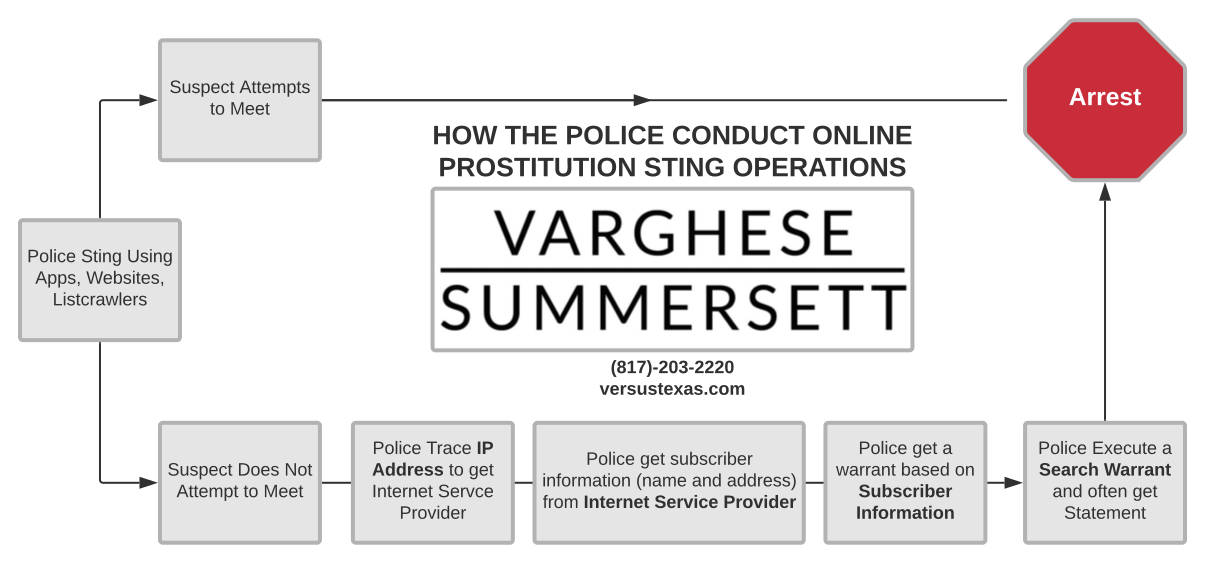
How a Police Solicitation Sting Actually Works
Almost every solicitation sting in Texas follows the same architecture. Understanding it matters, because the defense in these cases usually lives in the details of how the operation was run.
1. The decoy ad. An officer posts an ad on a site or app where commercial sex is advertised. The ad is written to look like a real listing — photos (often of an officer, a volunteer, or a stock image), a first name, a phone number, and coded language. The number routes to a phone monitored by the operation.
2. The conversation. When someone responds, an undercover officer takes over the text thread. This is the most important evidence in the case, and it is preserved. The officer’s goal is to get three things on the record: an agreement to engage in a specific sexual act, an agreed fee, and a meeting location. Officers are trained to let the target propose the act and the price whenever possible — precisely because that undercuts an entrapment claim later.
3. The location. The meeting is almost always at a hotel room already controlled by the operation, or occasionally a residence. The room is staffed. There are usually officers in the adjoining room or the bathroom, and the conversation inside is recorded.
4. The arrest. In most Texas operations the offense is complete long before anyone arrives anywhere. Under Texas Penal Code § 43.021, the knowing offer or agreement to pay a fee for sexual conduct is the offense. Travel, arrival, payment, and sexual contact are evidence of intent — they are not elements. Officers typically make the arrest once the person shows up, but the crime the State will charge was finished in the text thread.
5. The reverse sting. In a “reverse” operation, officers pose as buyers instead of sellers to arrest people offering commercial sex. These target a different population and carry very different penalties.
How Do I Know If I Was Talking to an Undercover Officer?
There is no reliable checklist, and anyone who sells you one is guessing. But there are patterns that recur in Texas sting transcripts:
- The other party pushes to move the conversation to explicit, specific terms quickly — naming acts and dollar figures in writing.
- The other party resists a phone call or video call, or the call is very brief.
- The location is a mid-range chain hotel, and the room number arrives only when you are close.
- The other party volunteers an age, unprompted, and then repeats it.
- The ad and the person you are texting seem slightly mismatched.
Important: none of this makes an arrest unlawful. Undercover work, decoy ads, and false identities are all legal in Texas. Recognizing a sting is useful for avoiding one — it is not, by itself, a defense to one.
Listcrawler Arrests: What Happens After a Sting
A large share of Texas solicitation arrests still come out of operations run on Listcrawler, particularly across Dallas–Fort Worth, Houston, San Antonio, and Austin. If you were arrested after responding to a Listcrawler ad, the mechanics above are almost certainly what happened to you: the listing was placed by police, the person you were texting was an officer, and the hotel room was already theirs.
Three things matter about a Listcrawler arrest specifically:
Your messages are the case. Screenshots, an extraction report from the officer’s phone, and often a full download of your own phone after arrest. Deleting the thread on your end does not delete it on theirs.
The charge is a felony from the first offense. Not a ticket, not a Class C. See the charge ladder below.
Age representations change everything. If the ad or the thread represented the person as under 18 — even once, even in passing, even though the person you were actually texting was an adult officer — you are on a different rung of the ladder entirely.

Which Texas Agencies Run These Operations
Solicitation stings in Texas are run at every level:
- Municipal police departments — Austin PD, Dallas PD, Houston PD, Fort Worth PD, San Antonio PD, Arlington PD, and dozens of suburban departments run their own vice operations.
- County sheriff’s offices — Tarrant, Bexar, Harris, Collin, Denton, and Montgomery counties all run periodic operations, frequently multi-day.
- Texas Department of Public Safety — DPS runs both prostitution stings and minor-focused online solicitation operations, often with local agencies and often at hotels along interstate corridors.
- Multi-agency human trafficking task forces — these combine local, state, and federal resources, and are the most likely to produce trafficking and promotion charges alongside solicitation charges.
- Internet Crimes Against Children (ICAC) task forces — these run the minor-decoy operations. An ICAC case is a fundamentally different and far more serious matter than an adult solicitation sting.
Which agency ran the operation affects which prosecutor’s office handles the case, whether federal charges are possible, and how the case is likely to be resolved.
What You Can Actually Be Charged With
This is where most online explanations go wrong. There is not one “solicitation” charge in Texas — there is a ladder, and where you land on it depends almost entirely on facts you may not have thought about at the time.
Solicitation of Prostitution — Texas Penal Code § 43.021
This is the buyer-side offense. Texas moved it out of § 43.02 into its own section in 2021 and raised it from a Class A misdemeanor to a felony at the same time.
| Circumstance | Offense level | Punishment range |
|---|---|---|
| First offense, adult involved | State jail felony | 180 days – 2 years in a state jail, fine up to $10,000 |
| Prior conviction or deferred adjudication for solicitation | Third-degree felony | 2 – 10 years in prison, fine up to $10,000 |
| Person is under 18, represented as under 18, or believed to be under 18 | Second-degree felony | 2 – 20 years in prison, fine up to $10,000 |
| On or within 1,000 feet of school premises, or where an official school function or UIL event was taking place | Punishment increased to the next highest category — the offense grade itself does not change | e.g., a state jail felony is punished as a third-degree felony |
Several things about this table are commonly reported incorrectly elsewhere, and each of them matters.
A “first offense” is not automatically a state jail felony. If the decoy was presented as a 16-year-old, a true first offense is a second-degree felony — 2 to 20 years. The absence of a criminal record does not move you down the ladder when an age representation is in the thread.
Where the person actually is under 18, the State does not have to prove you knew it. Section 43.021(b)(2)(A) applies “regardless of whether the actor knows the age of the person at the time of the offense.” Subsections (B) and (C) separately reach a person represented as under 18 or believed by you to be under 18 — which is what covers the undercover-decoy case.
A prior deferred adjudication counts as a prior. Section 43.021(c) is explicit: a plea “in return for a grant of deferred adjudication, regardless of whether the sentence for the offense was ever imposed.” Deferred does not reset the counter.
The statute changed on September 1, 2025. House Bill 1778 rewrote § 43.021(b)(2). The prior version reached the person “to whom the actor offers or agrees to pay the fee for the purpose of engaging in sexual conduct.” The current version reaches the person “with respect to whom the actor offers or agrees to engage in sexual conduct.” That shift moves the enhancement from the payee to the intended sex partner — so it now reaches a defendant who negotiates with a purported parent, handler, or third party, a configuration undercover officers use frequently. The change applies only to offenses committed on or after September 1, 2025, which makes your offense date a live issue if your case straddles that line.
Prostitution — § 43.02
The seller-side offense, charged in reverse stings. It remains a Class B misdemeanor for a first offense (up to 180 days in jail, up to a $2,000 fine), rising to a Class A with one or two priors and a state jail felony with three or more.
Texas raised the penalties on buyers in 2021 while leaving sellers at a Class B misdemeanor. Section 43.02(d) also preserves a defense for a person who committed the conduct as a victim of human trafficking or compelled prostitution.
Online Solicitation of a Minor — § 33.021
This is the ICAC charge, and it is the most serious of the common sting offenses.
- § 33.021(b) — a person 17 or older who communicates in a sexually explicit manner with a minor, or distributes sexually explicit material to a minor, over the internet or by text, with intent to commit certain sex offenses. Third-degree felony, or second-degree if the minor is younger than 14 or is believed to be younger than 14.
- § 33.021(c) — soliciting a minor to meet for sexual contact. Second-degree felony, flat. There is no under-14 enhancement for subsection (c) — many law firm websites get this backwards.
- Under § 33.021(d), it is not a defense that the meeting never happened.
- Under § 33.021(a)(1), a “minor” includes anyone the actor believes to be younger than 17. This is why an undercover adult works.
- Under § 33.021(e), the marriage defense and the three-year age-gap defense apply only to subsection (c) conduct — not to subsection (b).
Two corrections worth stating plainly, because outdated versions circulate widely:
The “fantasy defense” language is gone. Section 33.021(d) used to say it was no defense that the actor was engaged in fantasy, or that he did not intend the meeting to occur. The Legislature repealed both prongs in 2015 (SB 344). Today (d) says only that it is no defense that the meeting did not occur. That does not make fantasy a defense — it means the issue is litigated as a question of intent rather than being foreclosed by statute, which is a meaningfully different posture for the defense.
It is wrong to say § 33.021(b) is unconstitutional. The Court of Criminal Appeals struck down the pre-2015 version of subsection (b) in Ex parte Lo, 424 S.W.3d 10 (Tex. Crim. App. 2013). The Legislature rewrote it in 2015, and the current version is prosecuted routinely. Subsection (c) has been challenged repeatedly and upheld, including in Ex parte Fujisaka, 472 S.W.3d 792 (Tex. App.—Houston [1st Dist.] 2015, pet. ref’d), and by the Court of Criminal Appeals in Ex parte Ingram, 533 S.W.3d 887 (Tex. Crim. App. 2017). Read more about online solicitation of a minor under PC 33.021.
Criminal Solicitation of a Minor — § 15.031
A broader statute that is not limited to internet communications. It covers requesting, commanding, or attempting to induce a minor — defined here as a person younger than 17 — or someone believed to be a minor, to commit certain enumerated offenses. Two features distinguish it: the grade is derivative, one category lower than the offense solicited unless a criminal street gang finding applies; and corroboration is required under § 15.031(c), so there is no conviction on the uncorroborated testimony of the minor solicited. More on criminal solicitation of a minor under PC 15.031.
Child Grooming — § 15.032
Added in 2023 and amended in 2025, this offense covers knowingly persuading, inducing, enticing, or coercing a child younger than 18 — a broader age range than § 15.031 — to engage in conduct constituting a Chapter 43 offense or certain sexual activity. Third-degree felony, second-degree with an enumerated prior. It has become a standard companion count in Texas internet stings, and as of September 1, 2025 it is a registerable offense.
Other Charges That Ride Along
Sting arrests frequently generate additional counts that have nothing to do with solicitation: unlawful carrying of a weapon if there is a gun in the car, possession of a controlled substance, and — increasingly — child pornography counts if the phone is searched and something is found.
The 2025 Legislature sharply lowered the § 43.26 possession tiers. The third-degree tier now caps at fewer than 10 visual depictions (it was fewer than 100); 10 to 49 is a second-degree felony; 50 or more is a first-degree felony. A § 43.26 conviction also carries lifetime sex offender registration — a far worse outcome than the underlying solicitation charge.
The Legislature separately created § 43.235 (SB 20), covering obscene material that appears to depict a child, including cartoons, animation, and AI-generated images, and using a real child’s image to train an AI model. It is a state jail felony, escalating with priors, and is not currently a registerable offense.
Sex Offender Registration: The Question Everyone Asks First
Registration is usually the consequence that matters most, and the answer depends entirely on which rung of the ladder you land on.
| Charge | Registration required? |
|---|---|
| § 43.021 solicitation — adult involved (state jail felony, or third-degree repeat) | No |
| § 43.021 solicitation — person under 18, represented as under 18, or believed to be under 18 (second-degree) | Yes |
| § 33.021 online solicitation of a minor — any subsection, any grade | Yes |
| § 15.032 child grooming | Yes, for offenses on or after September 1, 2025 |
| § 15.031 criminal solicitation of a minor | Depends on the underlying offense solicited |
| § 43.26 child pornography (a common companion count) | Yes — and for life |
Three critical caveats:
Deferred adjudication does not avoid registration. Article 62.001(5) of the Code of Criminal Procedure defines a “reportable conviction or adjudication” to expressly include a deferred adjudication. Someone who takes deferred on an online solicitation charge still registers.
For § 33.021 and § 43.021, registration is a 10-year duty, not lifetime. Neither is classified as a “sexually violent offense,” so the duty runs 10 years from discharge rather than for life. That is meaningful — but 10 years of registration is still life-altering.
That 10-year rule does not extend to companion charges. A § 43.26 child pornography conviction is a lifetime registration offense. Where a phone search produces a child-pornography count alongside the solicitation charge, the registration analysis is driven by that count, not the solicitation.
Because registration is triggered by the charge, negotiating down from a second-degree § 43.021 to the state jail felony version is often the single highest-value objective in these cases — frequently worth more than a difference in sentence length.

Is a Sting Operation Entrapment?
Usually not. But the reason is more specific than most people expect, and the law on this is widely misstated online — including on other law firm websites.
What the statute says
Texas Penal Code § 8.06(a):
It is a defense to prosecution that the actor engaged in the conduct charged because he was induced to do so by a law enforcement agent using persuasion or other means likely to cause persons to commit the offense. Conduct merely affording a person an opportunity to commit an offense does not constitute entrapment.
That last sentence decides nearly every sting case. Posting an ad is affording an opportunity. Running a decoy profile is affording an opportunity. Responding to your message is affording an opportunity. Agreeing to a price you proposed is affording an opportunity. None of it is entrapment.
The actual test
Texas uses a hybrid subjective-objective test from England v. State, 887 S.W.2d 902, 908 (Tex. Crim. App. 1994). The defendant must produce evidence of four things:
- He engaged in the conduct charged;
- because he was actually induced by a law enforcement agent (the subjective prong);
- who used persuasion or other means; and
- the inducement would have caused an ordinary law-abiding citizen of average resistance to commit the offense (the objective prong).
The correction that matters most
At trial, entrapment in Texas is not an affirmative defense, and the defendant does not carry a burden of persuasion on it. A great many websites say otherwise, and they are wrong.
Section 8.06 says “it is a defense” — which means Penal Code § 2.03 governs, not § 2.04. The practical consequence is significant: once the defendant produces some evidence raising entrapment, the burden shifts to the State to disprove it beyond a reasonable doubt. As the Eastland Court of Appeals put it in Cross v. State, No. 11-23-00102-CR (Tex. App.—Eastland Jan. 15, 2026), quoting Hernandez v. State, 161 S.W.3d 491, 498 (Tex. Crim. App. 2005), in this burden-shifting posture “entrapment acts like a justification defense such as self-defense.” (Cross was a drug-delivery case, but it is the cleanest recent statement of the standard, and the standard is the same in a solicitation prosecution.)
That is a better structural position than the “you must prove it” framing suggests — and it is a reason not to abandon the issue prematurely.
One important qualifier: that burden allocation is the trial posture. If you seek a pretrial dismissal at an Article 28.01 entrapment hearing, the standard runs the other way — the defendant must establish entrapment as a matter of law on undisputed facts, which is a considerably harder ask.
The catch: you have to admit the conduct
Element one of the test is that the defendant engaged in the conduct charged. You cannot argue “it wasn’t me, someone else used my phone” and simultaneously argue entrapment. The Fort Worth Court of Appeals illustrated this in Carman v. State, No. 02-24-00056-CR (Tex. App.—Fort Worth July 24, 2025), an online solicitation sting where the defendant told officers on body camera that his son had sent the texts — which made the facts disputed and foreclosed any pretrial entrapment ruling.
Raising entrapment means conceding the act and contesting who originated the criminal design. That is a strategic decision to make deliberately, early, and with counsel — not a fallback.
When entrapment actually has traction
Not from the existence of the sting. From what the officer did inside it:
- Repeated solicitation after you declined or disengaged
- Appeals to sympathy, hardship, or friendship to overcome reluctance
- Officer-initiated escalation — the officer, not you, introduces the sexual terms, the price, or the age
- Extraordinary inducement: an unusually low price, offers of drugs, threats, or pressure
- An operation with no supervision, no script, and no recording of the early contacts
The full text of the thread — including the messages before the part quoted in the police report — is where these facts live. Getting the complete extraction, not the officer’s summary, is often the most important early step in the case.
A related defense worth knowing about
In Crumley v. State, No. PD-0471-23 (Tex. Crim. App. Aug. 21, 2024), the Court of Criminal Appeals held that expert testimony about a defendant’s autism spectrum disorder was inadmissible in an online solicitation sting because it did not directly rebut the mens rea elements. But Judge Newell’s concurrence, joined by three other judges, made clear the evidence is not categorically inadmissible. The fatal gap was that the defense never explained how autism could have caused the defendant to misperceive the age of the person he was communicating with.
The lesson for anyone whose case involves a neurodevelopmental condition: the evidence can come in, but only if the expert ties the condition specifically to the mens rea element — misperception of age, or absence of intent to engage in sexual conduct. Generalized testimony will be excluded.
Defenses That Come Up Most Often in Sting Cases
Entrapment gets the attention. These issues come up far more often.
No agreement was formed. Section 43.021 requires an offer or agreement to pay a fee for sexual conduct. Ambiguous messages, coded language the State interprets one way and you meant another, banter that never became an agreement, and threads where price and act were never both settled are all attackable. The State’s summary of the conversation is frequently more definite than the conversation.
No specific intent. Showing up is not the offense. The State must prove you intended to engage in the agreed conduct in exchange for the fee. People arrive at these locations for reasons that are not the charged offense — and the messages sometimes show it.
The age representation is contestable. In minor-decoy cases the second-degree exposure rests on age. Where the representation is buried, ambiguous, or contradicted later in the thread, the charge level may be contestable. Be careful here, though: § 43.021(b)(2)(C) separately reaches a person the actor believed to be under 18, and § 33.021(a)(1) does the same at 17. A later disclaimer by the decoy creates a fact question for the jury; it does not eliminate the enhancement.
Suppression. Warrantless phone searches, statements taken after you asked for a lawyer, consent obtained through pressure, defective warrants, and searches of a vehicle without justification all come up in these cases. Sting operations move fast and Fourth Amendment corners get cut.
Incomplete evidence. Missing portions of the thread, unrecorded early contacts, deleted decoy accounts, and officers who cannot say who wrote which message all create reasonable doubt — and often leverage.
Mistaken identity. Shared phones, shared accounts, and spoofed numbers are more common than prosecutors assume.
Trafficking victim status. In reverse stings, § 43.02(d) provides a defense for a person who engaged in the conduct as a victim of trafficking or compelled prostitution.
Which of these applies — and whether any of them applies — depends entirely on the facts of a specific case. No defense works in the abstract. For the underlying charge itself, see our page on solicitation of prostitution in Texas.
What to Do If You Were Arrested in a Sting
Say nothing about the case. The officers in the room have already read the entire text thread. Nothing you explain will improve your position, and the explanation itself frequently supplies the intent element the State was missing. Say you are invoking your right to remain silent, and say you want a lawyer.
Do not consent to a search of your phone. If they have a warrant, they do not need your consent. If they are asking, they may not have one. Declining is not evidence of guilt.
Do not delete anything. Deleting messages after an arrest can support a separate tampering charge and looks far worse than the underlying content. It also rarely works — the other side of the conversation is already preserved.
Write down what happened while it is fresh. Who contacted whom first, what was said before the part in the report, whether you tried to end the conversation, whether the officer raised age or price, and what happened at the location. Send it to your attorney, not to anyone else.
Assume the case is public. Many Texas agencies publish names and photos of everyone arrested in an operation, sometimes within hours and sometimes before charges are even filed. Ask your attorney about this early. Here are other signs you may be under investigation.
Call a lawyer before the first setting. The window in which the charge level can still be influenced — before indictment, while the case is still with an intake prosecutor — is the most valuable period in a solicitation case, and it closes quickly.

Frequently Asked Questions About Solicitation Sting Arrests
Is it entrapment if the police posted the ad?
No. Posting a decoy ad is the textbook example of “merely affording an opportunity,” which § 8.06 expressly excludes from entrapment. Entrapment requires officer-originated persuasion that would move an ordinary law-abiding person to commit the offense.
Can I be convicted if no money changed hands and nothing happened?
Yes. Section 43.021 is complete on the offer or agreement to pay a fee for sexual conduct. Under § 33.021(d), it is expressly not a defense to online solicitation that the meeting never occurred.
I was arrested in a Listcrawler sting. Is that different from any other solicitation arrest?
Not legally. The platform is not an element of any of these offenses, and a Listcrawler arrest is charged under the same statutes as any other solicitation case. It matters practically, because it tells your attorney what kind of operation you likely encountered, which agency probably ran it, and what records should exist.
The person was actually an adult officer. Doesn’t that end the case?
No. Section 33.021(a)(1) defines “minor” to include anyone the actor believes to be under 17, and § 43.021(b)(2) reaches a person represented or believed to be under 18. In Robinson v. State, No. 01-24-00855-CR (Tex. App.—Houston [1st Dist.] Feb. 19, 2026), a defendant argued the three-year age-gap defense in § 33.021(e)(2) should be measured against the undercover officer’s real age; the court held it is measured against the minor the officer portrayed.
Will I have to register as a sex offender?
Not for an adult-only solicitation charge under § 43.021. Yes for any § 33.021 online solicitation conviction, yes for a second-degree § 43.021 involving someone under, represented as under, or believed to be under 18, and yes for § 15.032 child grooming for offenses on or after September 1, 2025. Deferred adjudication does not avoid registration. A § 43.26 child pornography companion count carries lifetime registration.
Is deferred adjudication available?
Statutorily, yes — none of §§ 43.021, 33.021, or 15.031 appears on the list of offenses ineligible for deferred adjudication. But statutory eligibility is not the same as availability: many Texas district attorney’s offices have written policies against offering deferred on any registerable sex offense, and the decision rests with the prosecutor and the court. Deferred also still counts as a prior for enhancement and still triggers registration where registration applies.
Can I get the record sealed?
An order of nondisclosure is barred for any offense requiring sex offender registration. That rules it out for § 33.021 entirely and for second-degree § 43.021. For an adult-only § 43.021 resolved by deferred adjudication, nondisclosure is potentially available after the statutory waiting period, subject to the court’s discretion.
Will my employer or my family find out?
Possibly, and quickly. Arrest records are public, many agencies publicize operation results, and a felony charge appears on background checks. This is a reason to involve counsel immediately rather than waiting to see what happens.

Talk to a Texas Sting Operation Defense Lawyer
Solicitation stings are built to produce guilty pleas. The evidence looks overwhelming in the police report, the charge is a felony, and most people arrested in these operations have never been in a courtroom before and want the matter to disappear as quickly as possible.
That instinct is what the operation is designed to exploit. These cases have real issues to litigate — in the completeness of the messages, in the intent element, in the age representation, in the search of the phone, and occasionally in the conduct of the officer. And the charge level, which drives everything from prison exposure to sex offender registration, is frequently negotiable in the early weeks.
Varghese Summersett defends solicitation, online solicitation, and sting-related sex offense cases across Texas from offices in Fort Worth, Dallas, Southlake, and Houston. Our team includes former prosecutors who charged and reviewed these cases from the other side, and we handle them with the discretion these matters require.
If you or someone you love has been arrested in a solicitation sting, don’t wait. Contact Varghese Summersett today for a free, confidential consultation. Call (817) 203-2220 now. Early intervention can make all the difference in protecting your freedom, your reputation, and your future.