
A charge for delivery or manufacture of a controlled substance in Fort Bend County is a felony that carries years — sometimes decades — in prison. The severity depends on the type of drug and the amount involved, but every level of this charge deserves an aggressive defense from day one.

Facing Drug Delivery Charges in Fort Bend County?
Varghese Summersett is a top-rated Texas criminal defense firm with offices in Fort Worth, Dallas, Houston, and Southlake. Our team of more than 70 legal professionals has helped clients achieve over 1,600 dismissals and more than 800 charge reductions across Texas. The firm brings more than 100 years of combined legal experience to every case it handles.
Leading the charge in the Houston and Fort Bend area is Mike Hanson, Senior Counsel and Area Lead. Mike is Board Certified in Juvenile Law by the Texas Board of Legal Specialization — one of the few attorneys in Texas with this distinction. Before joining Varghese Summersett, he served as an Assistant District Attorney in both Tarrant County and Fort Bend County, giving him direct insight into how Fort Bend prosecutors build and pursue drug cases. He has tried more than 60 cases before a jury and brings over a decade of experience as a prosecutor, military lawyer, and criminal defense attorney.
That kind of inside knowledge — knowing how the other side thinks — is exactly what matters in a drug delivery case.
You've Seen Us On






























What Does “Delivery of a Controlled Substance” Mean in Texas?
People often picture drug delivery as a street-level sale. But under Texas law, the definition is much broader than that. A delivery charge can arise from a hand-to-hand transaction, a package drop, a loan, or even an offer to transfer. You do not need to accept money, and you do not need to physically hand anything to anyone to be charged.
Texas Health and Safety Code § 481.002(8) defines “delivery” as the actual or constructive transfer of a controlled substance from one person to another. It also includes an offer to sell. “Manufacture” under § 481.002(25) covers the production, preparation, or processing of a controlled substance — including being caught with equipment or chemicals used in that process.
These charges are often connected to undercover operations, confidential informants, controlled buys, and surveillance. Fort Bend County law enforcement agencies — including the Fort Bend County Sheriff’s Office and the Sugar Land, Missouri City, and Rosenberg police departments — conduct active drug investigations. Cases can move quickly from investigation to arrest to indictment.
If you or someone you love is facing a delivery charge in Fort Bend County, speaking with a Fort Bend criminal defense lawyer as soon as possible can make a real difference in how the case unfolds.

What the Law Says: Elements the State Must Prove
Under Texas Health and Safety Code § 481.112, to convict a person of delivery or manufacture of a controlled substance in Penalty Group 1, the prosecution must prove beyond a reasonable doubt:
- The defendant knowingly or intentionally manufactured, delivered, or possessed with intent to deliver a controlled substance
- The substance was a Penalty Group 1 controlled substance (cocaine, methamphetamine, heroin, fentanyl, oxycodone, and others)
- The weight of the controlled substance meets the threshold for the charged offense level
Similar elements apply under § 481.113 for Penalty Group 2 substances (MDMA, THC concentrates, synthetic cannabinoids, PCP), and under § 481.114 for Penalty Group 3 substances (benzodiazepines, anabolic steroids).
The burden of proof rests entirely on the State. The defendant has no obligation to prove innocence, explain themselves, or testify. The State must establish every element beyond a reasonable doubt — the highest standard in the law.
Penalties for Drug Delivery and Manufacture in Fort Bend County
The punishment range is driven almost entirely by two factors: what the drug is and how much of it was involved.
Penalty Group 1 (Cocaine, Methamphetamine, Heroin, Fentanyl) — § 481.112
- Less than 1 gram: State Jail Felony — 180 days to 2 years in a state jail facility, up to a $10,000 fine
- 1 gram to less than 4 grams: Second Degree Felony — 2 to 20 years in prison, up to $10,000 fine
- 4 grams to less than 200 grams: First Degree Felony — 5 to 99 years or life in prison, up to $10,000 fine
- 200 grams to less than 400 grams: Enhanced First Degree — 10 to 99 years or life, up to $100,000 fine
- 400 grams or more: Enhanced First Degree — 15 to 99 years or life, up to $250,000 fine
Penalty Group 2 (MDMA, THC Concentrate, PCP) — § 481.113
- Less than 1 gram: State Jail Felony
- 1 gram to less than 4 grams: Third Degree Felony — 2 to 10 years
- 4 grams to less than 400 grams: Second Degree Felony — 2 to 20 years
- 400 grams or more: First Degree Felony — 5 to 99 years
Penalty Group 3 (Benzodiazepines, Anabolic Steroids) — § 481.114
- Less than 28 grams: State Jail Felony
- 28 grams to less than 200 grams: Second Degree Felony
- 200 grams to less than 400 grams: First Degree Felony
- 400 grams or more: Enhanced First Degree
Delivery of Marijuana — § 481.120
- Less than 1/4 ounce, no money exchanged: Class B Misdemeanor
- Less than 1/4 ounce for payment: Class A Misdemeanor
- More than 1/4 ounce to 5 pounds: State Jail Felony
- 5 pounds to 50 pounds: Second Degree Felony
- 50 pounds to 2,000 pounds: First Degree Felony
Beyond prison time and fines, a drug delivery conviction brings consequences that follow a person for life: loss of voting rights while incarcerated, suspension of a driver’s license, difficulty finding employment, loss of professional licenses, and ineligibility for federal student loans. If you are not a U.S. citizen, a drug delivery conviction can trigger deportation proceedings.
For a broader look at how Texas classifies controlled substance charges, see our overview of possession of a controlled substance in Texas.

Bond Amounts for Drug Delivery Charges in Fort Bend County
Based on an analysis Varghese Summersett completed of over 1,800 drug offense bonds in Fort Bend County, here is what bond has looked like for manufacture and delivery charges:
Typical Bond Amounts for Manufacture/Delivery of PG 1 Controlled Substance (§ 481.112)
| Weight Range | Charge Level | Average Bond | Most Common Bond |
|---|---|---|---|
| Less than 1 gram | State Jail Felony | $15,625 | $15,000 |
| 1 gram to less than 4 grams | 2nd Degree Felony | $19,455 | Varies |
| 4 grams to less than 200 grams | 1st Degree Felony | $62,813 | $30,000 |
| 200 grams to less than 400 grams | Enhanced 1st Degree | $50,000 | $50,000 |
| 400 grams or more | Enhanced 1st Degree | $135,000 | $150,000 |
Typical Bond Amounts for Manufacture/Delivery of PG 2 (§ 481.113)
| Weight Range | Charge Level | Average Bond | Most Common Bond |
|---|---|---|---|
| 1 gram to less than 4 grams | 3rd Degree Felony | $19,857 | $7,500 |
| 4 grams to less than 400 grams | 2nd Degree Felony | $41,875 | $50,000 |
| 400 grams or more | 1st Degree Felony | $42,000 | $25,000 |
Bond is not the end of the fight — it is the beginning. Once a person is out of the Fort Bend County jail (located in Richmond), the real work of building a defense begins. An attorney should be involved at the bond stage if at all possible, because early advocacy can influence bond conditions and the overall trajectory of a case.
Common Defenses to Drug Delivery Charges
The prosecution must prove every element of this offense beyond a reasonable doubt. That gives the defense multiple angles to attack the State’s case. Here is how experienced attorneys challenge each element:
Lack of Knowledge or Intent
The State must prove the defendant intentionally or knowingly delivered or manufactured a controlled substance. If the defendant was unaware they were carrying drugs, or was used as an unwitting intermediary, that is a direct challenge to the intent element. This defense surfaces frequently in cases where a person was handed a package, drove a vehicle belonging to someone else, or was present at a location where drugs were found.
Unlawful Search and Seizure
Many drug cases are won or lost before a jury ever hears the evidence — at the suppression stage. If law enforcement searched a vehicle, home, or person without a valid warrant or a recognized exception, a motion to suppress can knock out the drugs entirely. Without the physical evidence, the State often cannot proceed. This applies to traffic stops based on insufficient probable cause, warrantless home entries, and overbroad search warrants.
Challenging the Weight
The weight of a substance is the single biggest driver of punishment range. Penalty Group 1 jumps from a state jail felony to a first-degree felony when the weight crosses 4 grams. Challenging the lab testing methodology, the chain of custody, or whether adulterants were included in the measurement can make a significant difference in the charged range.
Identity and Misidentification
In undercover operations and confidential informant cases, misidentification happens. If the case rests on a CI’s description or a brief encounter captured on surveillance, there may be legitimate questions about whether the right person was arrested.
Confidential Informant Reliability
Prosecutors often rely on confidential informants to set up controlled buys. But CIs have their own motives — often to work off their own charges. A Fort Bend drug delivery lawyer can investigate the CI’s history, prior reliability, and any agreements made with the government. Attacking the credibility of a CI can seriously undermine a drug delivery case built on a controlled buy.
Entrapment
If law enforcement or a CI induced a person to commit a drug offense they would not otherwise have committed, entrapment may be a viable defense. This is not simply a claim that police were involved — it requires showing that government conduct would have induced a law-abiding person to commit the crime.
For more on how defenses apply in drug cases, see our page on manufacture and delivery of a controlled substance and our overview of drug defense in Texas.

A Case Result Worth Knowing
Varghese Summersett has defended clients charged with manufacture and delivery of Penalty Group 1 controlled substances weighing between 4 and 200 grams. In the firm’s case history, four such cases resulted in dismissals. The firm has also secured a dismissal in a manufacture/delivery of PG 1 case charging over 400 grams.
These outcomes reflect the firm’s willingness to fight — not just negotiate — when the facts support it. Past results do not guarantee future outcomes.

How a Drug Delivery Case Moves Through Fort Bend County Courts
Fort Bend County drug felonies are handled in the district courts in Richmond, Texas. Cases generally move through these stages:
- Arrest and booking — The defendant is booked into the Fort Bend County Jail. Bond is set by a magistrate, often within 24-48 hours.
- Grand jury — For felony charges, the State must present the case to a grand jury for indictment. Defense attorneys sometimes present evidence at this stage to prevent an indictment.
- Pretrial hearings — Motions to suppress evidence, discovery disputes, and other pretrial matters are resolved here. This is often where the most important work happens.
- Plea negotiations — The defense and prosecution discuss possible resolutions. A skilled defense attorney uses the strength of the defense to negotiate from a position of strength.
- Trial — If no acceptable resolution is reached, the case goes to a jury. The State must prove guilt beyond a reasonable doubt. The defendant has no burden to testify or present any evidence.
Drug delivery cases in Fort Bend County can also intersect with federal charges. The U.S. Attorney’s Office for the Southern District of Texas prosecutes significant drug trafficking cases, and Fort Bend cases can move to federal court if they involve conspiracy, distribution across state lines, or large quantities. Federal drug charges carry mandatory minimum sentences and different rules — which is why it matters to have a defense team with both state and federal experience. See our overview of federal drug conspiracy charges if you believe your case could go federal.
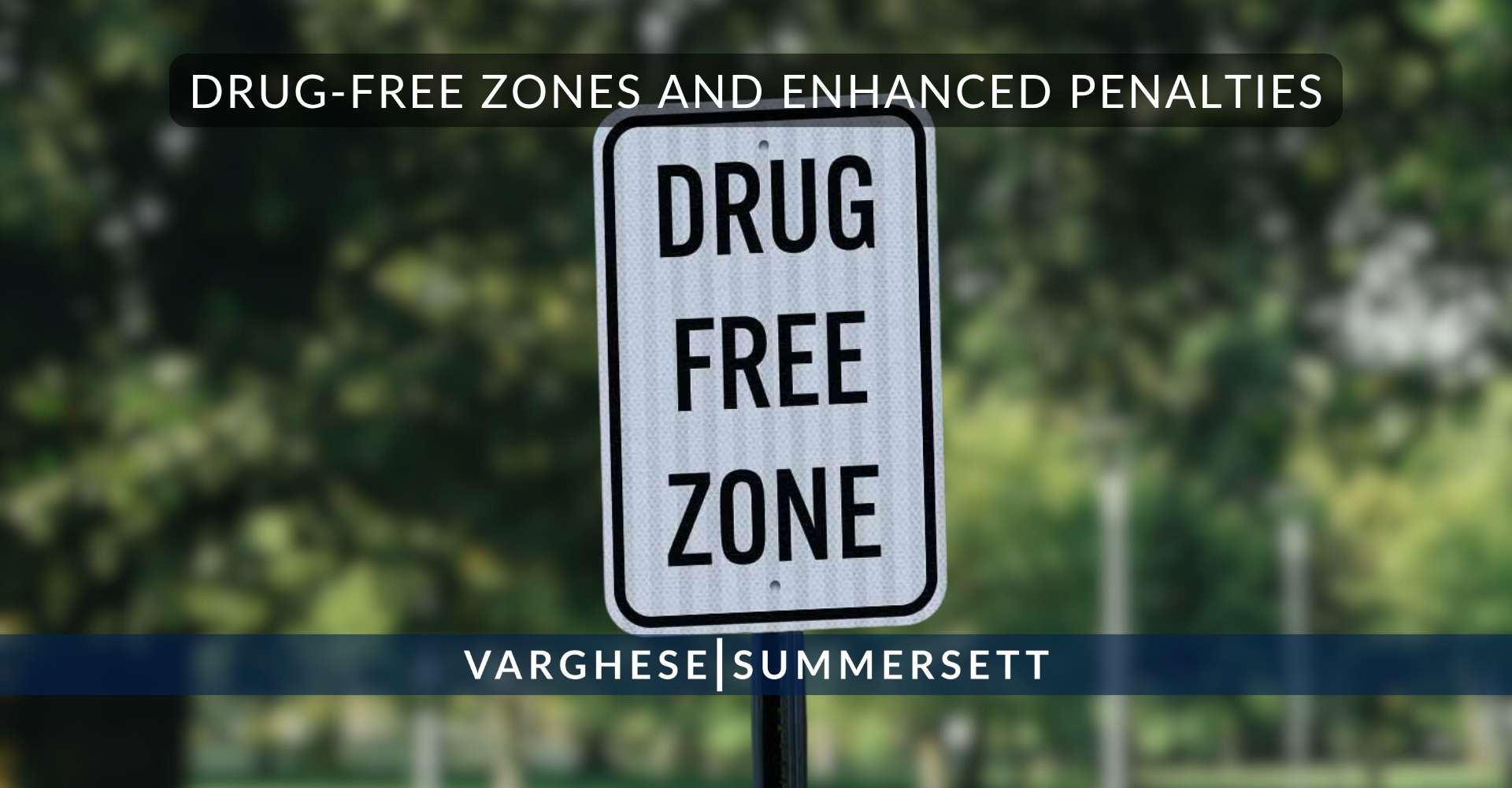
Drug-Free Zones and Enhanced Penalties
Texas imposes enhanced punishment when drug delivery occurs within 1,000 feet of a school, university, daycare, or playground. Under Texas Health and Safety Code § 481.134, penalties can increase one degree. A state jail felony can become a third-degree felony. A first-degree offense can become an aggravated first-degree offense with no eligibility for probation. Fort Bend County has dense residential areas, schools, and community centers throughout Sugar Land, Missouri City, Stafford, and Pearland — making this enhancement a real risk in many cases. Learn more about how drug-free zones affect penalties.

What to Expect From Varghese Summersett
When you hire Varghese Summersett, you get a team — not just a name on a door. The firm has represented clients across Texas for more than a decade, building a record of results that speaks for itself: 1,600+ dismissals, 800+ charge reductions, and 100+ years of combined legal experience across a team of more than 70 professionals.
Fort Bend County drug delivery cases receive the full weight of that experience. Mike Hanson knows the Fort Bend County District Attorney’s Office from the inside — he prosecuted cases there before becoming a defense attorney. That perspective shapes how the firm investigates, challenges, and resolves cases in that jurisdiction.
Here is what clients can expect from the moment they call:
- A prompt response, around the clock — drug arrests do not happen on a schedule
- A thorough review of how the evidence was gathered and whether any constitutional violations occurred
- Honest advice about options — including diversion programs, negotiated pleas, and trial
- Regular communication so clients always know where their case stands
- Attorneys who have actually tried drug cases before juries in Texas — not just settled them
If you are facing a delivery or manufacture charge in Fort Bend County, reach out to the firm for a free consultation. The earlier an attorney is involved, the more options are available.
Speak with a Fort Bend drug delivery attorney at (281) 805-2220 — available 24/7.
Award-Winning Legal Excellence














Ask Varghese Summersett AI
Versus-AI has been taught everything from our website and is here to help you find the answers you need. Ask Versus-AI anything.
Watch: Fort Bend County Criminal Defense
Our attorneys have addressed drug charges and criminal defense in Fort Bend County on video. Browse the playlist below for more information.
Frequently Asked Questions: Drug Delivery Charges in Fort Bend County
What is the difference between delivery and possession with intent to deliver?
Both charges are prosecuted under Texas Health and Safety Code § 481.112, and both carry the same punishment ranges. The difference is in what the State alleges happened. Delivery means a transfer actually occurred or was offered. Possession with intent to deliver means police believe someone had a drug for the purpose of distributing it — often based on large quantities, baggies, scales, or cash. Both are serious felony charges requiring the same aggressive defense.
Can I be charged with delivery even if no money changed hands?
Yes. Under Texas law, “delivery” includes any transfer — paid or unpaid — and even an offer to sell or transfer. Sharing drugs at a party, giving drugs to a friend, or offering to connect someone with a dealer can all lead to delivery charges in Texas.
What happens if the delivery allegedly occurred near a school?
Delivery within 1,000 feet of a school, daycare, youth center, or playground triggers an automatic one-level enhancement under § 481.134. A state jail felony becomes a third degree felony. In some circumstances, probation is not available. Fort Bend County prosecutors take these enhancements seriously and often pursue them aggressively.
Is there any diversion or probation option for drug delivery charges?
Depending on the circumstances, diversion programs or probation may be available — particularly for first-time offenders charged at the lower end of the weight ranges. However, for first degree and enhanced first degree felonies, probation eligibility is limited and sometimes barred entirely. Fort Bend County has its own policies on drug diversion that an experienced local attorney can help you navigate.
How important is it to hire an attorney who knows Fort Bend County specifically?
Very important. Every county has its own culture in the courthouse — how prosecutors make offers, which judges favor which approaches, and how local law enforcement builds its cases. An attorney who has practiced in Fort Bend County, or who prosecuted cases there, brings a level of local knowledge that translates directly into better outcomes for clients.

Fort Bend County Criminal Defense Practice Areas
Experienced criminal defense attorneys serving Fort Bend County
Facing charges in Fort Bend County? Get a free consultation.
Texas Drug Crimes Defense
Experienced drug defense attorneys across Texas