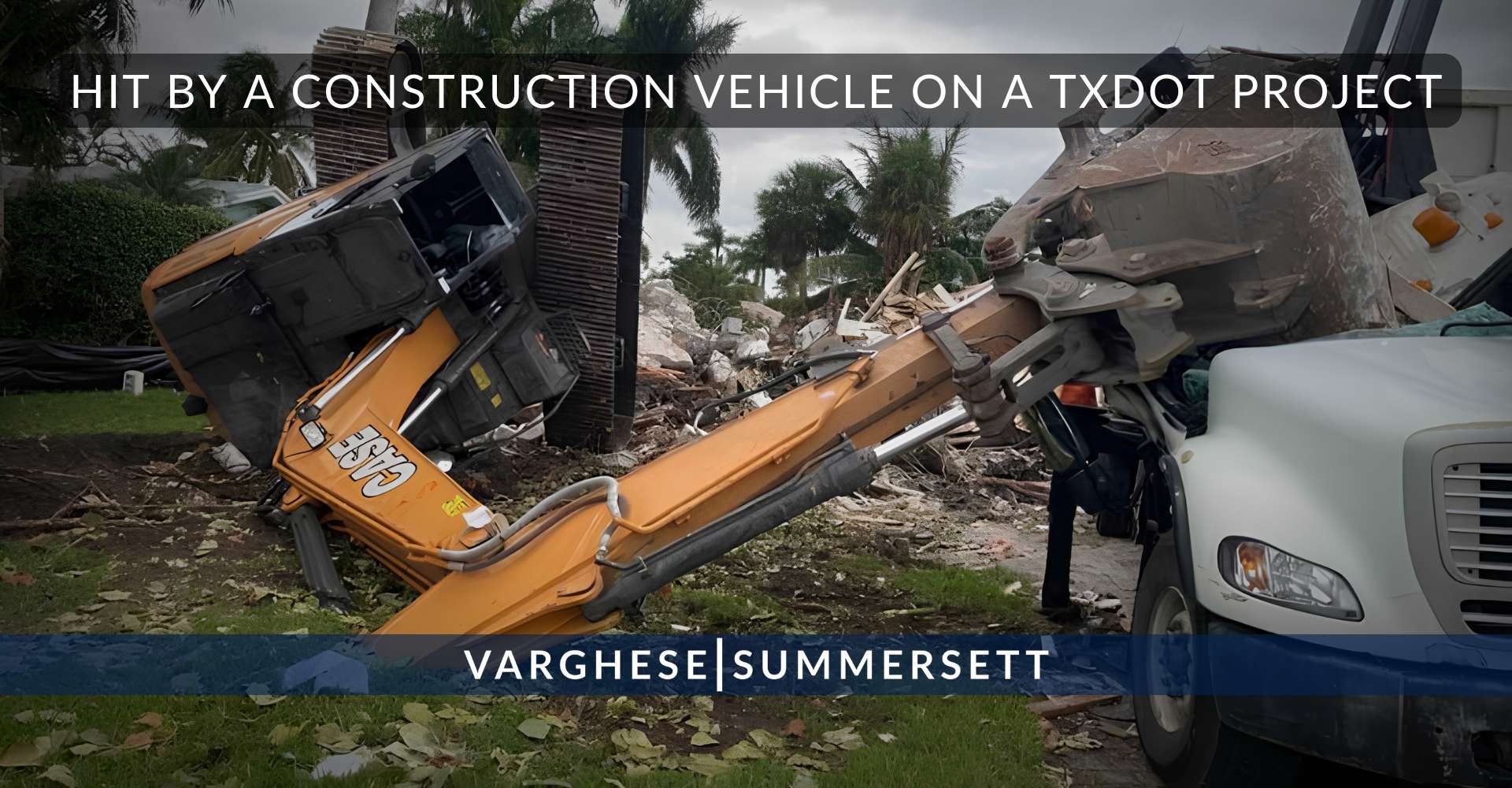
You were driving through a TxDOT work zone when a dump truck backed into traffic, a loader swung into your lane, or a piece of heavy equipment crossed the centerline without warning.
The crew scattered. The foreman started making calls. Now you have a fractured spine, a traumatic brain injury, or worse, and every contractor on that job site is pointing at someone else.
Here is what you are actually dealing with, and what it takes to get every dollar you are owed.

The Structure of a TxDOT Construction Project
TxDOT does not build roads with its own employees. It awards a prime contract to a private general contractor, who then hires subcontractors to perform the actual work. A major highway project can have a dozen or more subcontractors: an earthwork sub, a paving sub, a traffic control sub, a utility relocation sub, a concrete sub, a striping sub, the list goes on.
The construction vehicle that hit you was almost certainly operated by an employee of one of these private companies, not a TxDOT employee.
That layered structure is not an accident. It creates a layered liability problem, and every party in that chain has a financial incentive to push responsibility toward someone else. Your job, through your personal injury lawyer, is to hold every responsible party accountable at once.
Who Is Liable: Every Potential Defendant
TxDOT
TxDOT is a state agency, and sovereign immunity applies. You cannot sue TxDOT the same way you sue a private company. The Texas Tort Claims Act (TTCA), Tex. Civ. Prac. & Rem. Code §101.021, waives immunity in two relevant situations: when a government employee causes injury through the negligent use or operation of a motor vehicle, and when a government employee’s negligent use of tangible personal property causes injury or death.
That waiver comes with hard limits. Under TTCA §101.023(b), damages against a state agency are capped. Punitive damages are unavailable against TxDOT under any theory. Under TTCA §101.101, you must serve TxDOT with formal written notice of your claim within six months of the incident. Miss that deadline and your claim against TxDOT could be extinguished, regardless of how strong the evidence is. Failure to provide formal notice can bar the claim unless TxDOT had actual notice under §101.101(c), which courts apply narrowly.
TxDOT will also invoke the discretionary function exception. If TxDOT approved the Traffic Control Plan or made policy-level decisions about how the project was awarded, it will argue those were discretionary governmental acts that immunity still covers. That defense does not protect TxDOT for operational failures: a TxDOT project inspector who observed a non-compliant traffic control setup and did nothing is engaging in operational negligence, not a protected policy decision.
The Prime (General) Contractor
The general contractor is almost always the most important defendant. The GC holds the prime contract with TxDOT, controls the project site, and bears direct contractual responsibility for implementing and maintaining the Traffic Control Plan. Unlike TxDOT, the GC is a private company: no sovereign immunity, no damage caps, full exposure to punitive damages when the facts support them.
The GC is directly liable when its own employees operate the vehicle that hits you. The GC is also liable for failure to maintain safe traffic control, failure to supervise subcontractors performing flagging or lane-closure operations, and failure to correct a dangerous condition it knew about or should have known about.
The GC is vicariously liable for a subcontractor’s negligence when the GC retained control over the manner of the work, not just the end result. Texas courts focus on whether the GC had the right to control the specific activity that caused the injury. If the GC’s project superintendent was directing lane closures, positioning equipment, or overseeing flagging operations, the GC is exposed for what went wrong.
The Subcontractor That Operated the Vehicle
If the vehicle was operated by a subcontractor’s employee, that subcontractor is directly liable under respondeat superior. The sub is also independently liable for negligent hiring, negligent training, and negligent supervision of the operator.
Traffic control subcontractors deserve particular focus. Many TxDOT projects outsource TCP implementation entirely to a specialty traffic control firm. These companies provide the flaggers, channelizing devices, arrow boards, and lane-closure management. When a flagger waves you into active equipment traffic, positions a cone incorrectly, or fails to coordinate with approaching construction vehicles, that traffic control sub is the direct cause of your injury.
Equipment Owners and Lessors
The vehicle that hit you may have been leased rather than owned by the operator’s employer. Under Texas law, an equipment lessor can face liability when it retains a right of control over the equipment or when the operator is considered the lessor’s borrowed servant. Pull the equipment lease before writing off the lessor as a defendant.
The Insurance Coverage Stack
TxDOT prime contracts require the GC to carry specified insurance minimums. Standard requirements typically include commercial general liability, commercial automobile liability covering all project vehicles, and umbrella or excess liability. TxDOT is named as an additional insured on the GC’s policy as a matter of course.
The GC, in turn, requires each subcontractor to carry its own CGL and commercial auto coverage, with the GC named as an additional insured. On a serious injury claim, that means you may have access to: the subcontractor’s primary CGL policy, the GC’s primary CGL policy as an additional insured, the GC’s umbrella policy, and the subcontractor’s umbrella policy. These stack. A thorough coverage analysis can reveal several million dollars in available insurance that a surface-level investigation would miss entirely.
TxDOT does not carry commercial insurance. It is self-insured through the state’s risk management program, and any TxDOT recovery is limited by the TTCA caps.
Your own uninsured/underinsured motorist (UM/UIM) coverage is a final backstop. Construction vehicles are not always insured like passenger vehicles, and coverage gaps appear in real cases. UM/UIM fills those gaps up to your policy limits.
The Texas Laws That Govern Your Case
The MUTCD (Manual on Uniform Traffic Control Devices), adopted by TxDOT under 43 Tex. Admin. Code §25.1(a), governs every element of temporary traffic control in a construction zone: advance warning sign placement based on posted speed, taper lengths, flagger qualifications and positioning, and illumination requirements for night work. A MUTCD violation is not just a regulatory infraction. It is evidence that the responsible party failed to follow the specific safety rule designed to prevent exactly what happened to you, which may support a negligence per se theory.
The express negligence doctrine, established by the Texas Supreme Court in Ethyl Corp. v. Daniel Construction Co., 725 S.W.2d 705 (Tex. 1987), limits how far the GC can push liability downstream through indemnity clauses. A contractual indemnity provision cannot shift liability for a party’s own negligence unless the contract specifically and expressly states that intent in clear, unambiguous terms. If the GC was negligent, it cannot escape that exposure through a generic subcontract indemnity clause.
The Texas Construction Anti-Indemnity Act, Tex. Ins. Code §151.102 , restricts the enforceability of indemnity provisions that require a subcontractor to indemnify the GC for the GC’s own negligence. This law limits the GC’s ability to use contractual language to transfer its liability entirely to the sub.
Texas modified comparative fault, Tex. Civ. Prac. & Rem. Code §33.001, bars your recovery only if you are found more than 50 percent responsible. Below that threshold, your damages are reduced proportionally. This is why defendants invest heavily in blaming the victim early.
Evidence That Disappears Fast
Construction zones change by the hour. The lane configuration, cone placement, and equipment position that caused your crash will be modified, documented over, and eventually dismantled. The following must be preserved immediately.
The Traffic Control Plan is on file with TxDOT’s district office for the project. Your attorney should request it immediately through a Texas Public Information Act request and compare it against dated photographs of the scene.
TxDOT project inspectors maintain daily inspection reports and project diaries documenting site conditions, contractor performance, and noted deficiencies. These records can show TxDOT and the GC knew about a non-compliant TCP setup before your crash. They are held by TxDOT’s project office and must be requested before they are archived or purged.
Construction vehicles on TxDOT projects increasingly carry dashcams, GPS telematics, and onboard diagnostic systems that log speed, location, braking events, and equipment operation in real time. Most contractors retain telematics data for 30 to 90 days before it is overwritten. This data must be preserved through a written spoliation demand before that window closes.
TxDOT’s own traffic monitoring cameras cover many active construction corridors. Footage retention on those systems is typically short. The GC’s site cameras and any third-party traffic monitoring services contracted for the project are additional sources.
A spoliation letter must go to TxDOT’s project office, the GC, every identified subcontractor, and any equipment lessor within days of retaining counsel. The letter places each party on written notice that litigation is anticipated and demands preservation of all project records, telematics data, video footage, inspector daily reports, TCP documents, operator qualification files, employment records, and insurance certificates. Once a party receives that letter, destruction of responsive documents can result in adverse jury instructions, discovery sanctions, or an independent spoliation claim.
What an Experienced Lawyer Does Differently
In the first 48 hours: spoliation letters go to every party in the contractor chain simultaneously. An investigator and a traffic engineering expert go to the scene to document conditions before the TCP is modified. A Texas Public Information Act request goes to TxDOT’s district office for the full project file, inspector daily reports, and the TCP. A general PI lawyer sends a letter to the most obvious insurance carrier and waits for a response.
In the first two weeks: an experienced lawyer identifies every subcontractor on the project by reviewing TxDOT’s publicly available project records, pulls the prime contract and available subcontract documents to map the full indemnity chain, and retains a traffic engineering expert to perform a formal MUTCD compliance analysis. The expert’s report becomes the backbone of the liability case.
Before filing suit: TTCA notice is served on TxDOT before the six-month deadline if TxDOT is a viable defendant. The insurance certificate requirements in the prime contract are used to identify every insurer in the coverage stack. Prior OSHA citations, TxDOT contractor performance ratings, and TCP violation history on this and other projects are gathered to support a punitive damages theory against the GC if the facts support it.
Every Source of Recovery, Ranked
| Source | Coverage Type | Damage Cap |
|---|---|---|
| Prime contractor CGL and umbrella | Primary and excess liability | None |
| Subcontractor CGL and umbrella | Primary and excess liability (GC as additional insured) | None |
| Equipment lessor liability | Depends on lease and retained control | None |
| TxDOT (TTCA) | State self-insurance | Statutory cap [VERIFY] |
| Your UM/UIM coverage | Your own auto policy | Your policy limits |
A lawyer who sues only the vehicle operator and the operator’s direct employer leaves the GC, the GC’s umbrella carrier, and the equipment lessor entirely off the table. In catastrophic injury cases, the difference between a thorough defendant analysis and a shallow one is the difference between an adequate recovery and a complete one.
The Defense Playbook
You will see the same defenses from every defendant in these cases. Knowing them is how your lawyer beats them before they gain traction.
Comparative fault. Every defendant will argue you were speeding through the work zone, distracted, or ignored posted warning signs. The response is a MUTCD compliance analysis that establishes the warning signs were inadequate, improperly placed, or absent entirely. You cannot be blamed for failing to react to a warning that was never there.
Independent contractor defense. The GC will argue it is not responsible for the sub’s negligence because the sub was an independent contractor. The counter is the retained control doctrine: if the GC’s superintendent was present, directing work, or had authority to stop unsafe operations, the GC retained sufficient control to be vicariously liable. Daily inspection reports, superintendent testimony, and project meeting minutes establish that control.
Discretionary function (TxDOT only). TxDOT will frame every decision as a high-level policy judgment immune from suit. The response is to focus on operational failures: the inspector who saw the non-compliant condition and signed off anyway was making an operational decision, not a policy one.
TCP compliance. The GC will claim the TCP was being followed at the moment of impact. Inspector daily reports showing prior notice of deficiencies and the MUTCD expert’s testimony are the tools that defeat this argument. Prior violations documented in the project record are particularly damaging to this defense.
Mistakes That Damage These Cases
Do not give a recorded statement to any insurance adjuster: TxDOT’s risk management office, the GC’s carrier, the subcontractor’s carrier, or anyone else. Adjusters ask structured questions designed to elicit admissions about your speed, your attention level, and your familiarity with the work zone. Every word is preserved and used against you.
Do not sign a medical authorization for any defendant’s insurer. A blanket authorization gives them access to your full medical history, which they will search for any prior condition they can use to argue your injuries were pre-existing.
Do not post about the crash, your injuries, or your recovery on social media. Defense investigators monitor plaintiff accounts throughout litigation, and a photograph of you at a family event becomes a damages argument.
Do not delay medical treatment or allow gaps in your care. Gaps in treatment are used to argue that your injuries resolved or that something unrelated to the crash caused your condition to worsen.
Do not wait. The six-month TTCA notice deadline runs from the date of the incident, not from when you hire a lawyer or finish your medical treatment.
What to Do Right Now
Get medical care and follow your doctors’ instructions completely. If you can safely return to the scene, photograph the TCP setup, the equipment involved, the signage, and the road configuration before it changes. Write down the names of everyone present: the GC’s superintendent, the subcontractor’s foreman, the equipment operator, every flagger, and any civilian witnesses. Obtain the police report. Do not contact any insurance company. Call a personal lawyer who has specifically handled TxDOT construction zone injury cases.
How Varghese Summersett Handles These Cases
Varghese Summersett is a Texas personal injury firm with offices in Fort Worth, Dallas, Southlake, and Houston. We handle TxDOT construction zone cases as trial lawyers. That means we retain traffic engineering experts qualified to testify on MUTCD compliance, we work through TxDOT’s public records to identify every contractor in the chain, and we map the full insurance coverage stack before the defense knows what we know.
We send spoliation letters within 24 hours of being retained. We serve TTCA notices before the six-month deadline closes. We use the retained control doctrine to hold general contractors accountable when they try to hide behind their subs. And when the defense presents its playbook at mediation, we have already built the case to defeat each argument.
If you or a family member was struck by a construction vehicle on a TxDOT project, call us at 817-203-2220 or contact us online for a free consultation. You pay nothing unless we recover for you.
Facing charges in Southlake? Get a free consultation.
