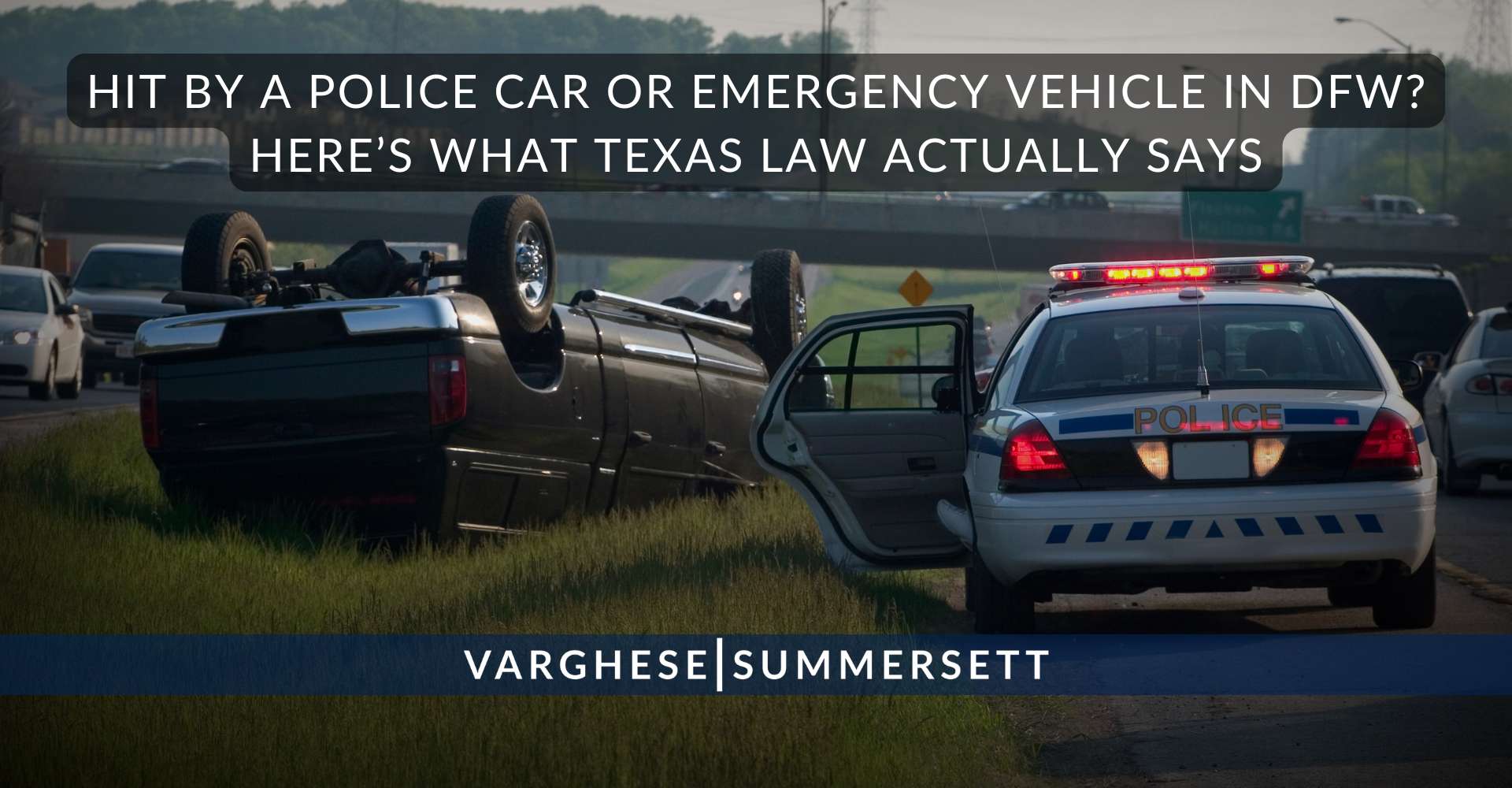
A Fort Worth patrol car running lights and siren blows through a red light and hits your vehicle broadside. Or a Dallas fire engine responding to a call crosses the center line and strikes you head-on. You are seriously hurt, the other driver was a government employee, and suddenly, the rules that would apply to any other car accident case look completely different.

Crashes involving police cars, fire engines, ambulances, and other government-operated emergency vehicles in Texas often operate under a different legal framework than ordinary motor vehicle wrecks because governmental immunity may apply unless the Texas Tort Claims Act waives it.
Texas Transportation Code Chapter 546 gives police officers, firefighters, and EMTs certain privileges when operating an authorized emergency vehicle in specific circumstances, including proceeding past a red light after slowing as necessary for safety, exceeding the speed limit without endangering life or property, and disregarding certain movement regulations. And if you do not send written notice to the correct governmental unit on time, you may lose your claim, but the deadline is not always 90 days — the Texas Tort Claims Act sets a six-month default notice period, and some local governments may adopt shorter deadlines by charter or ordinance.
This article explains the law, the real money, and what has to happen in the next few weeks for your case to survive.
Who Is Responsible When a Police Cruiser or Emergency Vehicle Hits You
The first question in every emergency vehicle crash is which government entity owns the vehicle and employs the driver. In most cases, that governmental unit is the primary defendant, although procedural issues can arise if the employee is named individually at the outset.In the DFW area, the most common governmental units you will be suing are:
- City of Dallas through Dallas Fire-Rescue or the Dallas Police Department
- City of Fort Worth through its Fort Worth Police Department or Fort Worth Fire Department
- Tarrant County through its Sheriff’s Office or county EMS
- Dallas County through its Sheriff’s Office or county health and emergency services
- Texas Department of Public Safety (DPS) for state troopers operating on DFW highways
- Smaller municipalities such as Arlington, Plano, Irving, Garland, Grand Prairie, or Denton if the vehicle belonged to a suburb’s fleet
Private ambulance companies operating under contract with a city, such as AMR (American Medical Response) or other contracted EMS providers, are a separate situation. They generally are not governmental units entitled to sovereign immunity under the TTCA in the same way a city or county is, although the contractual structure should be verified in each case. In a mutual aid situation, where officers or vehicles from multiple jurisdictions respond to the same scene, you may have claims against more than one governmental unit simultaneously, and each may have its own notice requirements and defenses.
The individual officer, firefighter, or EMT is generally not the right defendant. Under Texas law, a governmental unit can be sued directly for the torts of its employees acting within the scope of employment, subject to TTCA limits and election-of-remedies issues. Suing the employee personally requires defeating official immunity, which is discussed below. Most cases are brought against the city or county, not the individual driver.
Section 546 of the Texas Transportation Code: What Emergency Drivers Are Actually Allowed to Do
Texas Transportation Code Chapter 546 governs when an authorized emergency vehicle operator may depart from the normal rules of the road. Understanding it matters because both the government’s immunity argument and your negligence argument depend on whether the driver was in compliance with it.
Under Section 546.001, an operator of an authorized emergency vehicle may, while responding to an emergency call or pursuing a suspected violator of the law:
- Park or stand regardless of the Transportation Code
- Proceed past a red light or stop sign after slowing as necessary for safety
- Exceed the maximum speed limit as long as the driver does not endanger life or property
- Disregard regulations governing direction of movement or turning in certain directions
These privileges come with an important condition. Section 546.003 generally requires audible or visual signals, and Section 546.004 contains exceptions, including limited law-enforcement situations where an officer may operate without the usual signals. So instead of saying “no lights and siren means no privilege,” a safer statement is that emergency-driving privileges generally depend on compliance with the signal requirements and any statutory exception.
Even when lights or other legally sufficient signals are active, Section 546.005 makes clear that the operator is not relieved from the duty to drive with due regard for the safety of all persons, and the privileges do not protect a driver who acts with reckless disregard for the safety of others. Speeding through a school zone at 90 miles per hour with children present is not protected by Section 546, even with full lights and siren. The reckless disregard standard is your foothold when the officer claims the privileges applied.
The Texas Tort Claims Act: When the Government Has to Pay
Sovereign immunity means the government cannot be sued unless it consents. Texas gave that consent, with limits, in the Texas Tort Claims Act (TTCA), Texas Civil Practice and Remedies Code Chapter 101. For emergency vehicle crashes, two provisions control.
Section 101.021 waives immunity for personal injury or death caused by the negligence of a governmental employee acting within the scope of employment, if the claim arises from the use or operation of a motor-driven vehicle or equipment. A police cruiser, fire engine, or ambulance qualifies. This is the primary waiver that lets you sue the city for what the officer did.
Section 101.055 takes back part of that waiver. The TTCA does not apply to a claim arising from the action of an employee responding to an emergency call if the action taken is in compliance with the laws and ordinances applicable to emergency action. In plain English: if the officer was responding to a legitimate emergency and complied with the applicable emergency‑driving laws and did not act with reckless disregard, the city may be immune. This creates the central fight in almost every DFW emergency vehicle crash case:
- Was there a real emergency call or was the officer just in a hurry?
- Were lights and siren actually activated before and during the collision?
- Even if they were, did the officer act with reckless disregard that forfeits the privilege?
Dashcam footage, bodycam footage, and Computer Aided Dispatch (CAD) records answer these questions directly. That is why getting them before they are overwritten is the single most important action in the first week after the crash.
The Notice Trap
This is where injured people lose cases that they should win. Texas Tort Claims Act Section 101.101 generally requires notice of a claim within six months, stating the damage or injury claimed, the time and place of the incident, and the incident itself, unless a shorter period applies under another law or local rule.
And while this sounds like plenty of time, it is not, for several reasons. People spend the first weeks in the hospital or in physical therapy, not thinking about lawyers. Hiring an attorney sometimes happens in month two. If the attorney you hire is not experienced in government tort claims, the notice requirement may not be on anyone’s radar until it is too late.
There is a narrow exception if the governmental unit had actual notice, but courts construe actual notice narrowly. The fact that the police department investigated the crash and generated a report does not automatically establish actual notice of your injury claim. The safe practice is still to give formal written notice as soon as possible and to verify the governing notice deadline for the specific city, county, or state agency before publication or filing.
Different defendants may require notice sent to different offices. The City of Dallas and City of Fort Worth each have city secretary offices and city attorney offices that handle tort claims. DPS claims go to the Office of the Attorney General. Tarrant County and Dallas County each have county clerk and county attorney offices. An attorney who handles government cases knows exactly where to send these notices and does it on day one.
Damages Are Capped
Even if you win, the TTCA limits what you can recover from a governmental unit. Under Section 101.023, the liability caps depend on what kind of entity you are suing.
For the State of Texas and its agencies, and for municipalities (cities), the caps are generally:
- Personal injury or death: $250,000 per person, up to $500,000 per occurrence
- Property damage: $100,000 per occurrence
For counties and most other local governmental units, the caps are lower:
- Personal injury or death: $100,000 per person, up to $300,000 per occurrence
- Property damage: $100,000 per occurrence
These caps apply regardless of how catastrophic your injuries are. That means a person with a spinal cord injury, traumatic brain injury, or permanent disability cannot recover more than the applicable statutory cap from that governmental unit under the TTCA, no matter what a jury might otherwise award.
This makes identifying every non-governmental source of recovery essential. The caps are real and they bind. The strategy in every serious DFW government vehicle crash case is to recover the full TTCA cap from the governmental unit and then pursue every other available source of funds in parallel.
Official Immunity and Federal Qualified Immunity: The Difference Matters
When lawyers talk about police immunity in car crash cases, they often conflate two different doctrines that operate in completely different courts.
Official immunity is a Texas state law doctrine. A government employee in Texas has official immunity from personal liability if the employee was performing a discretionary function, was acting in good faith, and was acting within the scope of authority. For an officer responding to a call, this usually means the officer personally cannot be sued in Texas state court even if the city can be. The practical effect is that in most TTCA cases, the governmental unit is the right defendant and the individual officer’s personal assets are not in play.
Federal qualified immunity applies in federal civil rights claims brought under 42 U.S.C. Section 1983. To bring a Section 1983 claim, you must show the officer violated a clearly established constitutional right. In a car accident case, the constitutional hook is usually substantive due process under the Fourteenth Amendment, which requires showing conduct that shocks the conscience, a standard that is very difficult to meet in an ordinary collision. Section 1983 claims against police officers for emergency vehicle crashes are possible but uncommon and difficult. Most DFW crash victims are better served by pursuing the TTCA claim against the city rather than a Section 1983 claim in federal court.
Every Source of Recovery, Ranked
Before giving up at the TTCA cap, an experienced attorney examines every pocket that may be available:
- Governmental unit under the TTCA — the primary claim against the city, county, or state agency, subject to the statutory damages caps (often up to $250,000 per person and $500,000 per occurrence for the State of Texas and municipalities, and lower caps such as $100,000 per person and $300,000 per occurrence for many other local governmental units).
- Your own underinsured motorist (UIM) coverage — if the TTCA cap leaves your damages uncompensated, your own UIM policy may cover the gap. Government vehicles are technically underinsured relative to your actual damages when the TTCA cap applies. This is a critical policy to find and preserve immediately.
- Private ambulance or contract EMS company — if a private company’s vehicle was involved, no sovereign immunity applies. Corporate defendant, commercial auto policy minimums in Texas for commercial vehicles up to the policy limits, often $1 million or more.
- Med-pay coverage on your own auto policy — pays medical expenses regardless of fault
- Health insurance subrogation — manage carefully to maximize net recovery
- Workers’ compensation — if you were in the course and scope of employment at the time of the crash
Evidence That Disappears Fast
Government agencies routinely overwrite or delete video and electronic records on short cycles. In a DFW emergency vehicle crash, the following evidence has defined and often short retention windows:
| Evidence Type | Who Holds It | Typical Retention Window |
|---|---|---|
| In-car dashcam footage | Police department / fire department IT | 30 to 90 days before overwrite |
| Officer bodycam footage | Police department Evidence / IT | 60 to 90 days absent hold |
| CAD dispatch records | 911/dispatch center | 90 to 180 days |
| NG911 audio recordings | Regional 911 authority (e.g., Tarrant County 911) | 30 to 90 days |
| Traffic signal camera footage | City traffic management | 30 days |
| Police vehicle EDR / black box data | Fleet maintenance | Overwrites on next download or engine cycle |
| Officer incident and supplement reports | Department records | Indefinite but not always complete |
A spoliation and preservation letter goes to the city attorney, the police chief or fire chief, and the 911 dispatch authority within days of the crash. The letter identifies every category of evidence by type and location, demands immediate suspension of any automatic deletion or overwrite policies, and puts the governmental unit on notice that destruction of evidence may give rise to adverse inference instructions at trial. Under Texas Rule of Civil Procedure 196.4 and the common law spoliation doctrine, failure to preserve after notice can be devastating for the government at trial.
CAD records are particularly valuable because they establish the exact time a call was dispatched, whether the officer was actually assigned to an active emergency or was traveling independently, the routing and location of the vehicle, and radio communications before and during the collision. If the officer claims emergency response status but the CAD record shows no active dispatch at the time of the crash, the Section 101.055 immunity argument collapses.
What an Experienced Plaintiff’s Lawyer Does Differently in the First 48 Hours
An attorney who handles general car accident cases and an attorney who routinely litigates against Texas governmental units will do fundamentally different things immediately after a DFW emergency vehicle crash. The differences are not stylistic. They determine whether the case survives.
In the first 48 hours, a government-litigation plaintiff’s attorney:
- Identifies the exact governmental unit and confirms the officer’s employment relationship and assignment at the time of the crash
- Sends an immediate preservation letter to the city attorney, department head, and dispatch authority covering all electronic and video evidence listed above
- Files or prepares a Texas Public Information Act (PIA) request to the city for the CAD records, dashcam footage, bodycam footage, and any internal review of the crash
- Calendars the notice deadline and drafts written notice for immediate delivery by certified mail
- Confirms whether any private contractors, mutual aid agencies, or non-governmental entities were involved in the response
- Photographs and documents the scene before any road resurfacing, signal timing changes, or barrier relocation
In the first two weeks, the attorney retains an accident reconstructionist, locates and interviews witnesses, obtains your complete medical records to document the injury claim accurately for the TTCA notice, and reviews your auto policy for UIM coverage that may backstop the TTCA cap.
The Defense Playbook and How to Counter It
The city’s lawyer will run a predictable defense in every DFW emergency vehicle crash case. Knowing it in advance lets your attorney prepare the counter on day one.
Defense: The officer was responding to an emergency and had lights and siren active, so Section 101.055 bars the claim. Counter: CAD records will show whether the officer was actually dispatched to an active emergency. Dashcam audio and video will show whether the siren and lights were on before and at the moment of impact. Witnesses at the scene can testify to what they heard and saw. Many officers activate lights without siren or vice versa. Emergency‑driving privileges generally depend on compliance with Chapter 546’s signal requirements and any applicable exceptions, so what signals were actually used becomes a central factual fight.
Defense: Even if lights and siren were on, you failed to yield and contributed to the crash. Counter: Texas comparative fault under Chapter 33 of the Civil Practice and Remedies Code does reduce recovery proportionately, but a plaintiff who is less than 51% at fault can still recover. The intersection geometry, signal timing, and dashcam footage together establish whether a reasonable driver could have seen and yielded to the approaching vehicle in time.
Defense: Your written TTCA notice was defective or untimely, so the claim is barred. Counter: Notices prepared by an experienced government litigation attorney are complete, timely, and delivered by certified mail with return receipt to the correct offices. This argument does not succeed when the attorney knows the rules.
Defense: The officer’s conduct may have been negligent but not recklessly disregarding safety, so even if Section 101.055 applies, Section 546.005 does not help you. Counter: Reckless disregard under Texas law means the actor was aware of a risk and consciously disregarded it. Evidence of excessive speed, failure to slow for visible cross-traffic, running multiple lights in sequence, or a prior history of unsafe emergency driving can support a reckless disregard finding even within an active emergency response.
Mistakes Injured People Make in the First Week
These mistakes do not just complicate a case. In government vehicle crash claims, several of them end it entirely.
- Missing the TTCA notice deadline. There is no extension, no grace period, and no court that will save you after that deadline unless you can prove actual notice, which is narrow and uncertain.
- Assuming the police report tells the full story. Officers involved in crashes involving their own colleagues write reports that reflect institutional interests. CAD records, bodycam, and independent witnesses routinely contradict the official narrative.
- Waiting to hire a lawyer until after major evidence has been overwritten. Dashcam footage is gone in 30 to 90 days absent a preservation hold. There is no recovering it after automatic overwrite.
- Accepting that the TTCA cap is all the money available. UIM coverage, private contractor claims, and workers’ compensation may each provide substantial additional recovery. None of them are pursued automatically.
- Giving a recorded statement to the city’s insurance adjuster or risk management office without counsel. Anything you say is used to build the city’s defense. You are not required to give a statement before litigation.
- Assuming the city will do the right thing because it was their employee who caused the crash. Municipal risk management departments are claims-defense operations. Their goal is to pay as little as possible, and they are experienced at it.
Varghese Summersett: Experienced in DFW Government Vehicle Crash Cases
Suing a Texas city, county, or state agency for an emergency vehicle crash is fundamentally different from filing a standard car accident case. The TTCA notice deadline, the Section 546 immunity analysis, the evidence preservation race against automatic government retention policies, and the cap on damages all require a lawyer who handles these cases routinely and knows where the landmines are.
Varghese Summersett is a Texas personal injury firm with offices in Fort Worth, Dallas, Southlake, and Houston. Our attorneys represent seriously injured Texans and their families against government entities, commercial defendants, and insurance carriers throughout the DFW area. We know how to preserve the evidence, meet the deadlines, and build the case that forces the city to answer for what its employee did to you.
If you or a family member was hurt in a collision with a police cruiser, fire engine, ambulance, or other emergency vehicle in Dallas, Fort Worth, or anywhere in the DFW area, contact Varghese Summersett for a free consultation. Time is not on your side in these cases. Call us now at 817-203-2220.
