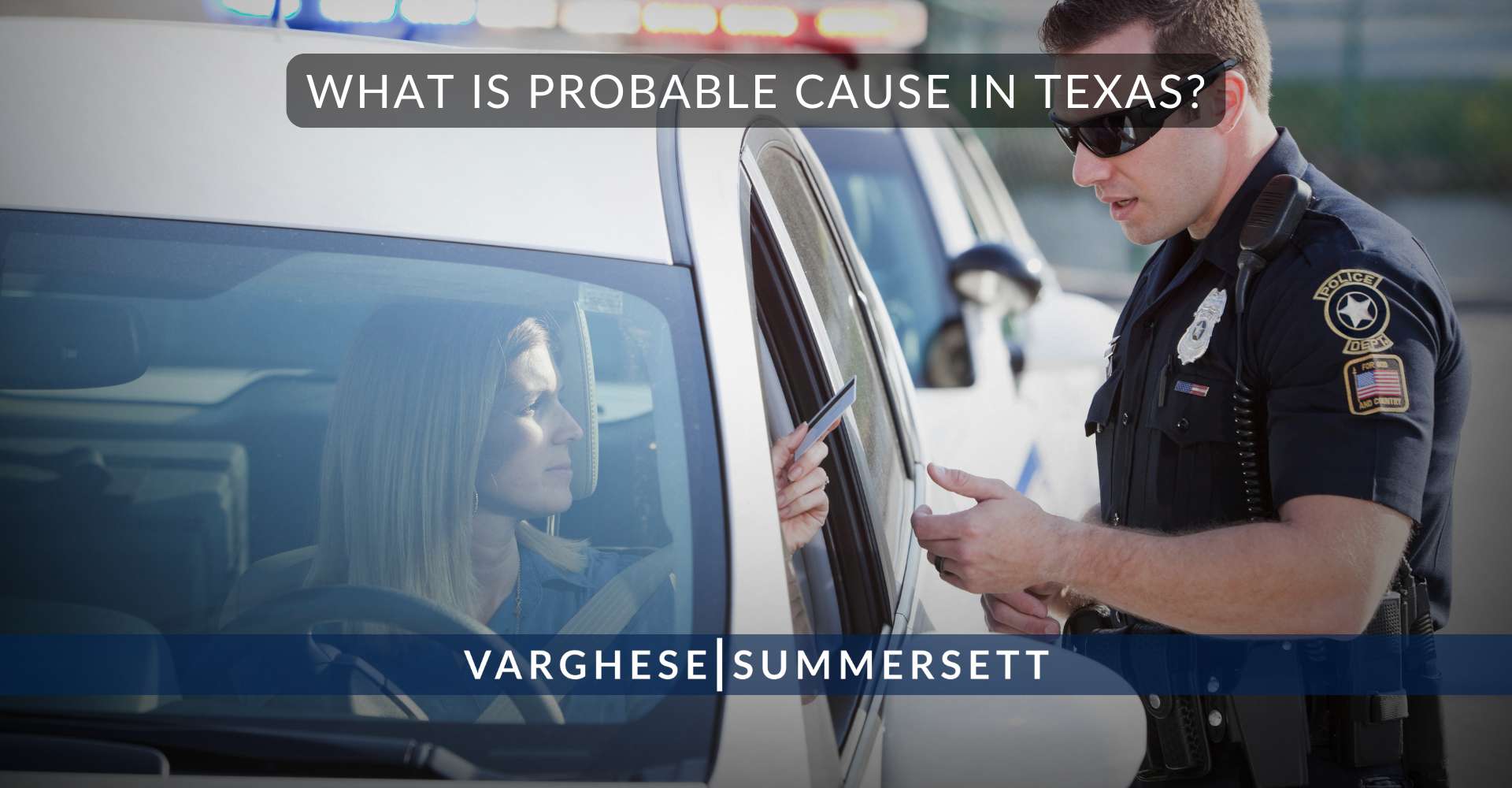
If a police officer arrested you, searched your car, or got a warrant for your home, one phrase decides whether that was legal: probable cause. It is one of the most important protections you have, and it is also one of the most misunderstood. Here is what probable cause actually means in Texas, where it comes from, when it applies, and what happens when the police get it wrong.

What probable cause means in plain terms
Probable cause means the police have enough facts to reasonably believe that a crime has been committed and that you are connected to it, or that evidence of a crime will be found in the place they want to search. It is a common-sense standard based on real facts and circumstances, not a hunch, a guess, or a gut feeling.
The key word is reasonable. Courts do not ask what the officer personally believed. They ask whether the facts the officer knew at the time would lead a reasonable officer to the same conclusion. Judges weigh the whole picture together, which courts call the totality of the circumstances. There is no checklist or magic number of facts. It is a practical judgment about whether everything known, taken together, adds up to a fair probability of criminal activity.
Where probable cause comes from
The requirement has two sources that work together in Texas. The Fourth Amendment protects everyone in the country against unreasonable searches and seizures and says no warrant can be issued without probable cause. The Texas Constitution provides its own protection against unreasonable searches and seizures under Article I, Section 9.
On top of those constitutional protections, the Texas Code of Criminal Procedure sets out detailed rules that officers must follow. In many situations, Texas statutes require a warrant unless a specific exception applies. So in practice, Texas officers generally need either a valid warrant supported by probable cause, or a specific statute that authorizes a warrantless arrest or search. This statutory layer is what makes Texas different, and it is often where cases are won or lost.
Probable cause is a lower bar than guilt
A lot of people assume probable cause means the police were sure you did it. That is not the case. Probable cause is well below the standard needed to convict you.
To find you guilty at trial, the State must prove its case beyond a reasonable doubt. Probable cause requires far less. It does not even require the police to show it is more likely than not that you committed a crime. It only requires a fair probability, based on the facts, that criminal activity occurred or that evidence will be found. That is why someone can be lawfully arrested and still be acquitted, or never charged at all.
Probable cause vs. reasonable suspicion
These two terms get confused constantly, but they are not the same, and the difference matters in almost every case that starts with a traffic stop.
| Standard | What it allows police to do | How much it takes |
|---|---|---|
| Reasonable suspicion | Briefly stop and detain you to investigate | Specific, articulable facts suggesting something criminal may be happening |
| Probable cause | Arrest you, or get a warrant to arrest or search | Enough facts to reasonably believe a crime occurred and you are tied to it |
An officer needs only reasonable suspicion to pull you over or briefly detain you. To go further and arrest you, the officer needs probable cause. A pat-down for weapons during a stop requires its own justification: specific facts suggesting you may be armed and dangerous. Texas courts have warned against blurring these standards, because each one unlocks a different level of police power. Knowing where one ends and the next begins is often the heart of a strong defense.
When probable cause comes up in a Texas case
Probable cause shows up in three main situations.
Arrest warrants
Before a judge signs an arrest warrant, an officer must submit a sworn statement, called an affidavit, laying out the facts. A good affidavit explains the who, what, when, where, why, and how of the alleged offense. It has to contain real facts, not just the officer’s conclusions. The judge then decides independently whether those facts add up to probable cause. The rules for arrest warrants appear in Chapter 15 of the Texas Code of Criminal Procedure.
Arrests without a warrant
This is where Texas law has an important twist. Police cannot arrest you without a warrant just because they have probable cause. In Texas, a warrantless arrest is only legal if a specific statute allows it. Most of those situations are listed in Chapter 14 of the Texas Code of Criminal Procedure.
One key provision, Article 14.03(a)(1), allows officers to arrest people found in suspicious places under circumstances that reasonably show they have committed a felony or certain other offenses, or are about to. Other parts of Article 14.03 authorize warrantless arrests in assault, family violence, and protective order situations when the officer has probable cause to believe the specific offense occurred. Texas courts treat these as narrow exceptions to the general warrant requirement, rooted in the need for prompt action.
The takeaway: for a warrantless arrest, probable cause by itself is not always enough. The arrest also has to fit one of the categories the law specifically allows. If it does not, the arrest may be unlawful even if the officer had a reasonable belief you committed a crime.
What counts as a suspicious place
People assume a suspicious place has to be somewhere obviously shady. That is not how Texas courts read it. Almost any location can qualify, depending on the circumstances. The real question is whether the place and everything happening around it, taken together, reasonably point to your involvement in a crime. A hospital, a roadside, or your own driveway can all become a suspicious place if the surrounding facts line up that way.
Search warrants
To search your home, phone, or other property, the police usually need a warrant backed by probable cause. Texas law is explicit on this point. Under Article 18.01(b) of the Code of Criminal Procedure, no search warrant can be issued unless the officer first presents enough facts to satisfy the judge that probable cause actually exists.
The affidavit cannot just state conclusions or say evidence is probably there. It has to give the judge the underlying facts so the judge can independently decide whether probable cause exists. Texas does allow a judge to consider sworn information communicated by telephone or other reliable electronic means under Article 18.01(b-1), as long as the oath requirement is met, but the substance still has to add up to probable cause.
What counts toward probable cause
When a judge or a court reviews probable cause, they look for things like:
- Specific facts and details, not vague conclusions or labels
- A clear connection between you and the offense, or between the place and the evidence
- How recently the alleged crime happened compared to the arrest or search
- Whether information from an informant or tipster was corroborated by other facts
- Reasonable, common-sense conclusions drawn from everything known together
Informants, tips, and combined police knowledge
Police can rely on information from informants and even secondhand information, but only if, taken as a whole, it is reliable enough to support a reasonable belief. Courts look at how trustworthy the source is, how the source knew the information, and whether other facts back it up. No single one of those is decisive on its own. They are all part of the common-sense picture.
Officers can also act on the combined knowledge of their department, often called collective knowledge. If one officer who has the facts directs another officer to make an arrest, the arrest can rest on what the requesting officer knew, even if the arresting officer did not personally know every detail.
What happens if there was no probable cause
This is where probable cause becomes a powerful defense tool. If the police arrested you or searched your property without probable cause, and no exception applies, the evidence they found may be thrown out.
Under Article 38.23 of the Texas Code of Criminal Procedure, evidence obtained through an illegal search or arrest can be suppressed, which means it cannot be used against you. When key evidence gets suppressed, the State’s case can fall apart, sometimes leading to reduced charges or a dismissal. Texas law also requires a prompt review of probable cause after certain warrantless arrests under Article 17.033, and if probable cause is not established within the required time, the person must be released.
How a defense lawyer challenges probable cause
Challenging probable cause is detailed, fact-specific work. A defense attorney will read the arrest reports and warrant affidavits closely, looking for conclusions dressed up as facts, missing details, weak or uncorroborated tips, gaps in timing, and arrests that do not fit any statute allowing a warrantless arrest. If the facts fall short, your lawyer can file a motion to suppress and ask the court to exclude the evidence.
These motions are often the turning point in a criminal case. Winning one can change everything about how your case ends.
Frequently asked questions
Can the police arrest me on suspicion alone?
No. A brief stop can be based on reasonable suspicion, but an arrest requires probable cause. A vague suspicion or a hunch is not enough to take you into custody.
Does probable cause mean I will be convicted?
No. Probable cause is a much lower standard than the proof beyond a reasonable doubt needed for a conviction. Many people who are lawfully arrested are never convicted.
What if the police searched me without a warrant?
A warrantless search is not automatically illegal, because the law recognizes certain exceptions. But if no exception applies and there was no probable cause, the evidence may be suppressed. An attorney can review exactly what happened and whether the search was legal.
Can the police arrest me without a warrant in Texas?
Only in specific situations the law allows, most of which are listed in Chapter 14 of the Texas Code of Criminal Procedure. Even with probable cause, a warrantless arrest that does not fit one of those categories can be challenged as unlawful.
Can a judge throw out my case if there was no probable cause?
If your lawyer shows that an arrest or search lacked probable cause, the court can suppress the evidence that came from it. When that evidence is central to the case, the charges may be reduced or dismissed.
Legal foundation and key authorities
For readers who want the underlying law, the standards described above come from a combination of constitutional provisions, Texas statutes, and court decisions.
Constitutional and statutory basis: U.S. Const. amend. IV; Tex. Const. art. I, sec. 9; Tex. Code Crim. Proc. arts. 14.01 to 14.06 (warrantless arrests), 15.01 to 15.05 (arrest warrants), 18.01(b) and 18.01(b-1) (search warrants), 17.033 (release after warrantless arrest), and 38.23 (exclusion of illegally obtained evidence).
The probable cause standard: Illinois v. Gates, 462 U.S. 213 (1983) (totality of the circumstances; informant reliability and basis of knowledge as factors rather than rigid requirements); Devenpeck v. Alford, 543 U.S. 146 (2004) (probable cause is judged by an objective standard, not the officer’s stated reason).
Texas search and seizure framework: Hulit v. State, 982 S.W.2d 431 (Tex. Crim. App. 1998) (Article I, Section 9 does not impose an across-the-board warrant requirement, but Texas statutes often do); Randall v. State, 656 S.W.2d 487 (Tex. Crim. App. 1983) (warrantless arrests are statutory exceptions to the warrant requirement).
Suspicious place arrests: Johnson v. State, 722 S.W.2d 417 (Tex. Crim. App. 1987) (whether a location is a suspicious place depends on the totality of the circumstances, not the inherent nature of the place).
Reasonable suspicion and frisks: Terry v. Ohio, 392 U.S. 1 (1968); Davis v. State, 829 S.W.2d 218 (Tex. Crim. App. 1992); Worthey v. State, 805 S.W.2d 435 (Tex. Crim. App. 1991).
Collective knowledge: Whiteley v. Warden, 401 U.S. 560 (1971); Green v. State, 470 S.W.2d 901 (Tex. Crim. App. 1971).
This article is general information about Texas law and is not legal advice. Every case turns on its own facts. If you have questions about your situation, speak with a licensed Texas criminal defense attorney.
Talk to a Fort Worth criminal defense attorney
If you believe you were arrested or searched without probable cause, the details matter, and they need to be reviewed quickly. The attorneys at Varghese Summersett have handled thousands of criminal cases across Fort Worth, Dallas, Southlake, and Houston, and we know how to scrutinize whether the police followed the law. Contact us today for a confidential consultation.
