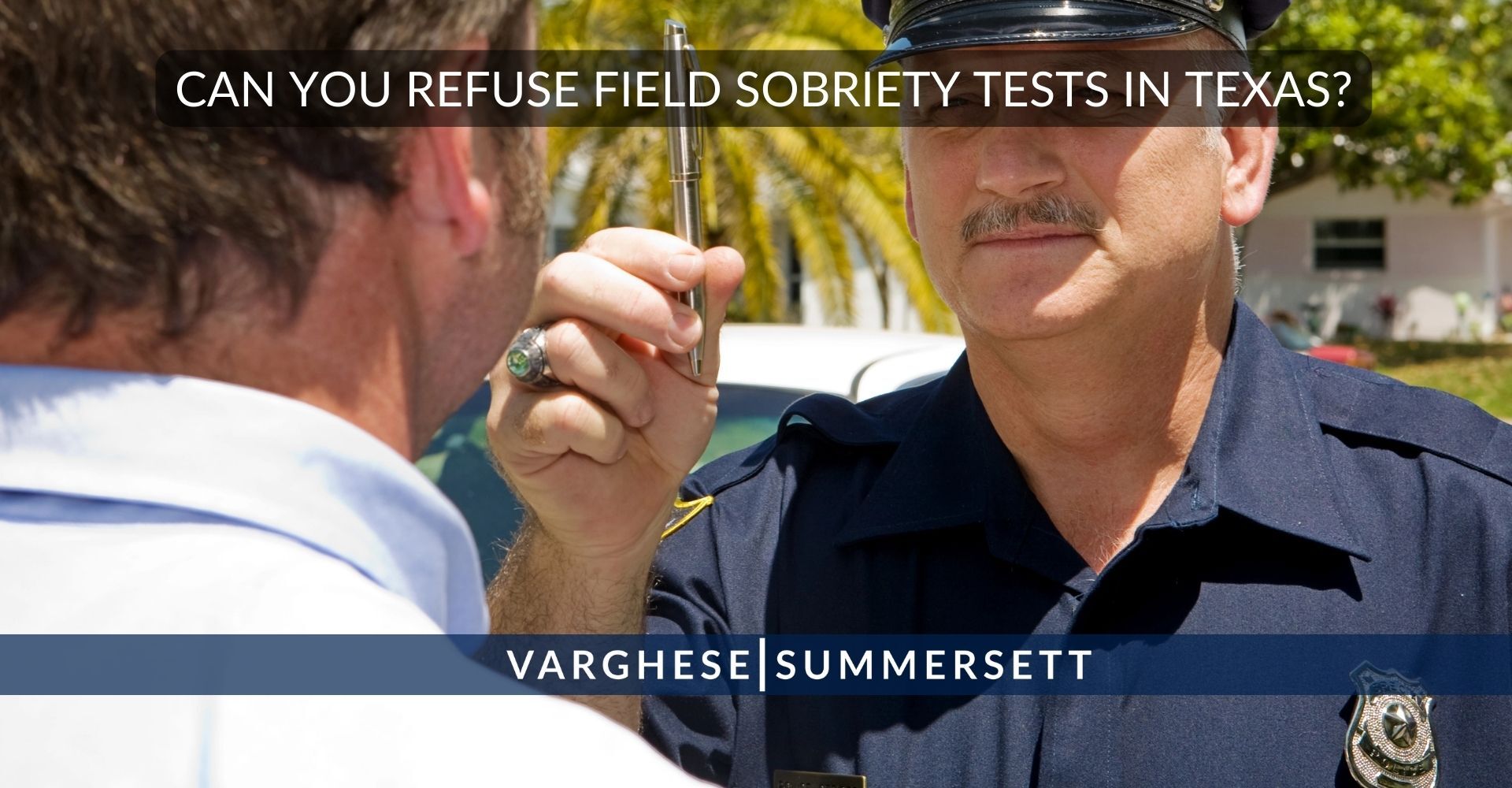
Yes, you can refuse a field sobriety test in Texas. Unlike breath or blood tests, field sobriety tests are completely voluntary, and refusing them does not trigger automatic license suspension under Texas law. In fact, politely declining these tests is often the smartest decision you can make during a DWI stop.
At Varghese Summersett, our DWI defense attorneys have reviewed thousands of DWI arrest videos. What we’ve found is troubling: the vast majority of officers administer these tests incorrectly. Even when you’re completely sober, poorly administered tests can make you look impaired on camera.
Visit our location-specific DWI pages: Denton County DWI Lawyer | Houston DWI Lawyer | Fort Bend DWI Lawyer | Fort Worth DWI Lawyer | Dallas DWI Lawyer
What Are the Standardized Field Sobriety Tests?
The National Highway Traffic Safety Administration (NHTSA) recognizes three standardized field sobriety tests that officers use during DWI investigations:
The Horizontal Gaze Nystagmus (HGN) Test involves an officer moving a stimulus (usually a pen or finger) in front of your eyes while watching for involuntary jerking movements. The Walk-and-Turn Test requires you to take nine heel-to-toe steps along a straight line, turn, and take nine steps back while following specific instructions. The One-Leg Stand Test asks you to stand on one foot with the other foot raised approximately six inches off the ground for 30 seconds.
These tests were developed in the 1970s and, when administered correctly under ideal conditions, have accuracy rates between 65% and 77% according to NHTSA research. However, roadside conditions are rarely ideal, and proper administration is uncommon.
Why Are Field Sobriety Tests Unreliable?
Field sobriety tests have significant reliability problems that most people don’t understand until they’re facing DWI charges.
Subjective interpretation plagues these tests. Consider the Walk-and-Turn test. “Stops while walking” counts as a clue of intoxication. But what’s the difference between a brief pause and a stop? That determination falls entirely to the officer’s judgment. On the One-Leg Stand, “swaying while balancing” is a clue. How much movement constitutes a sway? Again, the officer decides in the moment.
Administration errors are rampant. NHTSA publishes detailed protocols for each test. The HGN test alone has over a dozen specific requirements. Officers must hold the stimulus at the correct distance, move it at the proper speed, and observe for specific time periods. After reviewing thousands of DWI videos, we can confirm that officers rarely follow these protocols precisely. When they don’t, the scientific validity of the results collapses.
Physical conditions affect performance. Age, weight, medical conditions, inner ear problems, fatigue, nervousness, and even the type of shoes you’re wearing can all impact your performance. Uneven pavement, flashing police lights, traffic noise, and weather conditions add additional challenges that have nothing to do with intoxication.
What Happens If You Refuse Field Sobriety Tests?
Refusing field sobriety tests is not illegal in Texas, and there is no administrative penalty like license suspension attached to that refusal. However, you should understand what may follow.
The officer may still arrest you based on other observations. Your driving pattern, the odor of alcohol, slurred speech, bloodshot eyes, or admissions you made can all contribute to probable cause for arrest. Your refusal itself can be mentioned in court, where prosecutors sometimes argue it shows “consciousness of guilt.” A skilled defense attorney can effectively challenge this characterization.
After arrest, the officer will likely request a breath or blood test. This is where Texas implied consent laws apply, and different rules govern your decision. If the officer has probable cause and you refuse the breath or blood test, your license faces a 180-day administrative suspension. If you take the test and fail, the suspension is 90 days.
Despite the longer suspension period, refusing the breath or blood test is almost always the better choice. Without chemical evidence showing your blood alcohol concentration, prosecutors have a much weaker case. Let the officer obtain a warrant if they believe they have probable cause. This approach preserves your rights and limits the evidence against you.
Do You Have to Get Out of the Car During a DWI Stop?
Yes. This is different from field sobriety tests. In Pennsylvania v. Mimms (1977), the U.S. Supreme Court ruled that officers can order drivers out of vehicles during lawful traffic stops for safety reasons. This order requires no suspicion of impairment. You must comply.
Refusing to exit your vehicle can result in charges for resisting or obstructing an officer under Texas Penal Code § 38.03. However, stepping out of your car does not obligate you to perform any tests. Once outside, you can (and often should) politely decline field sobriety tests.
What Should You Say When Refusing Field Sobriety Tests?
Officers are trained to make requests sound like requirements. They might say “I need you to perform some tests” or “Step over here so we can make sure you’re okay to drive.” These phrases are designed to obtain compliance, not inform you of your rights.
If asked directly whether you have to do the tests, most officers will admit you don’t. But they won’t volunteer that information. You have to assert your rights clearly.
A simple, polite statement works best: “I respectfully decline to perform any field sobriety tests.” You don’t need to explain your reasoning or justify your decision. Repeat this statement if the officer persists. Remain calm and courteous throughout the interaction.
You also have the right to remain silent beyond providing your license, registration, and insurance. You don’t have to answer questions about where you’ve been, whether you’ve been drinking, or how much you’ve had. Politely declining to answer (“I’m choosing not to answer questions”) is within your rights.
What Should You Do If You’re Stopped for Suspected DWI?
Follow these steps to protect your rights while remaining cooperative with law enforcement:
Provide your license, registration, and proof of insurance when requested. Exit the vehicle if ordered to do so. State clearly: “I do not consent to any field sobriety tests.” If asked questions beyond identifying information, respond: “I’m exercising my right to remain silent.”
Do not physically resist if the officer decides to arrest you. Continue asserting your right to remain silent. Request to speak with an attorney as soon as possible. If the officer obtains a warrant for a blood draw, do not physically resist. At that point, the draw is legally authorized, and resistance creates additional criminal exposure.
How Can a DWI Attorney Help After an Arrest?
Even if you’re arrested after refusing field sobriety tests, an experienced DWI defense attorney can challenge the case against you.
Our attorneys at Varghese Summersett examine every aspect of the stop and arrest. Was the initial traffic stop legally justified? Did the officer have reasonable suspicion to investigate DWI? Was there actual probable cause for arrest, or did the officer rely on assumptions? If a blood warrant was obtained, was the affidavit truthful and sufficient?
We also scrutinize any evidence that does exist. If you performed any tests before refusing others, we analyze whether they were administered correctly. We review body camera and dash camera footage for inconsistencies between what officers wrote in reports and what actually happened.
Our team includes board-certified specialists in criminal law, a designation held by less than 10% of Texas attorneys. With over 100 years of combined experience and more than 1,100 five-star reviews, we’ve helped thousands of Texans facing DWI charges.

Frequently Asked Questions About Refusing Field Sobriety Tests
Can refusing field sobriety tests be used against me in court?
Yes, prosecutors can mention your refusal and may argue it suggests you knew you were impaired. However, this argument cuts both ways. Your attorney can counter that you simply exercised your legal right and that refusing tests designed to gather evidence against you is a reasonable decision for any driver.
Will I automatically be arrested if I refuse field sobriety tests?
Not necessarily. Officers need probable cause to arrest you for DWI. Without field sobriety test results, they must rely on other observations like driving patterns, physical symptoms of intoxication, or statements you made. Some officers will arrest anyway; others may let you go.
Is refusing a field sobriety test the same as refusing a breathalyzer?
No. Field sobriety tests are physical coordination exercises that carry no penalty for refusal. Breathalyzer and blood tests fall under Texas Transportation Code § 724.011 (implied consent) and carry administrative license suspension penalties for refusal. These are completely separate legal issues.
What if the officer says I have to do the tests?
The officer is mistaken or attempting to pressure you. Field sobriety tests are voluntary in Texas. You can politely but firmly decline. If the officer insists they’re mandatory, continue declining and let your attorney address the officer’s misrepresentation later.
Should I ever agree to field sobriety tests?
In most situations, declining is the better choice. Even sober individuals can fail these tests due to nervousness, physical conditions, or improper administration. The tests exist to gather evidence for prosecution, not to prove your innocence.
Contact a Fort Worth DWI Defense Attorney Today
If you’ve been arrested for DWI in Texas, whether you refused field sobriety tests or not, contact Varghese Summersett immediately. Early intervention by an experienced attorney can make a significant difference in your case outcome.
Our team is available 24/7 to take your call. We offer free confidential consultations and can begin protecting your rights today. Call (817) 203-2220 now to speak with a board-certified criminal defense attorney.
