
When a daycare facility fails to protect your child, Texas law gives your family the right to hold that facility financially accountable. A Fort Bend County daycare abuse lawyer can investigate what happened, identify who is responsible, and fight for the compensation your child deserves.

Por qué las familias de Fort Bend confían en Varghese Summersett
Varghese Summersett is one of Texas’s most recognized law firms, with a team of more than 70 legal professionals and offices in Fort Worth, Dallas, Houston, and Sugar Land. Our personal injury attorneys are former prosecutors who know how institutions operate, how insurance companies think, and what it takes to win in court.
Ty Stimpson leads the firm’s Personal Injury Division. He began his career as a prosecutor at both the Dallas County and Tarrant County District Attorney’s Offices, handling hundreds of cases before transitioning to personal injury law. He is recognized by Super Lawyers and was named to Fort Worth Inc.’s 40 Under 40. Damian Williams, also a Partner, has secured multiple seven-figure results in catastrophic injury cases and is recognized by Lawdragon as one of The 500 Leading Plaintiff Consumer Lawyers.
When your child has been harmed, you deserve attorneys who will not back down.
Nos has visto en



































What Families Ask After a Daycare Injury in Fort Bend County
Parents who come to us after a daycare incident often have the same urgent questions. Can we sue the facility? What if the staff claims it was an accident? What if our child cannot fully describe what happened? These are all legitimate concerns, and the answers are often more favorable to families than they expect.
Texas law holds daycare facilities to a legal duty of reasonable care. That means a facility does not have to intend harm for it to be held responsible. A pattern of inadequate supervision, unsafe equipment, undertrained staff, or a failure to follow state-mandated child-to-caregiver ratios can all form the basis of a valid civil claim — even if the incident looks like an accident from the outside.
It is also important to understand that a civil lawsuit is separate from any criminal investigation or Child Protective Services inquiry. Your family can pursue compensation through the courts regardless of whether criminal charges are filed against a caregiver.
Texas Law: What Must Be Proven in a Daycare Abuse Case
A daycare injury or abuse case in Texas is a civil negligence claim. Under the Texas Civil Practice and Remedies Code, the legal framework that governs these cases focuses on four elements your attorney must establish by a preponderance of the evidence — meaning it is more likely than not that each element is true. The burden of proof rests entirely on the plaintiff, which is your family.
Los cuatro elementos son:
- Duty: The daycare facility owed a legal duty of reasonable care to your child. This duty exists the moment a facility accepts your child into its care. Texas Human Resources Code § 42 requires licensed childcare centers to meet minimum health and safety standards set by the Texas Health and Human Services Commission. That statutory obligation reinforces the common-law duty of care owed to every child enrolled.
- Breach: The facility or its employees failed to meet that duty. This could be inadequate supervision, a dangerous facility condition, failure to conduct background checks on staff, improper child-to-caregiver ratios, or a deliberate harmful act by a caregiver.
- Causation: The breach directly caused your child’s injury. Your attorney must connect the facility’s failure to the specific harm your child suffered, not just establish that harm occurred.
- Damages: Your child or your family suffered actual harm — physical, emotional, or financial — as a result of the facility’s conduct.
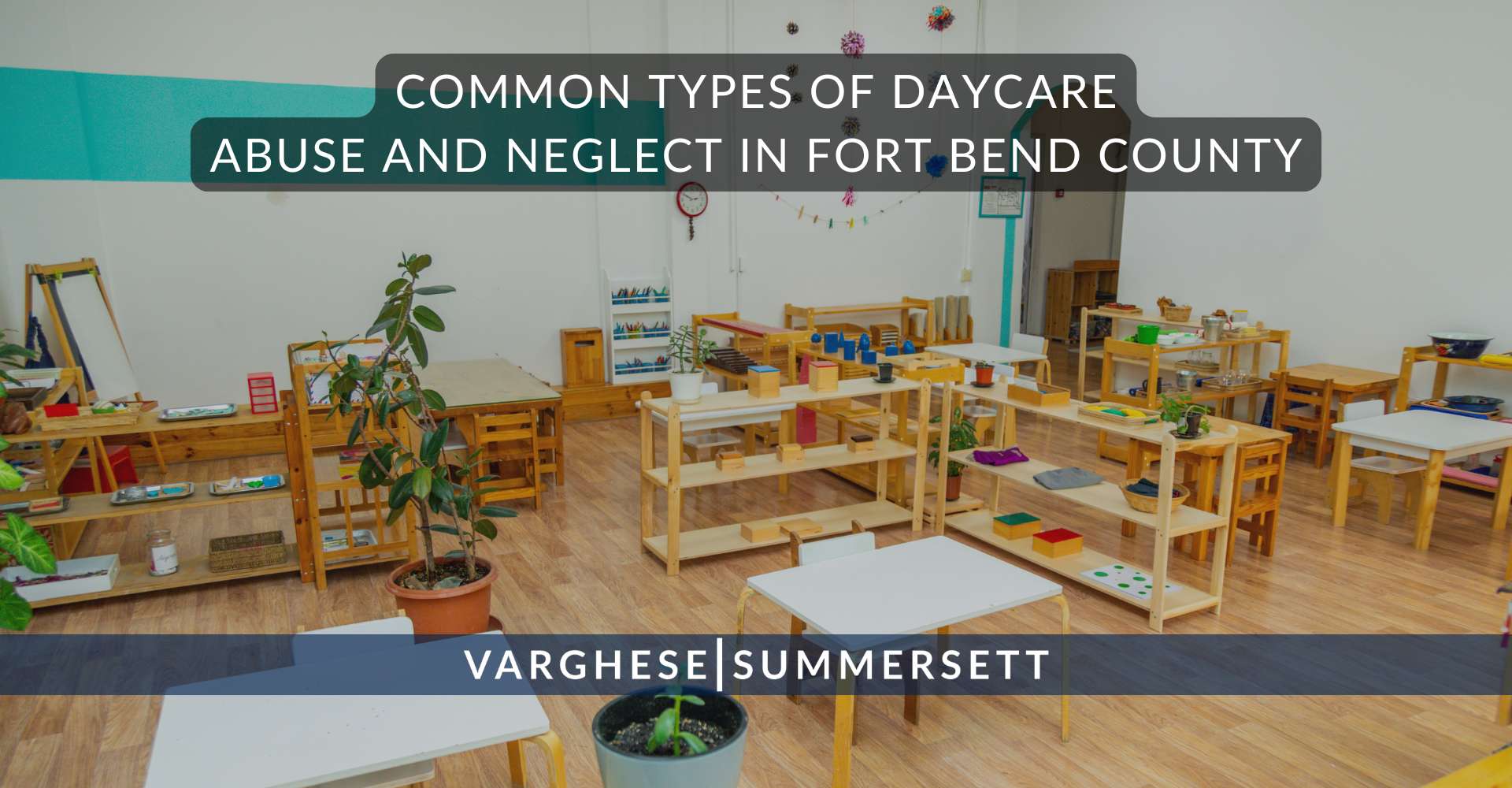
Common Types of Daycare Abuse and Neglect in Fort Bend County
Harm to children in daycare settings takes many forms. Physical abuse — striking, shaking, or restraining a child — is the most visible type, but it is far from the only one. Emotional abuse, including yelling, humiliation, isolation, and threats, can cause lasting psychological harm that is harder to see but just as real. Sexual abuse by a caregiver is among the most devastating injuries a child can suffer and often goes unreported for extended periods.
Neglect is also a major category of daycare liability. When a facility fails to provide adequate supervision, a child can drown in a water table, fall from climbing equipment, wander out of a fenced area, or be harmed by another child. Negligent hiring — placing a caregiver with a criminal history or prior abuse allegations in direct contact with children — is one of the strongest theories of institutional liability in these cases.
Unsafe physical conditions, including broken equipment, toxic materials, improper food handling, and failure to administer medication correctly, can all form the basis of a premises liability claim against the facility. You can read more about how Texas law treats these facility-related claims on our premises liability page.
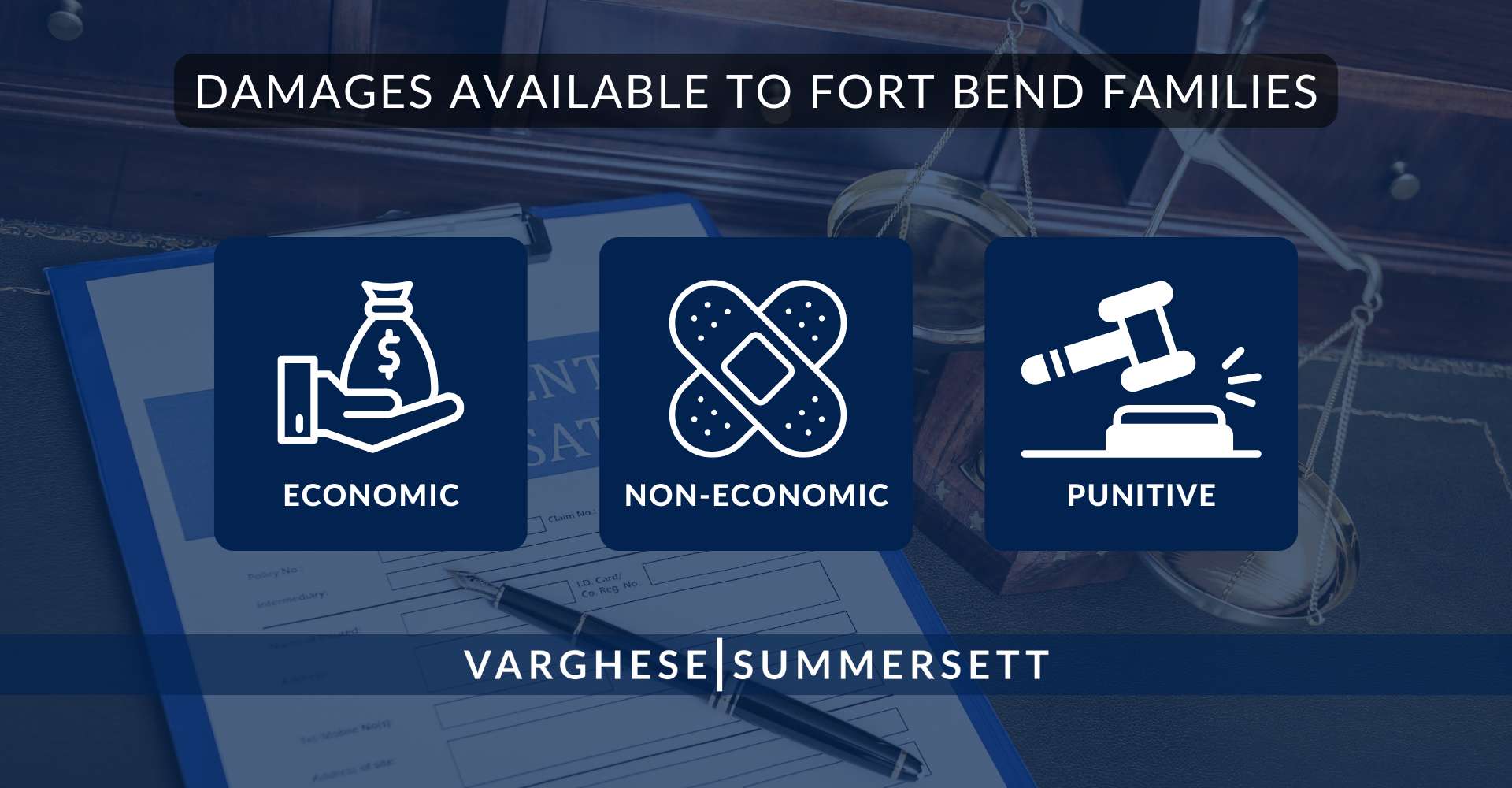
Damages Available to Fort Bend Families
Texas personal injury law allows families to recover two categories of damages: economic and non-economic.
Economic damages are the measurable financial losses your family has suffered. They include past and future medical expenses, therapy and counseling costs, the cost of specialized educational support your child may need, and any lost income for a parent who had to reduce working hours to care for an injured child.
Non-economic damages cover the harms that do not appear on a medical bill. Physical pain and suffering, emotional distress, loss of the enjoyment of life, and the psychological trauma of abuse all fall into this category. For a child survivor of abuse, these damages can be substantial — and courts in Texas take them seriously.
In cases where a facility’s conduct was particularly egregious — such as concealing prior abuse, falsifying records, or knowingly retaining a dangerous employee — punitive damages may also be available. Punitive damages are designed to punish wrongdoing and deter similar conduct by other facilities.
If your child suffered a catastrophic injury — a traumatic brain injury, spinal cord damage, or severe psychological trauma — the compensation available can be significantly higher to account for a lifetime of care needs.

Statute of Limitations: How Long Do You Have to File?
In Texas, personal injury claims are governed by a two-year statute of limitations under Civil Practice and Remedies Code § 16.003. This means a lawsuit must generally be filed within two years of the date of injury.
However, there is an important exception for children. Under Civil Practice and Remedies Code § 16.001, the statute of limitations is tolled — paused — while a child is under the age of 18. This means a child who is harmed in a daycare typically has until their 20th birthday to bring a claim, regardless of when the injury occurred.
Despite this tolling provision, waiting is almost never in your family’s interest. Physical evidence deteriorates, surveillance footage is overwritten, witnesses move on, and staff memories fade. State inspection records and incident reports can also be lost or become harder to subpoena over time. The sooner an attorney can begin investigating, the stronger your case will be.

¿Cuánto puede valer su caso?
Every case is different, and no attorney can honestly promise a specific outcome. What we can tell you is that the factors that most significantly affect the value of a daycare injury claim include the severity and permanence of your child’s injuries, the strength of evidence linking the facility’s conduct to those injuries, whether the facility had prior notice of dangerous conditions or caregiver misconduct, and the emotional and developmental impact of the harm on your child’s life going forward.
Cases involving physical abuse by a caregiver, sexual abuse, near-drowning incidents, or injuries resulting in lasting cognitive or developmental impairment consistently produce the largest recoveries. Cases where a facility has a documented history of violations with the Texas Health and Human Services Commission — and failed to correct them — can also support particularly strong claims.
To understand what your specific situation may be worth, the most important first step is a confidential consultation with an experienced attorney who can review the facts.

El proceso legal: qué esperar
Most families who come to us have never been involved in a lawsuit. Understanding the process reduces fear and helps you make informed decisions at every step.
The process typically begins with an investigation. Your attorney will gather incident reports filed with the facility, request Texas HHSC inspection records and licensing history, subpoena internal communications and security footage, interview witnesses, and retain expert witnesses — including pediatric physicians, child trauma specialists, and childcare licensing experts — to build the strongest possible case.
Before a lawsuit is filed, your attorney will send a demand letter to the facility’s insurance carrier. Many cases resolve at this stage through a negotiated settlement. If the insurance company refuses to offer fair compensation, your attorney files suit in Fort Bend County District Court, located at the Fort Bend County Justice Center in Richmond, Texas.
Discovery follows filing — a formal exchange of evidence between both sides. This phase often brings the most critical facts to light, including internal communications about prior complaints and records of caregiver background checks. After discovery, most cases either settle or proceed to trial before a Fort Bend County jury.

Why Insurance Companies Fight Daycare Claims
Childcare facilities carry commercial general liability insurance specifically to cover incidents involving children in their care. However, the insurance company’s interest is in paying as little as possible — not in making your family whole.
Insurance adjusters commonly argue that a child’s injuries are not as severe as claimed, that the facility followed proper procedures, or that a parent somehow contributed to the incident by failing to disclose relevant medical history. They may also move quickly after an incident to offer an initial settlement that sounds significant but is far less than what a case is actually worth.

Local Resources for Fort Bend County Families
If your child has been injured or abused at a daycare facility in Fort Bend County, these local resources can help:
- Memorial Hermann Sugar Land Hospital — 17500 W Grand Pkwy S, Sugar Land, TX 77479 | (281) 725-5000 | Emergency pediatric care
- OakBend Medical Center — 1705 Jackson St, Richmond, TX 77469 | (281) 341-3000 | Regional hospital serving Fort Bend County
- Texas Children’s Hospital West Campus — 18200 Katy Fwy, Houston, TX 77094 | (832) 227-1000 | Level III pediatric emergency center, nearest major pediatric facility
- Fort Bend County Sheriff’s Office — 1410 Terry Hershey Park, Katy, TX 77493 | (281) 341-4665 | Report abuse or file a police report
- Texas DFPS Child Abuse Hotline — 1-800-252-5400 | Report suspected child abuse or neglect 24/7
- Texas Health and Human Services Commission, Child Care Licensing — (512) 438-3269 | Request inspection history and violation records for any licensed Fort Bend childcare facility
- Fort Bend County District Courts — Fort Bend County Justice Center, 1422 Eugene Heimann Cir, Richmond, TX 77469 | Civil cases are filed here

Qué esperar de Varghese Summersett
From the moment you call, you will speak with a legal professional who takes your situation seriously. We do not pass families off to paralegals and disappear. Our attorneys stay involved throughout the process, keeping you informed at every stage.
We handle daycare abuse and injury cases on a contingency fee basis, which means you pay nothing unless we recover compensation for your family. There are no upfront costs, no hourly billing, and no fees if we do not win.
Our team will conduct a thorough investigation, preserve critical evidence, consult with medical and childcare experts, and build the strongest possible case for your child. If a fair settlement cannot be reached, we are fully prepared to take the case to a Fort Bend County jury. Insurance companies know we try cases — and that changes the dynamic of every negotiation.
When you are ready to talk, our Fort Bend team is available around the clock. Reach us at (281) 805-2220 for a free, confidential consultation. You can also visit our Fort Bend personal injury page to learn more about our practice in Sugar Land and the surrounding area, or review our child injury and wrongful death resources if your child’s injuries were life-altering.
Excelencia jurídica galardonada















Pregúntale a Varghese Summersett IA
Versus-AI ha aprendido todo lo que hay que saber de nuestro sitio web y está aquí para ayudarte a encontrar las respuestas que necesitas. Pregúntale cualquier cosa a Versus-AI.
Watch: The Call No Parent Ever Wants to Get
Our team understands that a call about your child’s injury is one of the most terrifying moments a parent can face. This video from Varghese Summersett shares one family’s story of heartbreak, hope, and healing — and what it looks like to fight back.
Preguntas frecuentes
Can I sue a daycare if my child was injured but the injury appears minor?
Yes. Even injuries that appear minor at first — a bruise, a fall, repeated emotional distress — can form the basis of a civil claim if they resulted from a facility’s negligence. Some injuries, particularly psychological and developmental harm from abuse or chronic neglect, may not be fully apparent for months or years. An attorney can evaluate what happened and advise you on whether a claim is worth pursuing.
What if the daycare says the incident was an accident?
A facility calling something an “accident” does not eliminate its legal liability. Under Texas law, negligence does not require intent. If the facility failed to maintain safe conditions, provided inadequate supervision, or employed a caregiver without proper vetting, it can be held responsible even if no one meant for your child to get hurt.
Does my child need to testify?
Most daycare cases resolve through settlement before trial. If a case does go to trial, whether a child testifies depends on the child’s age, their ability to communicate, and what other evidence is available. Your attorney’s job is to build a case that does not place an unnecessary burden on your child. Medical records, facility records, expert witnesses, and caregiver statements can often tell the story without the child having to take the stand.
What if the daycare is already under investigation by CPS or law enforcement?
A government investigation does not prevent you from filing a civil lawsuit, and the two processes are entirely separate. In fact, evidence gathered during a CPS or criminal investigation may be useful in your civil case. You should not wait for a criminal case to resolve before speaking with a civil attorney — the two-year statute of limitations runs regardless of what is happening in a parallel government investigation.
¿Cuánto tiempo tardará mi caso?
Cases that settle before trial typically resolve within several months to a couple of years, depending on the complexity of the injuries and how aggressively the facility’s insurer contests the claim. Cases that go to trial take longer. Your attorney can give you a more realistic timeline once they have reviewed the specific facts of your situation. You can learn more about the general timeline on our daycare injuries page.

Áreas de práctica en materia de lesiones personales en el condado de Fort Bend
Nuestros abogados especializados en lesiones del condado de Fort Bend luchan para conseguir la máxima indemnización
Páginas principales
Accidentes de tráfico
Muerte por negligencia
¿Ha sufrido una lesión en el condado de Fort Bend? Solicite una consulta gratuita.
Your child deserved to be safe. If a Fort Bend County daycare failed that responsibility, Varghese Summersett is ready to stand beside your family. Call (281) 805-2220 or reach out online any time of day or night. There is no fee unless we recover compensation for you.