What Montgomery v. Caribe Transport Means for You
On May 14, 2026, the United States Supreme Court handed down a unanimous decision that changes the landscape for anyone injured in a commercial truck crash. In Montgomery v. Caribe Transport II, LLC, the Court ruled that freight brokers, the middlemen who arrange truck shipments, can be held legally responsible when they hire dangerous trucking companies that go on to cause crashes. If you or someone you love has been hurt in a truck wreck, this ruling matters. It may significantly expand who can be held accountable for your injuries, and it may open a path to compensation that did not exist before.
The Story Behind the Case
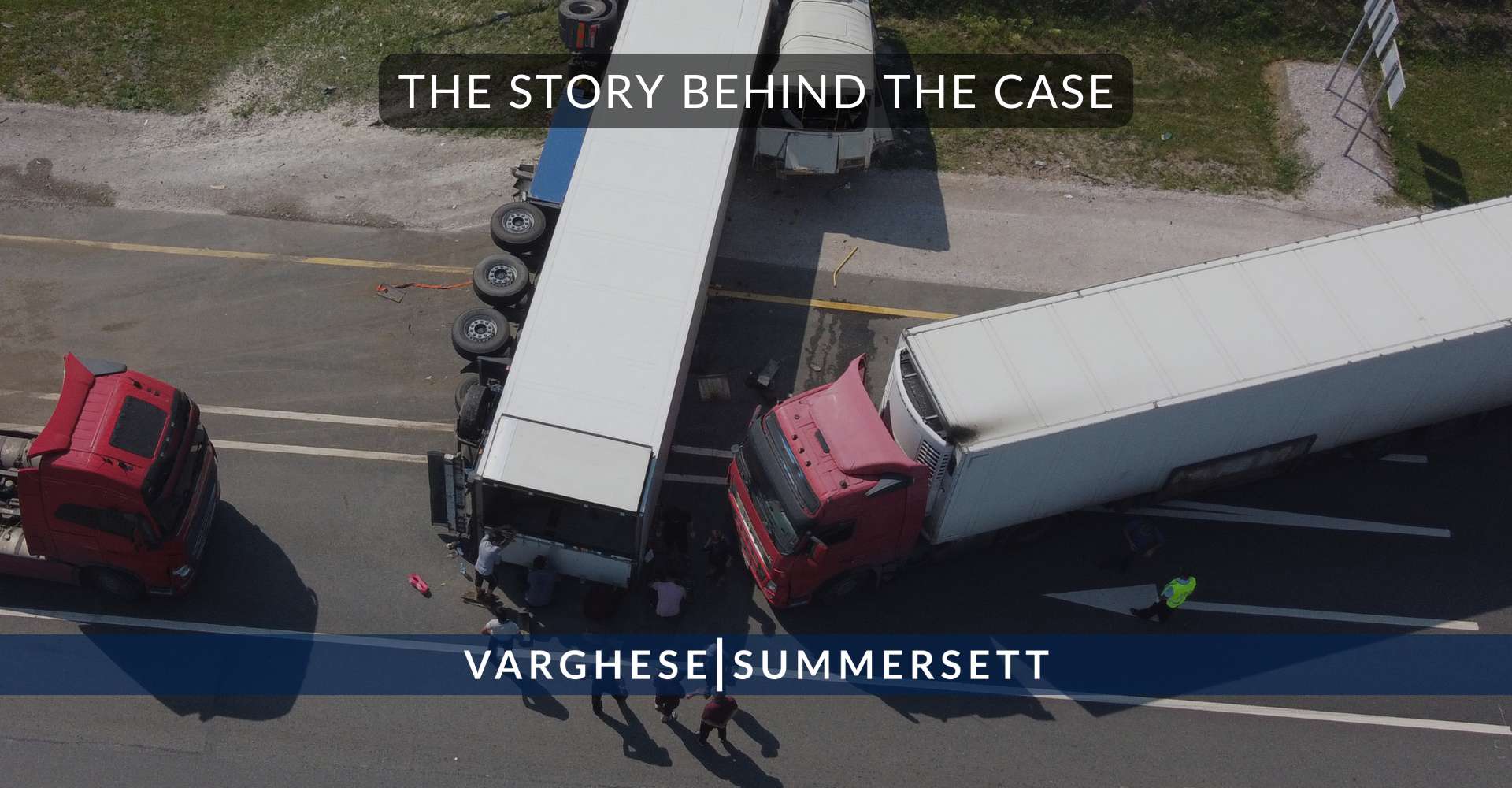
Shawn Montgomery was inside his tractor-trailer, pulled over on the side of an Illinois highway, when another truck veered off course and slammed into him. The driver, Yosniel Varela-Mojena, was hauling a load of plastic pots for a trucking company called Caribe Transport II. Mr. Montgomery’s injuries were catastrophic. His leg had to be amputated. He sustained other severe and permanent injuries. Here is the part that matters for this case. Caribe Transport did not find this load on its own. A freight broker called C.H. Robinson Worldwide, one of the largest brokers in the country, arranged it. And at the time the broker hired Caribe Transport, that trucking company had a “conditional” safety rating from federal regulators. That rating meant the company had been flagged for problems with driver qualifications, hours-of-service compliance, vehicle inspection and maintenance, and its crash rate. Mr. Montgomery sued the driver, the trucking company, and the broker. Against the broker, his claim was simple. You knew or should have known this trucking company was dangerous, and you hired them anyway. For years, brokers argued they could not be sued for this kind of claim because of a federal law that limits statea regulation of the trucking industry. The lower courts agreed with the broker. The Supreme Court reversed unanimously.
What Is a Freight Broker, and Why Should You Care?
Most people have never heard of a freight broker. Here is how it works. When a company needs to ship goods, say a manufacturer sending pallets from Texas to Illinois, they usually do not call a trucking company directly. Instead, they call a broker. The broker’s job is to find a trucking company willing to haul the load, negotiate the price, and coordinate pickup and delivery. The broker makes money on the spread between what the shipper pays and what the trucking company charges. Brokers are everywhere in the freight industry. There are roughly 28,000 of them in the United States, and they arrange about one-third of all freight that moves on American highways. That is hundreds of millions of loads every year. The catch is that brokers do not own the trucks. They do not employ the drivers. They are not the ones behind the wheel. So when a crash happens, brokers have long argued they have nothing to do with it. The Supreme Court just rejected that argument.

Listen: Analysis of Montgomery v. Caribe
Transcript
Picture this. It’s a freezing December day back in 2017. A man named Sean Montgomery is parked on the side of a road in Illinois — just parked. And out of nowhere, an 80,000-pound Mack truck hauling a massive load of plastic pots veers completely off course and violently strikes his tractor trailer. The crash is unimaginable. Montgomery sustains severe, permanent injuries, which tragically culminate in the amputation of his leg. A truly catastrophic event — it shattered a life in an instant. It really did. And it sparked a legal battle that took nearly a decade to resolve. Welcome to a new Deep Dive. Our mission today is to unpack a high-stakes clash over who is ultimately responsible for the safety of those massive trucks sharing the highways with you. The sources we’re using are compelling — the actual transcript of oral arguments and the final unanimous Supreme Court slip opinion in Montgomery v. Kariba Transport II LLC, decided today, May 14, 2026. We’re looking at a fundamental tension in American law: on one side, federal economic deregulation designed to keep the economy moving cheaply and efficiently. On the other, local state safety laws designed to keep you from getting killed on your morning commute. Let’s unpack this, because the lawsuit Montgomery filed did something that seems counterintuitive at first glance. The driver of the truck was a man named Yasniel Varela-Mojena, who worked for a trucking company called Kariba Transport — the motor carrier. But Montgomery didn’t just sue the driver, and he didn’t just sue the trucking company. He went further up the chain. He sued the broker who matched them together for this specific shipment — a colossal logistics corporation called C.H. Robinson. So why sue the middleman who wasn’t anywhere near the steering wheel? And does federal law even allow you to do that? To answer that, we have to look at the mechanics of the modern freight industry — specifically what a broker’s day-to-day operation actually looks like. Brokers are essentially the invisible matchmakers of the transportation world. Say a manufacturer has 40 tons of plastic pots that need to go from Chicago to Dallas. They aren’t opening the Yellow Pages and calling truckers. They call a broker. The broker acts like a travel agent for freight — they don’t own the trucks, they don’t hire the drivers. They sit at desks utilizing massive software platforms and digital load boards, connecting shippers with motor carriers — the trucking companies that actually have the vehicles. They negotiate a price with the shipper, find a carrier willing to do it for less, and pocket the margin. And the scale of this is staggering. There are roughly 28,000 brokers operating in the United States right now, and they coordinate about a third of all the freight moving across the entire country. They’re managing interactions with more than 780,000 individual carriers. They really are the central nervous system of the whole supply chain. So Montgomery’s lawsuit hits C.H. Robinson with an allegation of negligent hiring. For anyone not steeped in legal jargon, a tort is basically a civil wrong that causes someone harm, which then leads to legal liability. And the tort of negligent hiring means you didn’t do your homework before bringing someone on board, and somebody got hurt because of that failure. The specific allegations against C.H. Robinson are severe, because Kariba Transport — the carrier they matched for this load — didn’t have a clean record. They had what’s called a conditional safety rating from the Federal Motor Carrier Safety Administration, or FMCSA. A conditional rating means the federal government actually audited the trucking company and found significant violations. According to the lawsuit, Kariba Transport’s conditional rating highlighted major deficiencies in driver qualifications, poor management of hours of service (meaning drivers might be exhausted behind the wheel, driving too long without sleep), lax vehicle inspection, and a high recordable crash rate. They were basically a rolling hazard. Not quite bad enough for the government to pull their license, but definitely operating under a massive federal red flag. So Montgomery’s legal argument is that C.H. Robinson — a highly sophisticated logistics company — knew or should have known that hiring a carrier with that safety record to haul 80,000 pounds of freight was reasonably likely to result in a crash. The plaintiffs argue the broker essentially closed their eyes, looked only at the cheap price tag, and sent a ticking time bomb out onto the interstate. Here’s an analogy. If you hire a contractor to paint your house and they do a terrible job, your neighbor can’t sue you for negligent hiring — painting a house doesn’t pose an inherent risk of bodily harm to third parties. But if you use an app on your phone to hire a contractor to operate an 80,000-pound piece of heavy machinery directly next to a family minivan on the highway, that’s different. Shouldn’t the app be liable if they intentionally send someone with a terrible safety record? That’s the exact philosophical distinction the plaintiff’s lawyer, Paul Clement, made during oral arguments. You’re dealing with an inherently dangerous activity. What’s really fascinating is why the plaintiff’s bar — the lawyers representing accident victims — has increasingly targeted brokers over the last two decades, starting around 2004. Are they just chasing deeper pockets? A massive corporation obviously has way more money than a mom-and-pop trucking company. Deep pockets are absolutely a primary factor, because surprisingly, the federal government only requires trucking companies to carry a minimum of $750,000 in personal injury insurance. That number was set back in the 1980s. That’s nothing when you’re talking about a catastrophic injury — an amputation, lifetime medical care. $750,000 barely covers the initial hospital stay these days. Small carriers frequently can’t pay multimillion-dollar judgments. They just declare bankruptcy and fold, leaving the victim with a piece of paper saying they won, but no actual compensation. However, there’s a broader systemic goal beyond just compensation — deterrence. By targeting the brokers, the legal system is attempting to incentivize the entities who hold the purse strings. If the matchmakers face financial ruin for hiring dangerous carriers, they’ll be forced to prioritize safety in their algorithms. They’ll have to stop choosing the cheapest, most dangerous option. That makes sense at the state level. So why did this single truck crash have to go all the way to the Supreme Court? This brings us to the deregulation dilemma. The entire conflict revolves around a piece of federal legislation passed in 1994: the Federal Aviation Administration Authorization Act, or FAAAA. To understand its power, we have to look at how trucking used to work. For decades, the Interstate Commerce Commission — the ICC — tightly controlled the trucking market. It functioned almost like a government-sanctioned cartel. The ICC dictated prices, decided who could drive which routes, and heavily restricted new companies from entering the market. It stifled competition, created massive administrative burdens, and artificially inflated prices. So Congress stepped in. In 1994, Congress passed the FAAAA to dismantle that micromanagement. They wanted the free market to dictate logistics. But to ensure states didn’t just replace the old federal bureaucracy with 50 new local bureaucracies, the FAAAA includes an express preemption clause — federal law trumps state law. It explicitly forbids states from enacting any laws related to a price, route, or service of a motor carrier or a broker. A total ban on state interference in the business of freight. But there’s an exception — the safety exception. The statute states that this preemption shall not restrict the safety regulatory authority of a state with respect to motor vehicles. Those five words became the multibillion-dollar battleground here. Here’s the pushback on the plaintiff’s interpretation. A broker is sitting in an office building in Minneapolis or Dallas, typing on a keyboard, running software algorithms, maybe making a few phone calls. They don’t hire the driver. They don’t own the truck. They don’t check the tire tread or the brake lines. So how can a state lawsuit against a desk-bound middleman possibly be considered a regulation with respect to motor vehicles? They’re moving data, not trucks. That’s the exact conceptual knot the Supreme Court had to untangle. Is holding a middleman liable for a negligent software match a safety regulation concerning a motor vehicle, or is it an illegal backdoor state intervention into the core services of a broker? The plaintiff’s counter-argument is straightforward: if the FAAAA preempts these lawsuits, brokers are completely immunized from the consequences of their actions. They could intentionally orchestrate millions of shipments using demonstrably dangerous carriers, profit from the cheap labor, and face zero legal liability when the inevitable crashes occur. They get off scot-free. But we have to look closely at the defense. C.H. Robinson, and the U.S. government — which actually filed a brief siding with the brokers — presented a compelling case for why allowing these lawsuits would cause catastrophic damage to the American economy. The defense paints a picture of complete logistical chaos. If states are allowed to sue brokers for negligent hiring, we instantly create a 50-state patchwork of wildly varying legal standards. Congress passed the FAAAA specifically to destroy that kind of fragmentation. Here’s how that fragmentation plays out practically. Look at the legal concept of proximate cause — how directly responsible the defendant’s action was for the actual harm. Suppose California establishes a very loose proximate cause requirement. They decide that simply hiring a carrier with one minor past violation makes the broker liable for a crash. Meanwhile, Texas might require proof that the broker knew the specific driver was intoxicated. A much higher bar. So a broker in Chicago coordinating a load from New York to Los Angeles would have to operate under the constant fear of California’s strict liability standards. To protect themselves, they couldn’t just rely on a basic federal license anymore. They would literally have to hire an army of private investigators and risk management analysts to independently vet all 780,000 carriers against the most aggressive state standards in the country. And the brokers argue that vetting carriers is the federal government’s job anyway. That’s why the FMCSA exists. If a carrier possesses a valid federal license to operate on the interstate, a broker should be legally protected if they rely on that federal authorization. Except the victim’s lawyer brought up a terrifying statistic during oral arguments that blows a hole in that reliance. They pointed out that 94% of registered motor carriers haven’t had a meaningful federal safety inspection. The federal government just lacks the funding and manpower to constantly monitor three-quarters of a million trucking companies. So the defense’s argument relies on a federal safety net that, in many places, is full of holes. This brings up one of the bizarre aspects of the defense’s argument — a glitch in the legislation known as the intrastate anomaly. The FAAAA has another section, subsection (b), which completely preempts state regulation of intrastate broker services — shipments that start and end within a single state, like local trips. And subsection (b) has no safety exception attached to it. Which makes no sense. Why would Congress write a law that completely shields a broker from being sued for a trip from Los Angeles to San Francisco, but allow them to be sued for a trip from Los Angeles to Reno, Nevada? Crossing a state line doesn’t suddenly make a truck safer or a broker more culpable. It creates a glaring logical inconsistency, and the defense uses this anomaly to argue that Congress never intended for brokers to face safety liability at all. If Congress cared deeply about state safety laws applying to brokers, they wouldn’t have completely barred states from enforcing those laws on local intrastate trips. The defense argues the safety exception in the interstate section was meant for the physical trucks themselves, not the desk workers. The defense also pointed to a massive disparity in insurance requirements. Congress legally mandates that trucking companies carry $750,000 in personal injury insurance, but it does not require brokers to carry any personal injury insurance at all. Brokers are only required to hold a surety bond against financial default — basically insurance to make sure truckers get paid if the broker goes under. No bodily injury coverage required. So the defense poses a logical question: if Congress envisioned a system where brokers would be routinely hit with $10 million personal injury verdicts, wouldn’t they have mandated the insurance coverage necessary to pay those verdicts? A very strong point. Now think about the real-world economic fallout if the defense loses. If we make brokers terrified of these massive tort lawsuits, won’t they just default to the “nobody ever got fired for buying IBM” strategy — flight to massive corporate safety? If you’re running a brokerage and a single crash could bankrupt your company, you’re never going to hire Joe’s local trucking startup, even if Joe is a perfectly safe driver. You’re only going to hire massive monopolies — FedEx, J.B. Hunt — companies with massive legal teams and billion-dollar insurance policies. But that entirely freezes out the safe, small trucking companies, which stifles the exact competition the FAAAA was meant to create in the first place. And ultimately, that just raises the price of every single item you and I buy at the grocery store. If we connect this to the bigger picture, it highlights the classic “laboratories of democracy” problem inherent in our constitutional system. We want states to be able to experiment with local laws to protect their citizens — that’s a core feature of the U.S. But in a highly interconnected interstate logistics network, local laws have massive national consequences. One state with extremely generous plaintiff laws could essentially dictate the trucking rules for the entire United States. The FAAAA was enacted to establish a unified, free-flowing national market. Subjecting that market to the whims of local state juries threatens to plunge the whole system back into the costly, inefficient gridlock of the 1970s. That’s the defense’s core fear. So we have powerful, emotionally resonant arguments about keeping deadly trucks off the road on one side, and highly pragmatic, structural arguments about preventing total economic gridlock on the other. How did the Supreme Court ultimately resolve it? Justice Amy Coney Barrett delivered the opinion of the court — a 9–0 decision. Unanimous. The ruling states that the FAAAA does not preempt the claim. Montgomery’s lawsuit against the broker is officially saved by the safety exception. A unanimous decision against the brokers and against the federal government’s own position. How did they justify the text? The justices relied on strict textualism. They consulted dictionary definitions from the era the law was written — 1990s dictionaries — and zeroed in on the phrase “with respect to.” They determined that phrase simply means “concerns” or “regards.” So the legal question becomes: does a state law requiring a broker to exercise reasonable care in selecting a carrier concern motor vehicles? And the court concluded that yes, obviously it concerns the motor vehicles that will inevitably be used to transport the freight. The broker service is inextricably linked to the physical truck. You cannot separate the two. How did Justice Barrett deal with the intrastate anomaly? She acknowledged it as an odd mystery of statutory drafting, but her conclusion was essentially a shrug. She wrote, quote, “better to live with the mystery than to rewrite the statute.” The court’s role is to interpret the text of the interstate exception as written, not to fix Congress’s sloppy drafting in other sections of the law. Justice Kavanaugh wrote a concurring opinion that stepped away from the dictionaries a bit and looked at the reality on the ground. He cited some terrifying statistics: in 2022 alone, there were roughly 500,000 crashes in the United States, resulting in 5,000 deaths and 114,000 injuries. He noted that Congress passed the FAAAA to deregulate the economics of the trucking industry, not to deregulate safety. He argued Congress would never have intended to create a legal black hole where the massive corporations orchestrating the freight economy operate with zero safety oversight. He reinforced the idea that you cannot separate the matching service from the physical danger it creates. Here’s where it gets interesting. During oral arguments, Paul Clement, the victim’s lawyer, brought up an analogy that perfectly encapsulates the court’s logic — the coffee analogy. Think about the infamous McDonald’s hot coffee lawsuit from the 1990s. If Congress passed a sweeping federal law that preempted state regulations “with respect to coffee,” a tort lawsuit about negligently spilling piping-hot coffee into someone’s lap obviously still counts under that umbrella — because the injury is caused by the coffee. Apply that here: because the negligent hiring tort is ultimately triggered by the physical operation of an 80,000-pound truck, it is obviously a tort “with respect to motor vehicles.” A brilliant distillation of the principle. The court didn’t entirely dismiss the brokers’ economic warnings. Justice Kavanaugh explicitly acknowledged the valid concerns about rising costs of litigation and insurance eventually cascading down to American consumers — we all pay for it eventually. However, the ruling asserts that the plain text of the law prioritizes safety over economic efficiency. Keep unsafe trucks off the roads. The court’s underlying message to the brokerage industry is basically this: you have the power to protect yourselves. Stop blindly accepting the cheapest bid. Invest the time and resources to do your due diligence. Ask the carriers the hard questions — about their safety records, their drug testing policies, their driver proficiency — before you hand them the keys to a 40-ton missile. So what does this all mean for you, the person listening right now? Why should you care about a Supreme Court interpretation of a 1994 trucking statute? Because this isn’t just an academic debate over legal definitions in old dictionaries. This is about the literal physical safety of the highways you drive on with your family every single day. And it’s about the invisible, highly complex logistical web that ensures every package arrives at your doorstep. The Supreme Court just told the matchmakers of the American economy that they are legally and financially on the hook if they choose to match freight with danger. This decision fundamentally rewrites the risk calculations for a third of the United States freight economy overnight. One fascinating angle to ponder as this ruling ripples through the industry: now that these massive, multibillion-dollar broker corporations are legally incentivized to deeply, aggressively investigate the habits of every carrier just to avoid ruinous lawsuits, are we about to witness the rise of a privatized, shadow regulatory state? It raises profound questions about the future of surveillance and enforcement on the highways. If the federal government only manages to inspect a tiny fraction of carriers, but private brokers face total financial destruction if a bad driver crashes, corporate supply chains are going to take matters into their own hands. They’ll have to. Could we see brokers demanding real-time access to in-cab cameras? Will they build massive AI surveillance networks to monitor truck drivers’ braking habits, speed, and sleep schedules — far more strictly than the federal government ever legally could? We might be looking at a future where the concept of privacy on the open road is fundamentally erased, not by government police, but by the algorithm of a corporate freight broker desperately trying to avoid a tort claim. The heavy lifting on the highway is really just beginning. Thank you for joining us on this Deep Dive. We’ll catch you next time.
What the Supreme Court Decided
The Court’s ruling was short, clear, and unanimous. Justice Amy Coney Barrett wrote the opinion. The question was whether a 1994 federal law called the Federal Aviation Administration Authorization Act, which limits state regulation of the trucking industry, blocks injured people from suing brokers for negligently hiring dangerous trucking companies. The Court said it does not. The law contains an exception that preserves the states’ authority to regulate safety “with respect to motor vehicles.” The Court held that a lawsuit alleging a broker negligently hired an unsafe trucker is a safety claim that concerns motor vehicles. So it survives. In other words, federal law does not give brokers a free pass when they put unsafe trucks on the road.
What This Means for People Injured in Truck Crashes
If you have been hurt in a commercial truck crash, here is why this decision matters.
Trucking insurance often is not enough
Federal law requires interstate trucking companies to carry a minimum amount of liability insurance, but those minimums have not kept up with the real cost of serious injuries. A single catastrophic truck crash can easily produce damages that far exceed the trucking company’s policy limits. When that happens, injured people are often left without a meaningful path to full compensation. They cannot pay for surgeries, lost income, lifelong care, or anything else, because the available insurance is simply too small.
Brokers usually have far deeper pockets
Major freight brokers are large, sophisticated, well-insured companies. C.H. Robinson, the broker in this case, is a multi-billion-dollar corporation. If a broker negligently hired the trucking company that hurt you, the broker may now be on the hook alongside the trucking company. That can make the difference between a partial recovery and full justice.
Federal safety data finally has teeth
Every interstate trucking company in America has a public safety record kept by the Federal Motor Carrier Safety Administration. That record includes crash history, inspection results, out-of-service rates, hours-of-service violations, and driver qualification issues. Before this ruling, brokers in many parts of the country could ignore that data without consequence. After Montgomery, brokers across the country have a real legal reason to look at it, and a real legal exposure if they ignore obvious red flags.
More accountability, fewer preventable crashes
Truck crashes are a leading cause of catastrophic injury and death in the United States. According to federal data cited in the case, there were about 500,000 reported truck crashes in 2022, leading to roughly 5,000 deaths and 114,000 injuries. Not every crash is preventable, but many are. Some trucking companies are known to be unsafe. Some drivers are known to be unfit. When brokers can be held responsible for putting those carriers on the road, they have a powerful incentive to choose better ones.
What This Decision Does Not Mean
It is important to be honest about the limits of this ruling. Brokers are not automatically liable. Just because a broker hired the trucker who hit you does not make the broker responsible. To win a claim against a broker, an injured person still has to prove the broker was unreasonable, meaning the broker knew or should have known the trucking company was dangerous and hired it anyway. Brokers who do their homework are protected. The Court was clear that brokers who carefully check the carriers they hire and choose reputable ones should win these cases. The decision is not about punishing every broker. It is about holding accountable the ones who ignore obvious warning signs. The connection between the broker’s choice and the crash still has to make sense. If a broker hired a trucker with a poor safety record, but the actual cause of the crash had nothing to do with the safety problems on that record, the legal connection might not hold. This is called proximate cause, and it is a critical part of every personal injury case. This is not a new type of lawsuit. Negligent hiring claims have existed in Texas and across the country for a long time. The Supreme Court just removed a federal-law barrier that was blocking these claims when they were brought against brokers.

What to Do If You Have Been Hurt in a Truck Crash
Truck crash cases are complex, fast-moving, and require specialized knowledge. Here is what you should do right away. Get medical care immediately. Your health comes first, and consistent medical documentation is the foundation of every injury claim. Do not talk to insurance adjusters before talking to a lawyer. Adjusters for the trucking company, the broker, or even your own insurance company are trained to get statements and information that can be used to reduce or deny your claim. Preserve evidence. If you can, take photos of the crash scene, the truck, the trailer, and any visible DOT numbers or company names. The DOT number on the side of the truck is the key that unlocks the federal safety database for that carrier. Try to find the shipping paperwork. The bill of lading often reveals the broker’s name. Without it, the broker’s involvement can be hidden. Act quickly. Texas gives you two years from the date of the crash to file a personal injury lawsuit. But critical evidence on commercial trucks, including black box data, electronic logs, dashcam video, and maintenance records, can be lost or overwritten in days or weeks. The sooner a lawyer can send preservation letters, the better. Hire a lawyer who handles trucking cases. Commercial truck litigation is a specialty. Federal regulations, hours-of-service rules, electronic logging requirements, broker-carrier contracts, and now broker liability all require focused experience. A car wreck attorney is not the same as a truck wreck attorney.

For Lawyers: A Deeper Look at What Montgomery Changes
For attorneys who handle commercial trucking cases, Montgomery is one of the most significant federal preemption decisions in the trucking space in a generation. Here is the practical breakdown.
The doctrinal mechanics
The Federal Aviation Administration Authorization Act, codified at 49 U.S.C. § 14501(c), preempts state laws “related to a price, route, or service” of a motor carrier or broker “with respect to the transportation of property.” But the statute contains a safety exception at § 14501(c)(2)(A) preserving “the safety regulatory authority of a State with respect to motor vehicles.” Justice Barrett’s opinion proceeds in three moves. First, common-law duties and standards of care are part of a state’s safety authority, a point everyone conceded, and one supported by Kurns v. Railroad Friction Products Corp., 565 U.S. 625 (2012). Second, “with respect to” carries its ordinary meaning of “concerning,” consistent with the Court’s prior construction of the same phrase in Dan’s City Used Cars, Inc. v. Pelkey, 569 U.S. 251 (2013). Third, the statute defines “motor vehicle” broadly at § 13102(16) to include trucks and trailers used in transportation. A negligent-hiring claim against a broker concerns the trucks that will move the goods. The claim survives. The Court assumed without deciding that § 14501(c)(1) would otherwise preempt the claim. The exception did the work.
The circuit split, resolved
The decision resolves a 2-2 split that had developed over several years. The Seventh Circuit in Ye v. GlobalTranz Enterprises, Inc., 74 F.4th 453 (2023), and the Eleventh Circuit in Aspen American Insurance Co. v. Landstar Ranger, 65 F.4th 1261 (2023), had held these claims preempted. The Sixth Circuit in Cox v. Total Quality Logistics, Inc., 142 F.4th 847 (2025), and the Ninth Circuit in Miller v. C.H. Robinson Worldwide, Inc., 976 F.3d 1016 (2020), had held the opposite. The Supreme Court adopted the Sixth and Ninth Circuit view. Ye and Aspen are abrogated. For Texas practitioners, the Fifth Circuit had not squarely addressed the issue. Montgomery now controls nationwide.
Justice Kavanaugh’s concurrence, read it carefully
Justice Kavanaugh, joined by Justice Alito, wrote a concurrence that openly characterizes this as “a close case.” He concedes that contextual considerations cut both ways. Two points cut in the brokers’ favor. The FAAAA’s mandatory insurance provision applies to carriers but not brokers. And the intrastate preemption provision at § 14501(b)(1) contains no safety exception, creating an awkward asymmetry where intrastate broker claims may be preempted while interstate ones are not. What ultimately tips the case is the structure of the statute. The FAAAA was enacted as an economic deregulation statute, not a safety deregulation statute. The Court would not read its “oblique language” to silently strip out a swath of state tort law affecting truck safety, especially given the absence of meaningful federal safety regulation of broker hiring practices. Most importantly, Justice Kavanaugh signals two limiting principles that will dominate post-Montgomery litigation. First, reasonableness. Brokers who properly vet carriers should be able to defeat these claims. He quotes plaintiff’s counsel approvingly. Brokers “just have to hire carriers that actually have a reasonable policy,” and a broker “is not going to have a problem if it’s asking the hard questions of the carrier.” Second, proximate cause. Ordinary tort doctrine should protect brokers from excessive liability where the negligent-hiring theory is too attenuated from the actual mechanism of the crash. Expect defense counsel to quote this concurrence heavily in summary judgment briefing.
What did not change
The opinion leaves several issues open. The scope of subsection (b) and Congress’s authority to preempt intrastate broker activity remains unaddressed. See footnote 4. The substantive negligent-hiring standard remains a question of state law. Other broker liability theories, including vicarious liability, agency, and joint enterprise, were not before the Court, though Montgomery‘s reasoning plainly supports them where they rest on motor vehicle safety duties. And the Court did not actually decide that § 14501(c)(1) preempts the claim in the first place. It assumed it for the sake of argument.
Practice implications for plaintiff’s lawyers
The fight has moved from preemption to the merits. Plead these claims with care. Pull the carrier’s federal safety record as of the date of hire. Look at SMS scores, BASIC alerts, conditional or unsatisfactory ratings, out-of-service rates, and crash data. Allege the broker’s actual or constructive knowledge of these data points. They are publicly available on the FMCSA website. Identify the specific deficiencies in the carrier’s record and connect them to the mechanism of the crash to support proximate cause. Discovery should target the broker’s carrier qualification policies, audit logs, internal scorecards, communications about the carrier in question, third-party vetting services used (Carrier411, RMIS, MyCarrierPackets, Highway, and similar), and the volume of business between the broker and the carrier. A broker doing significant volume with a carrier cannot credibly claim ignorance. Designate a transportation safety expert who can speak to industry standards for broker carrier-vetting. Anticipate a defense expert who will testify brokers cannot meaningfully evaluate operational safety and should not be in the safety business at all. Above all, be prepared for the proximate cause fight. Justice Kavanaugh’s concurrence is the defense roadmap. If the carrier’s safety record showed hours-of-service problems but the crash was caused by a mechanical failure, that gap will be exploited. Tighten the causal chain at the pleading stage.
Practice implications for defense lawyers
The preemption shield is gone. Defense strategy now centers on the substantive tort elements. Document the broker’s carrier qualification process meticulously. The Kavanaugh standard, “asking the hard questions,” is now the benchmark. Brokers who can show systematic vetting, periodic re-evaluation, and refusal to use carriers with disqualifying safety records will be in a strong position. Fight hard on proximate cause. Identify the specific safety deficiency alleged and the actual mechanism of the crash. Where there is no logical connection, push for summary judgment. Reevaluate insurance coverage. Many brokers’ contingent auto liability and errors and omissions policies were underwritten in an environment where preemption was the assumed defense. That assumption is gone. Coverage should be reassessed for adequacy. Review broker-carrier indemnity provisions. Most are robust on paper but worthless when the carrier’s primary insurance is exhausted and the carrier has no assets.
Texas-specific considerations
Texas common law has long recognized negligent hiring of independent contractors. Otis Engineering Corp. v. Clark, 668 S.W.2d 307 (Tex. 1983), and its progeny have applied negligent-hiring principles in trucking contexts involving carriers and owner-operators. Texas adopts the Restatement (Second) of Torts § 411 framework cited by the Supreme Court in Montgomery. The path to broker liability under Texas law is straightforward. Expect aggressive removal practice from out-of-state broker defendants and transfer motions under § 1404(a). With Montgomery‘s nationwide effect, however, the forum-shopping incentive is reduced.

Lo esencial
For people injured in commercial truck crashes, Montgomery v. Caribe Transport is a significant victory. It removes a federal-law barrier that had been blocking legitimate claims against brokers who hired dangerous carriers. It opens a path to meaningful compensation in cases where the trucking company’s insurance is not enough. And it puts financial pressure on brokers across the country to police the carriers they put on the road. For lawyers, the case shifts the battlefield. The dispositive motion on preemption is no longer available. The fight now plays out on the merits, including reasonableness, proximate cause, and the practical realities of how brokers select carriers. If you or a loved one has been seriously injured in a crash involving a commercial truck, contact our office for a free, confidential consultation. We will review the federal safety data on the carrier, identify whether a broker was involved, and tell you honestly what your options are under the law as it now stands.