
Fort Worth Abogado de Robo
A Fort Worth theft lawyer at Varghese Summersett defends people charged with theft, shoplifting, and retail theft in Tarrant County. Our criminal defense attorneys are headquartered three blocks from the Tim Curry Criminal Justice Center at 300 Throckmorton Street, Suite 700, Fort Worth, Texas 76102. We have defended hundreds of theft cases — from Class C shoplifting tickets to first-degree felony theft — and our goal in every case is the same: keep you out of jail, off a conviction record, and eligible for an expunction or nondisclosure when the case is over.
If you were arrested for theft in Fort Worth, call our Fort Worth theft attorneys at 817-203-2220 for a free consultation.

¿Qué es el robo según la ley de Texas?
Theft under Texas Penal Code Section 31.03 is the unlawful appropriation of property with intent to deprive the owner. In plain English, theft in Texas means taking something that doesn’t belong to you, without permission, and without intending to return it. That sounds simple, but the Texas Penal Code contains more than a dozen sections describing different ways a person can be charged with theft in Tarrant County — from shoplifting at a Fort Worth retail store, to theft of services, to theft by deception, to theft of a trade secret.
The “owner” in a theft case is anyone with title, possession, or a greater right to control the property than the accused. “Appropriates” means acquiring or exercising control over property. It does not matter how long you kept the item — what matters is whether you took it from the rightful owner with intent to deprive.
Is Theft a Misdemeanor or Felony in Tarrant County?
Whether theft is charged as a misdemeanor or felony in Fort Worth depends primarily on the value of the property allegedly stolen. If the value is $2,500 or more, theft is a felony in Texas. If the value is below $2,500, theft is generally a misdemeanor — but a misdemeanor theft can be enhanced to a state jail felony if the accused has two or more prior theft convictions.
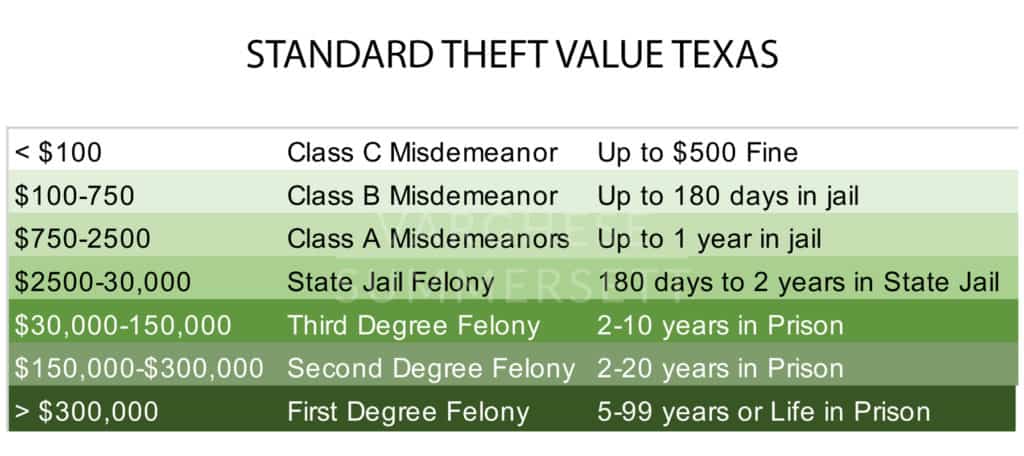
This is the Texas Theft Ladder our Fort Worth theft lawyers reference in every case:
Texas Theft Value Ladder (2026)
| Valor de la propiedad | Nivel de infracción | Castigo máximo |
|---|---|---|
| Menos de 100 | Delito menor de clase C | Up to $500 fine (no jail) |
| $100 - $750 | Delito menor de clase B | Hasta 180 días de cárcel, hasta 2.000 dólares de multa |
| 750 $ – 2500 $ | Delito menor de clase A | Hasta 1 año de cárcel, hasta 4.000 dólares de multa |
| $2,500 - $30,000 | Cárcel Estatal Delito Grave | 180 days – 2 years state jail, up to $10,000 fine |
| 30 000 $ – 150 000 $ | Delito grave de tercer grado | 2 – 10 years in prison, up to $10,000 fine |
| 150 000 $ – 300 000 $ | Delito grave de segundo grado | 2 – 20 years in prison, up to $10,000 fine |
| 300.000 dólares o más | Delito grave de primer grado | 5 – 99 years or life, up to $10,000 fine |
Being arrested for theft in Fort Worth can change your life overnight. Even a misdemeanor theft conviction is a “crime of moral turpitude” under Texas law, which means it can keep you out of jobs, schools, professional licenses, and even jury service. That is why hiring an experienced Fort Worth theft lawyer immediately after arrest matters so much.
Our Fort Worth criminal defense attorneys have three goals in every theft case:
- Keep you out of jail. Most clients tell us the hours and days following arrest were the worst of their lives. We work to get bond reduced and you released quickly.
- Keep theft off your record. A conviction for theft follows you forever. We fight to avoid one.
- Position the case for expunction. The right outcome on the front end is what makes a later expunction possible.

Fort Worth Shoplifting Defense
Shoplifting is the most common theft charge our Fort Worth theft attorneys defend. Under Texas law there is no separate “shoplifting” statute — shoplifting is prosecuted as theft under Penal Code 31.03 or as organized retail theft under Penal Code 31.16. The offense level depends on the value of the merchandise allegedly taken, exactly as it does for any other theft.
Common Fort Worth shoplifting scenarios our attorneys see:
- Self-checkout mistakes. An item doesn’t scan. A barcode reads the wrong product. A bag stays in the cart. Loss prevention treats it as theft.
- Forgotten items. Something stays in a stroller, under a child’s seat, or at the bottom of a cart. The customer walks out, and is stopped.
- Concealment claims. Loss prevention says merchandise was hidden in a bag, pocket, or stroller before checkout.
- Price tag switching. Allegations the customer swapped a price sticker to pay less.
- Return fraud. Allegations of returning stolen merchandise, returning items found in the store, or returning items obtained without a receipt.
A Fort Worth shoplifting charge is not just embarrassing — it carries real collateral consequences. Texas also allows the retailer to send a “civil demand letter” seeking up to $1,000 from an adult or up to $5,000 from a minor’s parents, completely separate from the criminal case. Ignoring that letter is fine in most cases. Pleading to the criminal case to make the demand letter go away is almost never a good idea. Talk to a Fort Worth theft lawyer first.
What Is the Punishment for Shoplifting in Fort Worth?
The punishment for shoplifting in Fort Worth follows the same Texas Theft Ladder above. A shoplifting case under $100 is a Class C misdemeanor (fine-only). Between $100 and $750 it is a Class B misdemeanor with up to 180 days in jail. Between $750 and $2,500 it is a Class A misdemeanor with up to a year in jail. Shoplifting becomes a state jail felony at $2,500 in merchandise. Organized retail theft under Penal Code 31.16 follows the same ladder but applies when a person receives, possesses, conceals, stores, barters, sells, or disposes of stolen retail merchandise.
A Class B or Class A shoplifting conviction also triggers driver’s license suspension implications, jury service restrictions, and an immigration impact for non-citizens that can be devastating.
When Can You Be Arrested for Theft in Fort Worth?
You can be arrested for theft in Fort Worth any time Tarrant County law enforcement believes you took property without the owner’s permission and without intent to return it. That covers everything from a candy bar at a Walmart in Hulen to allegations of trade secret theft at a tech company. The dollar value, the type of property, and your criminal history all affect the charge level.
Most Fort Worth theft arrests happen in one of three ways:
- On the spot — loss prevention or store security detains a suspected shoplifter and calls Fort Worth Police Department.
- By warrant — police investigate, get a warrant, and arrest later.
- By summons or filing — for Class C cases or some theft of services cases, you may simply be cited and given a court date in a Fort Worth municipal court or Tarrant County Justice of the Peace court.
How Is the Value of Stolen Property Calculated?
Texas, like most states, classifies theft offenses by the value of the property or services allegedly taken. To establish value, Tarrant County prosecutors rely on the fair market value of the property at the time of the offense, or the replacement value within a reasonable time after the theft. Texas Penal Code Section 31.08 governs how value is determined.
This is one of the most contested issues in felony theft cases. Loss prevention reports, store ledgers, and retail “shrink” calculations often overstate value — sometimes pushing a case from misdemeanor territory into state jail felony exposure. An experienced Fort Worth theft lawyer challenges value early and often.

Best Defenses to a Theft Charge in Texas
There are real defenses to theft charges in Fort Worth. The right defense depends on the facts, the evidence, and the way the State tries to prove the case.
Falta de intención
Theft requires intent to deprive the owner of property. If you forgot to scan an item, walked out with merchandise still in your cart, or believed you had paid, you did not commit theft. Lack of intent is the most common defense in shoplifting and self-checkout cases.
Mistake of Fact / Claim of Right
If you reasonably believed the property was yours or that you had the right to take it, that is a defense in Texas. Disputes between roommates, business partners, and former couples often look like theft to police but are really civil disputes.
Consentimiento
If the owner gave permission, there is no theft. Texas Penal Code Section 31.01 defines “effective consent” — and the issue often comes down to whether the consent was authorized, induced by deception, or given by someone with authority to give it.
Coacción o coerción
If you were forced or threatened into taking property, duress can be a defense.
Pruebas insuficientes
The State must prove every element beyond a reasonable doubt. Surveillance video that doesn’t show what loss prevention claims, missing receipts, sloppy chain of custody, and witness identification problems can all be the difference between a conviction and a dismissal.
Identidad equivocada
Surveillance footage is often grainy. Loss prevention frequently identifies the wrong person — especially in busy stores. Mistaken identity is a viable defense when the State cannot connect you to the actual taking.

The Texas Consolidated Theft Statute
Texas has a consolidated theft statute, meaning offenses that used to be charged separately have all been folded into a single “theft” statute. In the past, Texas distinguished between theft by false pretext, conversion by a bailee, theft from the person, shoplifting, acquisition by threat, swindling, swindling by worthless check, embezzlement, extortion, receiving stolen property, and concealing stolen property. Today, all of those are charged as theft under Penal Code 31.03.
Some specialized theft offenses still have their own statutes, including theft of services (31.04), theft of trade secrets (31.05), organized retail theft (31.16), and cargo theft (31.18).
A theft accusation against someone under 17 is handled in Tarrant County juvenile court. Our Fort Worth juvenile defense lawyer, Lisa Herrick — Board Certified in Juvenile Law — handles juvenile theft cases.

Common Types of Theft Charges in Fort Worth
Cambio de etiquetas de precio
Price tag switching is treated the same as shoplifting in Texas. On September 1, 2019, the 86th Texas Legislature passed House Bill 427, making the punishment for price tag switching identical to theft of property at the new “intended” price. Before HB 427, price tag switching was a flat Class A misdemeanor. Now the punishment depends on the difference between the marked price and the price paid — meaning, in extreme cases, a defendant could theoretically face felony exposure for swapping a sticker. See Texas Penal Code Section 32.47.
Robo a una persona
Under Penal Code 31.03(e)(4)(B), theft from a person of another — or from a human corpse or grave — is a state jail felony regardless of the value of the property, punishable by 180 days to 2 years in state jail and up to a $10,000 fine. This is the charge prosecutors typically use for pickpocketing, purse-snatching, and similar offenses that don’t involve force.
Theft With Prior Convictions
Theft charges are enhanced when the accused has prior theft convictions. A Class C theft with one prior theft conviction is enhanced to a Class B misdemeanor (which means jail time, not just a fine). Two prior theft convictions of any level enhance a new misdemeanor theft into a state jail felony — even if the new alleged theft is something as minor as a pack of gum. That means a person with two priors who shoplifts under $2,500 in merchandise is facing 180 days to 2 years in state jail.
Theft punishment can also be enhanced when the offense involves:
- A public servant who used their position to commit the theft
- A government contractor stealing from the government
- A Medicare provider stealing from the government
- Theft committed after a fire alarm was activated
- Theft committed after a retail theft detector was deactivated
See Texas Penal Code Section 31.03(e)(2)(B) for the full enhancement framework.
Theft of Trade Secrets
Theft of a Trade Secret under Penal Code 31.05 is a third-degree felony in Texas, punishable by 2 to 10 years in prison. A trade secret includes any scientific or technical information, design, process, procedure, formula, or improvement that has value and that the owner has taken reasonable measures to protect. A person commits theft of trade secrets if, without the owner’s consent, they knowingly steal a trade secret, copy an article representing a trade secret, or communicate or transmit a trade secret.

Posesión de bienes robados
Police often find suspects in possession of recently stolen property without catching anyone in the act of taking it. Under Texas Penal Code 31.03(b)(2), receiving stolen property — with knowledge that it was stolen — is consolidated into the general theft statute. In other words, knowingly possessing stolen property can be charged as theft. The “knowledge” element is often where these cases are won or lost.
Theft by Deception
Theft by deception involves taking property by using deceptive acts or false statements that the victim relied on. Examples include contractors who collect a deposit for work they never intended to perform, fraudulent investment schemes, and false-pretense sales. Theft by deception cases open more defensive theories than a straight shoplifting case — defense attorneys can dig into contract formation, partial performance, the victim’s state of mind, and whether the deception was material to the transaction.
Theft by Extortion
Theft by extortion is consolidated into the general theft statute but requires the appropriation to be induced by coercion or threat. “Coercion” includes threats to commit an offense, inflict bodily injury, accuse a person of an offense, expose someone to hatred or contempt, harm a person’s credit or business reputation, or take or withhold action as a public servant. See Penal Code 31.02.
Theft of Services
Theft of services is the charge prosecutors use when someone allegedly received a service without paying for it. The range covers roofing work, internet and cable service, electricity, vehicle repairs, hotel stays, taxi and rideshare fares, and rental property. Texas Penal Code 31.04 provides that a person commits theft of service if they secure performance of a service by threat or deception with intent to avoid payment. The same statute also covers personal property obtained through a written rental agreement and not returned.
A statutory defense exists if the service provider accepted a post-dated check and then presented it before the agreed-upon date. Other non-statutory defenses also apply — an experienced Fort Worth theft lawyer can identify them.

Robo organizado en comercios
Organized retail theft under Texas Penal Code Section 31.16 targets conduct related to large-scale or repeated retail theft. The statute punishes anyone who receives, possesses, conceals, stores, barters, sells, or disposes of stolen retail merchandise. The Texas Legislature significantly expanded organized retail theft enforcement effective September 1, 2025, lowering the value thresholds for certain enhancements and adding new aggregate-value provisions for repeated thefts within a thirty-day period.
The punishment for organized retail theft follows the Texas Theft Ladder by value:
- Less than $100 — Class C misdemeanor
- $100 to $750 — Class B misdemeanor
- $750 to $2,500 — Class A misdemeanor
- $2,500 to $30,000 — State jail felony
- $30,000 to $150,000 — Third-degree felony
- $150,000 to $300,000 — Second-degree felony
- $300,000 or more — First-degree felony
Robo de un arma de fuego
Theft of a firearm in Texas is automatically a state jail felony regardless of the firearm’s value. This is one of several “type of property” enhancements that override the standard theft ladder.
Cargo Theft
Cargo theft under Penal Code 31.18 applies to theft of cargo from a commercial vehicle, container, or storage facility and carries enhanced penalties for losses over $1,500.
Felony Theft Punishment Ranges in Texas
Our Fort Worth theft lawyers have handled the full range of theft charges, from Class C tickets to first-degree felonies. Here is what is at stake at each felony level:
- State Jail Felony — 180 days to 2 years in state jail and up to a $10,000 fine
- Third-Degree Felony — 2 to 10 years in prison and up to a $10,000 fine
- Second-Degree Felony — 2 to 20 years in prison and up to a $10,000 fine
- First-Degree Felony — 5 to 99 years or life in prison and up to a $10,000 fine
Misdemeanor Theft Penalties in Texas
- Class C Misdemeanor (under $100) — Up to $500 fine, no jail. Filed in municipal court or Justice of the Peace court.
- Class B Misdemeanor ($100 to $750, or any theft with one prior theft conviction) — Up to 180 days in jail and a $2,000 fine. Filed in Tarrant County Criminal Court.
- Class A Misdemeanor ($750 to $2,500) — Up to 1 year in jail and a $4,000 fine. Filed in Tarrant County Criminal Court.
Theft of a driver’s license, government-issued ID, election ballot, or certain other documents is enhanced to Class B regardless of value.
Can a Fort Worth Theft Case Be Dismissed?
Yes — Fort Worth theft cases get dismissed every day. The path to dismissal depends on the facts and the client’s background, but the most common routes our Fort Worth theft lawyers use are:
- Deferred Prosecution Program (DPP) — first-time offenders, especially under age 25, often qualify for the Tarrant County Deferred Prosecution Program. Successful completion results in dismissal, which makes the arrest eligible for expunction.
- Pretrial diversion — for adults outside the DPP age range, other Tarrant County diversion options may apply.
- Civil compromise or restitution — in some theft of services and theft by deception cases, full restitution combined with mitigation can produce a dismissal.
- Reduction to Class C — reducing a Class B or A shoplifting case to a Class C disorderly conduct or to a Class C theft can preserve eligibility for nondisclosure.
- Outright dismissal — for evidentiary problems, intent issues, identification issues, or value disputes.
Tarrant County Theft Diversion Programs
If you are 25 or under, this is your first arrest, and the alleged theft is a misdemeanor, you may be eligible for the Tarrant County Deferred Prosecution Program. Our Fort Worth theft attorneys have placed many young clients into DPP and walked them through to successful completion and expunction. Tarrant County also offers mental health diversion, the First Responder Diversion Program, RISE, YODA, and Veterans Court — each of which can apply to a theft case under the right circumstances.

Where Are Fort Worth Theft Cases Heard?
Theft cases in Fort Worth are heard at the Tim Curry Criminal Justice Center at 401 W. Belknap Street — the main Tarrant County criminal courthouse, located three blocks from our office. Class C theft cases are heard in Fort Worth Municipal Court or in a Justice of the Peace court. Class A and Class B misdemeanor theft cases are heard in one of Tarrant County’s ten Criminal Courts. Felony theft cases are heard in one of Tarrant County’s ten District Courts. Our Fort Worth theft lawyers appear in these courts every week.
What to Do If You Were Arrested for Theft in Fort Worth
- Do not talk to police, loss prevention, or store managers. Anything you say can be used. Politely decline to give a statement until you have a Fort Worth theft attorney.
- Do not sign anything from the store. Loss prevention will often hand you a “trespass warning” and a “civil demand” letter. Do not sign admissions of guilt to make the situation go away faster.
- Do not return to the store. A trespass warning means you can be arrested for criminal trespass if you go back.
- Document everything you can remember. Write down what happened, who said what, what you bought, what you didn’t, and the time sequence — while it is fresh.
- Call a Fort Worth theft lawyer immediately. The earlier we get involved, the more options we have — especially for diversion eligibility.
Why Hire Varghese Summersett for a Fort Worth Theft Case?
Varghese Summersett is a three-time Inc. 5000 Texas law firm built on a single principle: deep specialization in the things our clients are accused of. Our Fort Worth theft lawyers are former Tarrant County prosecutors and Board Certified criminal defense attorneys who have tried over 100 jury trials between them. We know the Tarrant County judges, the Tarrant County prosecutors, and the Tarrant County diversion coordinators by name — because we work with them every week.
What that means for a theft case:
- We know which prosecutors will reduce, which will dismiss outright, and which require a trial setting before they move.
- We know which judges accept what kinds of diversion outcomes.
- We know how loss prevention investigations are run — and where they break.
- We have an in-house team that handles the expunction after dismissal, so the arrest doesn’t follow you.
Frequently Asked Questions About Fort Worth Theft Cases
How much does a Fort Worth theft lawyer cost?
Fees depend on the level of the charge and the complexity of the case. Class C and Class B misdemeanor theft cases are generally the most affordable. Felony theft and organized retail theft cases require more investigation and more court appearances. Our Fort Worth theft attorneys offer free consultations and flat-fee pricing so you know exactly what representation will cost before you hire us.
Will a Fort Worth shoplifting charge show up on a background check?
Yes — until it is expunged or sealed. Even a dismissed arrest shows up on a background check unless and until you obtain an expunction. That is why our goal in every theft case is an outcome that qualifies for expunction.
Can I get a Fort Worth theft arrest expunged?
You can get a Fort Worth theft arrest expunged if (1) the case was dismissed, (2) you were acquitted, (3) you successfully completed pretrial diversion, or (4) you were no-billed by the grand jury. Our Fort Worth expunction lawyers handle the expunction petition once the underlying case is resolved.
Is theft a crime of moral turpitude in Texas?
Yes. Theft is a “crime of moral turpitude” under Texas law, which has consequences for employment, professional licensing, jury service, and — for non-citizens — immigration status. A theft conviction can be grounds for removal from the United States. If you are not a U.S. citizen and you have been arrested for theft in Fort Worth, talk to a Fort Worth theft lawyer before doing anything else.
Do I have to go to court for a Fort Worth shoplifting ticket?
For a Class C shoplifting citation, you do have to appear in Fort Worth Municipal Court or the appropriate Justice of the Peace court. In most cases, your Fort Worth theft attorney can appear for you. For Class B or higher charges, your appearance is generally required at certain settings.
What is the statute of limitations on theft in Texas?
The statute of limitations on misdemeanor theft is two years. The statute of limitations on most felony theft is five years. Theft from an elderly person, theft of certain government property, and certain other enhanced thefts have longer limitations periods.
Can a shoplifting case be reduced to something that isn’t on my record?
Often, yes. Common reductions our Fort Worth theft lawyers negotiate include reduction from Class B theft to Class C, deferred prosecution leading to dismissal, and outright dismissal in exchange for restitution. Each pathway preserves your ability to expunge the arrest later.
Contact a Fort Worth Theft Lawyer Today
If you have been charged with theft, shoplifting, retail theft, or any related offense in Fort Worth or Tarrant County, do not wait. The earlier a Fort Worth theft lawyer gets involved, the more options you have — diversion eligibility, prosecutor relationships, and evidence preservation all become harder as time passes.
Call Varghese Summersett at 817-203-2220 for a free consultation with an experienced Fort Worth theft attorney. During the consultation, we will:
- Discuss the facts and circumstances of your case
- Explain the offense level, the punishment range, and the collateral consequences
- Identify the defenses that apply to your situation
- Walk you through our approach to defending your case
- Quote a flat fee, in writing, before you decide whether to hire us
Our office is at 300 Throckmorton Street, Suite 700, Fort Worth, TX 76102 — three blocks from the Tim Curry Criminal Justice Center. We also have offices in Dallas, Southlake, and Houston, and we represent clients throughout Tarrant County, including Arlington, Mansfield, Grapevine, Keller, Southlake, Colleyville, Bedford, Euless, Hurst, North Richland Hills, Haltom City, Watauga, Saginaw, White Settlement, Benbrook, Crowley, Forest Hill, and Burleson.