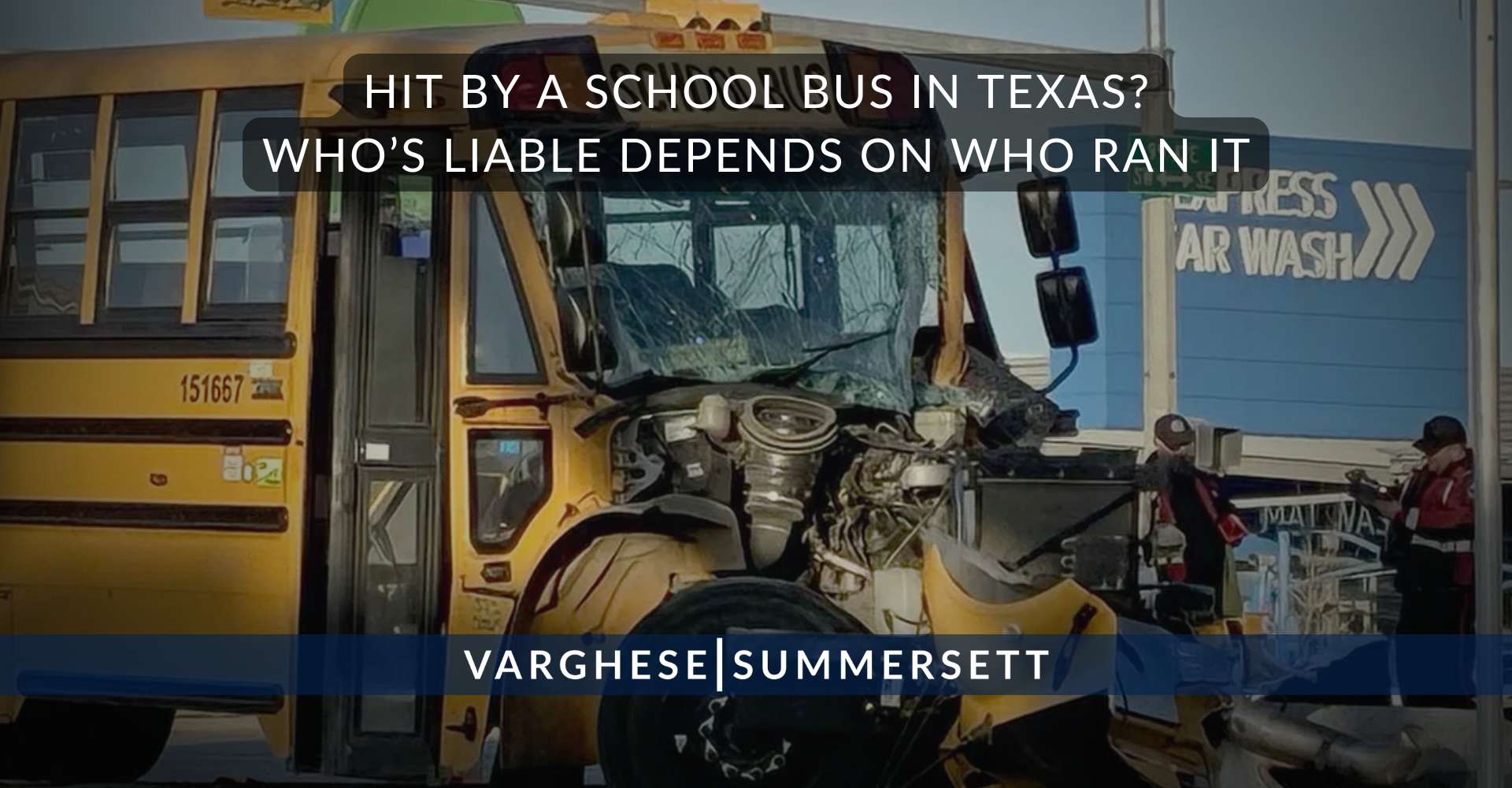
A school bus hit your car, ran a red light, failed to yield, or backed into you in a parking lot. You have injuries. You have a totaled vehicle. And you are about to discover that finding out who is liable — and what that liability is actually worth — is one of the most complicated questions in Texas personal injury law.

The reason is this: in Texas, a school bus is not just a school bus. It is a vehicle operated by one of three very different types of entities — a public school district, a charter school, or a private operator — and each type carries an entirely different legal framework for liability, damages, and procedure. The entity that ran the bus determines whether your claim is capped at a fraction of your actual damages, whether you had six months from the crash to file a notice of claim or lose your rights forever, and whether you can even sue the driver personally.
Most people who have been hit by a school bus do not know any of this. Most lawyers who do not regularly handle these cases do not either. At Varghese Summersett, our personal injury lawyers handle the full range of school bus collision cases — from ISD crashes subject to the Texas Tort Claims Act to private contractor cases where the full measure of damages is available. This article walks through every scenario so you understand exactly what you are facing.
The Three Types of School Bus Operators in Texas — and Why It Matters
Before analyzing liability, you need to know which type of entity operated the bus that hit you. The three categories are public school districts (ISDs), open-enrollment charter schools, and private operators. Each sits in a different legal position, and those differences are not minor — they can mean the difference between a recovery capped at $100,000 and a full verdict for all of your damages.
Distritos escolares independientes (DSI)
Texas public school districts are governmental units created under the Texas Education Code. When an ISD bus driver hits you, you are suing a governmental entity. That means the Texas Tort Claims Act (TTCA) governs your claim from start to finish — it determines what you can sue for, what your recovery is capped at, how long you have to give notice, and what happens if you miss any of those steps.
Charter Schools
Open-enrollment charter schools in Texas are created under Texas Education Code Chapter 12 and authorized by the Texas Education Agency. They are public schools in the educational sense — they receive state funding and serve public school students — but they are not ISDs. Whether a charter school is a “governmental unit” entitled to governmental immunity under the TTCA is a question Texas courts have not answered uniformly. That legal ambiguity creates real strategic complexity for anyone hit by a charter school bus.
Private Bus Operators
Private and parochial schools operate their own buses. More importantly, many ISDs and charter schools contract with private transportation companies to operate their bus fleets under service contracts. Those private companies are not governmental entities. They do not receive the protection of governmental immunity. They are not subject to the TTCA’s damages caps. If a private contractor’s driver hit you — even if the bus had a school district name painted on it — you may be dealing with an entirely different legal framework than if the district operated the bus itself.
The first task in any school bus case is identifying the employer of the driver at the wheel. That single fact shapes everything that follows.
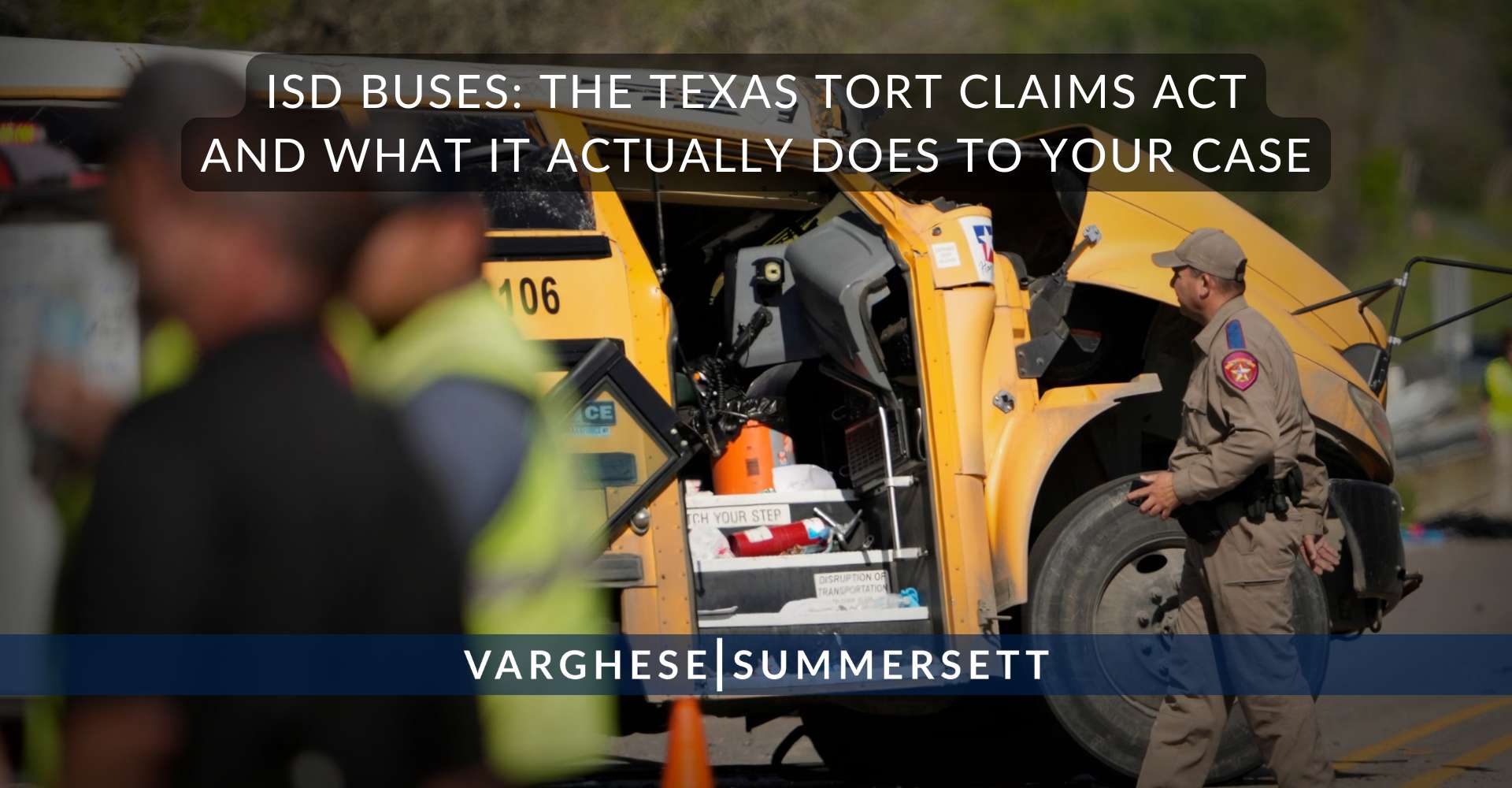
ISD Buses: The Texas Tort Claims Act and What It Actually Does to Your Case
If the bus was operated by an ISD — meaning the district employed the driver directly and owned or controlled the vehicle — your claim is governed by the Texas Tort Claims Act, Chapter 101 of the Texas Civil Practice and Remedies Code. Understanding the TTCA is not optional. It contains rules that, if missed, extinguish your claim entirely.
Governmental Immunity and the TTCA’s Waiver
Texas governmental entities, including ISDs, enjoy sovereign immunity — they cannot be sued unless the Legislature has specifically waived that immunity by statute. The TTCA contains such a waiver for personal injury and death arising from the operation or use of a motor-driven vehicle by a governmental employee acting within the scope of employment. Section 101.021 of the Texas Civil Practice and Remedies Code establishes this waiver. A school bus driver operating an ISD bus on an assigned route is a textbook example of a government employee acting within scope.
The waiver sounds broad. It is not. The TTCA gives with one hand and takes back with the other — through a damages cap that applies regardless of how severe your injuries are.
The TTCA Damages Cap: $100,000 Per Person, $300,000 Per Occurrence
Section 101.023 of the Texas Civil Practice and Remedies Code limits a governmental unit’s liability for personal injury and death to $100,000 per person and $300,000 per single occurrence. These caps apply no matter what your actual damages are. If the ISD bus driver ran a red light at forty miles per hour and left you with a traumatic brain injury, future surgeries, and two years of lost wages that total $800,000 in actual damages, your recovery from the ISD is still capped at $100,000.
This is not a theoretical concern. The $100,000 cap has been in place without adjustment for inflation since the TTCA’s current form took effect, and it represents a fraction of the actual damages in any serious collision case. Courts have repeatedly applied it to reduce recoveries well below a plaintiff’s proven losses. Understanding this cap at the outset is essential to building a complete case — because in many ISD bus cases, identifying additional defendants who are not subject to the cap is the only way to pursue full compensation.
The Pre-Suit Notice Requirement: Six Months, or You May Lose Everything
Section 101.101 of the Texas Civil Practice and Remedies Code requires a claimant to give a governmental unit formal written notice of a claim within six months of the incident giving rise to the claim. The notice must include the date and time of the incident, the place of the incident, a description of the incident, and the nature of the injury or damage. It must be sent to the governmental unit itself — the ISD — not to the driver, the insurer, or the school principal.
Failure to provide timely, adequate notice is a complete bar to the claim. This is not a technical formality that courts overlook. Texas courts have dismissed TTCA claims because notice was sent to the wrong entity, because the notice did not include sufficient description of the incident, and because the claimant waited too long — even when the lawsuit itself was filed within the two-year statute of limitations. The notice requirement and the statute of limitations are separate and independent deadlines. Missing either one ends your claim.
There is a narrow exception: if the governmental unit had actual notice of the claim — meaning it conducted its own investigation, sent representatives to the scene, or otherwise had actual knowledge of the incident and the claimant’s injury — formal written notice may not be required. The burden of proving actual notice falls on the claimant, and the standard is demanding. Actual notice requires the governmental unit to have had the same information a timely written notice would have provided. Do not assume the ISD’s investigation of the accident amounts to actual notice. It usually does not, and betting on that exception is a gamble with your entire case.
If you were hit by an ISD bus, the six-month clock started running the day of the crash. If you are reading this article weeks or months after the collision without having sent written notice, contact a lawyer today.
Driver Immunity and What It Means for Your Case
Under Texas law, a governmental employee acting within the scope of employment and in good faith may be entitled to official immunity from personal liability. In a typical ISD bus case, the district is the proper defendant — not the driver individually. Suing the driver alone is often insufficient to reach any meaningful recovery. The ISD, as the employer, is the entity with both the obligation under the TTCA and the resources to satisfy a judgment within the cap.
No Punitive Damages Against the ISD
The TTCA does not authorize exemplary or punitive damages against governmental units. Even if the evidence shows that the ISD’s driver was egregiously reckless — driving while intoxicated, running repeated stop signs, operating a bus with known mechanical failures — you cannot obtain a punitive damages award against the district. This limitation further underscores why identifying non-governmental defendants in school bus cases matters so much.

Charter School Buses: The Legal Ambiguity That Can Work For or Against You
Charter schools occupy a uniquely uncertain position in Texas tort law. They are public schools created by state statute and funded with state money, but they are not political subdivisions of the state in the traditional sense. They are authorized by state agencies and subject to state oversight, but they operate with substantial independence from local government. That hybrid character has produced inconsistent court decisions on the central question: is a charter school a “governmental unit” entitled to TTCA protection?
Why Courts Disagree
Under the TTCA, a “governmental unit” includes the state, agencies of the state, and “political subdivisions” of the state. Texas Education Code Chapter 12 creates open-enrollment charter schools as state-authorized entities, but it does not explicitly classify them as political subdivisions. Courts analyzing the question look at a series of factors: whether the entity performs a governmental function, the degree of state control over the entity’s operations, how the entity is funded, whether the entity can be sued independently, and whether the Legislature intended to extend immunity to this type of entity.
Some Texas courts have found that open-enrollment charter schools share enough characteristics with governmental units — state funding, state authorization, public-school mission — to qualify as governmental units and receive TTCA immunity and its damages caps. Other courts have looked at the same statutory scheme and concluded that charter schools lack the essential characteristics of political subdivisions and are therefore subject to full tort liability without caps.
The practical result: when a charter school bus hits you, the threshold question of whether the TTCA applies may itself require litigation to resolve. This is not a question a non-specialist will see coming, and it is not a question with a simple answer.
The Strategic Stakes
If a charter school is found to be a governmental unit, the TTCA framework applies: the $100,000/$300,000 caps limit your recovery, the six-month notice requirement applies, and driver immunity potentially applies. If it is not a governmental unit, you can pursue full tort damages — medical expenses past and future, lost wages, pain and suffering, and potentially exemplary damages — without any statutory ceiling.
This ambiguity cuts both ways. For the claimant, it creates uncertainty about what legal framework governs, which can complicate case evaluation and strategy. It also creates risk: if you assume the charter school is not a governmental unit and skip the TTCA notice, then a court later finds it is, your claim may be barred for lack of notice. For the same reason, sending the TTCA notice even in charter school cases — as a precaution — is standard practice for lawyers who handle these cases regularly.
Charter schools that are chartered by an ISD (rather than directly by the state) may face a different analysis than those chartered directly by the Texas Education Agency. The specific authorizing structure and governance arrangement matter to the immunity analysis. There is no one-size-fits-all answer, and the case law continues to develop.
Private Bus Operators: No Caps, No Immunity, Full Tort Recovery
Private bus operators — whether operating for private schools, parochial schools, or under contract to ISDs or charter schools — are not governmental entities. They are private companies subject to the full range of Texas tort law with no immunity, no damages caps, no pre-suit notice requirements, and no restrictions on exemplary damages. If a private contractor’s driver hit you, you are in a fundamentally different legal position than a claimant hit by an ISD bus.
Private Schools and Their Bus Fleets
Private and parochial schools that operate their own buses are treated as ordinary private entities. The school may be a nonprofit, a church-affiliated institution, or a for-profit educational company — in any case, no governmental immunity applies. You can pursue the full measure of your damages: medical expenses, lost wages, loss of earning capacity, pain and suffering, disfigurement, and, if the conduct was grossly negligent, exemplary damages under Chapter 41 of the Texas Civil Practice and Remedies Code.
Contracted Transportation Companies: The Most Overlooked Issue in ISD Cases
This is the most important point in this section, and the one most often missed: many ISDs and charter schools do not operate their own buses. They contract with private transportation companies — national companies with large regional fleets — to provide bus service under service agreements. The buses may carry the school district’s name on the side. The driver may wear a uniform that references the school. But the employer of record for the driver is the private transportation company, not the ISD.
When that private contractor’s driver causes a crash, the contractor — not the ISD — is the liable party for the driver’s negligence. The contractor is a private entity. It is not shielded by governmental immunity. It is not subject to the TTCA’s $100,000 damages cap. And the six-month pre-suit notice requirement does not apply to it. An injured person who correctly identifies the transportation contractor as the employer can pursue full tort recovery while the ISD remains on the fringe of the case at most.
Identifying whether the driver was an ISD employee or a contractor employee is the first investigation task in every ISD-adjacent bus case. The bus number, the employer listed on the driver’s license (if visible), the company name on the contract, and public records requests to the ISD for its transportation contracts all provide this information. Assuming the ISD was the employer because the school’s name was painted on the bus is a common and expensive mistake.
Liability Theories Against Private Operators
Against a private bus operator, the full range of Texas negligence theories applies. Respondeat superior makes the operator liable for its driver’s negligent acts committed within the scope of employment — a bus driver operating a contracted school route is unambiguously within scope. Negligent hiring applies if the contractor employed a driver with a disqualifying driving history, prior DUI convictions, or a record of safety violations. Negligent retention and supervision apply if the contractor had evidence of a dangerous driver and failed to act on it. Negligent entrustment applies if the contractor placed an unqualified driver in a bus it controlled.
Texas law also imposes specific requirements on commercial vehicle operators. If the bus operated under a USDOT number — which larger contracted fleets generally do — the Federal Motor Carrier Safety Administration regulations apply. FMCSA rules impose driver qualification requirements, hours-of-service limits, drug and alcohol testing after crashes, and vehicle inspection and maintenance standards. Violations of those regulations are independent evidence of negligence and may support claims beyond ordinary respondeat superior.
Commercial Insurance Coverage
Private bus contractors operating commercial motor vehicles are required to maintain commercial auto liability insurance. The coverage available against a private contractor is substantially higher than what the TTCA permits against an ISD — and it is not capped by statute. Policy limits, umbrella policies, and excess coverage are all in play. Obtaining the full policy documents — not just the declarations page — and identifying all available layers of coverage is essential.
Evidence That Is Specific to School Bus Cases
School buses are among the most heavily instrumented vehicles on public roads. Evidence that is critical to liability and damages begins disappearing within days of the crash.
Onboard camera systems: Most Texas school buses are equipped with exterior-facing and interior cameras. These systems record the roadway ahead, the area around the bus, and often the driver’s compartment. In a collision case, that footage is the most direct evidence of what the driver did in the seconds before impact. School districts and contractors retain this footage on their own servers, and their retention policies run on short cycles. A preservation demand must go to the right entity — the ISD or the contractor, depending on who operates the fleet — within the first days after a crash. Sending the demand to the wrong entity means the footage may be legally preserved by one party while the party that actually holds it overwrites it.
GPS and telematics data: Modern school bus fleets track real-time GPS location, speed, and route compliance through fleet management software. That data can show whether the driver was speeding before impact, whether the bus was on its assigned route, and whether any safety event — hard braking, sudden acceleration — was recorded in the moments before the crash. This data is time-sensitive.
Driver qualification records: The driver’s commercial driver’s license status, background check results, prior traffic violations, and drug and alcohol testing history are critical to a negligent hiring or negligent retention claim. For contractors subject to FMCSA regulations, these records must be maintained in the driver qualification file. For ISD employees, similar records exist in personnel files. Obtaining these records requires a formal demand or public records request.
Post-crash drug and alcohol testing: FMCSA regulations require post-crash drug and alcohol testing when a commercial motor vehicle is involved in a collision meeting certain thresholds. The results of those tests — or evidence that required testing was not conducted — are relevant both to the driver’s individual negligence and to the operator’s compliance with federal regulations.
Maintenance and inspection records: School bus mechanical failures — brake failures, steering problems, tire blowouts — produce both products liability claims and negligence claims against whoever failed to maintain the vehicle. Texas law requires ISDs and contractors to maintain inspection records. Those records should be preserved immediately.
Pre-crash complaints: In ISD cases, public records requests to the district can reveal prior complaints about the driver, prior crash reports, prior disciplinary action, and prior safety inspection failures that the district had notice of before your crash. In contractor cases, the same records exist internally. Those records are the foundation of a negligent retention or negligent supervision claim.
Texas Law: What Applies to Your Claim
Every school bus collision case in Texas begins with a standard negligence analysis: the driver owed everyone on the road a duty of ordinary care, they breached that duty, and that breach caused your injuries. When a driver violates a Texas traffic safety statute — running a red light, failing to yield, speeding — that violation may constitute negligence per se if it caused the kind of harm the statute was designed to prevent.
Texas uses proportionate responsibility. You can recover as long as you are found to be 50% or less at fault for the collision. A percentage of fault assigned to you reduces your recovery dollar-for-dollar. For ISD defendants, that analysis still runs, but your recovery is already capped before proportionate reduction even enters the picture.
The general two-year statute of limitations under Section 16.003 of the Texas Civil Practice and Remedies Code applies to personal injury claims. But against governmental entities, the TTCA’s six-month notice requirement is an independent and earlier deadline that can bar your claim before the two-year period expires. These deadlines operate in parallel, not in sequence.

Common Mistakes That Destroy School Bus Cases
Missing the six-month TTCA notice deadline. This is the single most common and most fatal error in ISD bus cases. Most injured people do not know the notice requirement exists. Most non-specialist lawyers either do not know or underestimate its rigidity. Six months from the crash — not from when you hired a lawyer, not from when you finished treating — is the deadline. There is no cure for a missed notice.
Assuming the ISD operated the bus. When a bus has a school district’s name on the side and the driver is wearing a uniform with the school’s colors, most people assume the district employed the driver. In a significant number of cases, a private contractor employed the driver. That assumption — if never checked — means a case against a capped governmental defendant when a case against an uncapped private company was the correct path.
Treating charter school cases like ISD cases. The TTCA framework that governs ISD buses does not automatically govern charter school buses. Assuming it does — and therefore sending TTCA notice and capping your damages analysis at $100,000 — may mean leaving a full-tort case on the table if a court determines the charter school is not a governmental unit. Conversely, assuming the charter school is a private entity and skipping the TTCA notice may bar the claim if a court finds otherwise. Charter school bus cases require the notice to be sent as a precaution while the governmental-unit question is evaluated.
Not identifying all available defendants. Even in ISD cases where the cap applies, other defendants may not be capped. If a contractor was involved in any aspect of the bus’s operation, if a third-party maintenance provider failed to repair a brake defect, or if another vehicle contributed to the crash, those parties may be subject to full tort liability. The ISD cap is not a ceiling on the entire case — it is a ceiling on the ISD’s share.
Giving a recorded statement before speaking with a lawyer. The ISD’s insurance carrier, the contractor’s insurer, and any other adjuster involved in the case will attempt to obtain a recorded statement. You are not required to give one. Statements given before you understand the legal framework — before the relevant deadlines have been identified and before your injuries are fully documented — are routinely used to minimize both liability and damages.

Qué hacer ahora mismo
- Get medical care immediately. Every symptom should be documented from the day of the crash. Gaps in treatment create gaps in your damages case.
- Write down everything: the bus number, the school name on the bus, any company name on the bus, the driver’s appearance and any name on a badge or uniform, the time and location of the crash, and what the driver said at the scene.
- Photograph the bus (especially any company names, bus numbers, and district markings), your vehicle, the crash scene, and your visible injuries.
- Do not assume who operated the bus. The name on the side is not a reliable indicator of the employer of record.
- Do not give any recorded statement to any insurance adjuster — yours or theirs — before speaking with a lawyer.
- Do not sign any documents sent by any insurer, including medical authorizations.
- Contact a Texas personal injury lawyer immediately. If the bus was operated by an ISD, the six-month pre-suit notice clock is already running. Waiting is not a neutral choice — it is a choice that can permanently extinguish rights you did not know you had.

How Varghese Summersett Handles School Bus Cases
School bus collision cases require the kind of threshold analysis that most personal injury practices are not equipped to do. Before we evaluate damages, we identify who operated the bus. Before we assess liability, we determine which legal framework applies — TTCA, full tort, or the contested middle ground of charter school law. We send TTCA notice immediately in every case that might involve a governmental entity, because missing that deadline is not a correctable error. We issue preservation demands for onboard camera footage and telematics data within days of being hired, because that evidence disappears on short cycles that do not wait for litigation schedules.
In ISD cases, we do not stop at the $100,000 cap — we investigate every additional defendant who may not be capped: contractors, maintenance providers, third-party drivers. In charter school cases, we evaluate the governmental-unit question at the outset and build the case to maximize recovery under either framework. In private contractor cases, we pursue the full measure of available damages, including exemplary damages when the evidence supports gross negligence, and we identify every layer of commercial insurance coverage available.
We handle personal injury cases as trial lawyers. That means the other side knows that settlement offers calibrated to what an unprepared firm might accept will not resolve these cases. It means we obtain records through formal discovery that adjusters assume will never be demanded. And it means the threat of a public trial verdict is real — which changes how the other side calculates what to offer.
We have offices in Fort Worth, Dallas, Southlake, and Houston. Personal injury cases are handled on a contingency fee basis — you pay nothing unless we recover for you. Consultations are free.
If you or a family member was hit by a school bus in Texas — ISD, charter, or private — contact us today. The clock on critical deadlines may already be running. Call 817-203-2220 to speak with an experienced Texas personal injury attorney today.