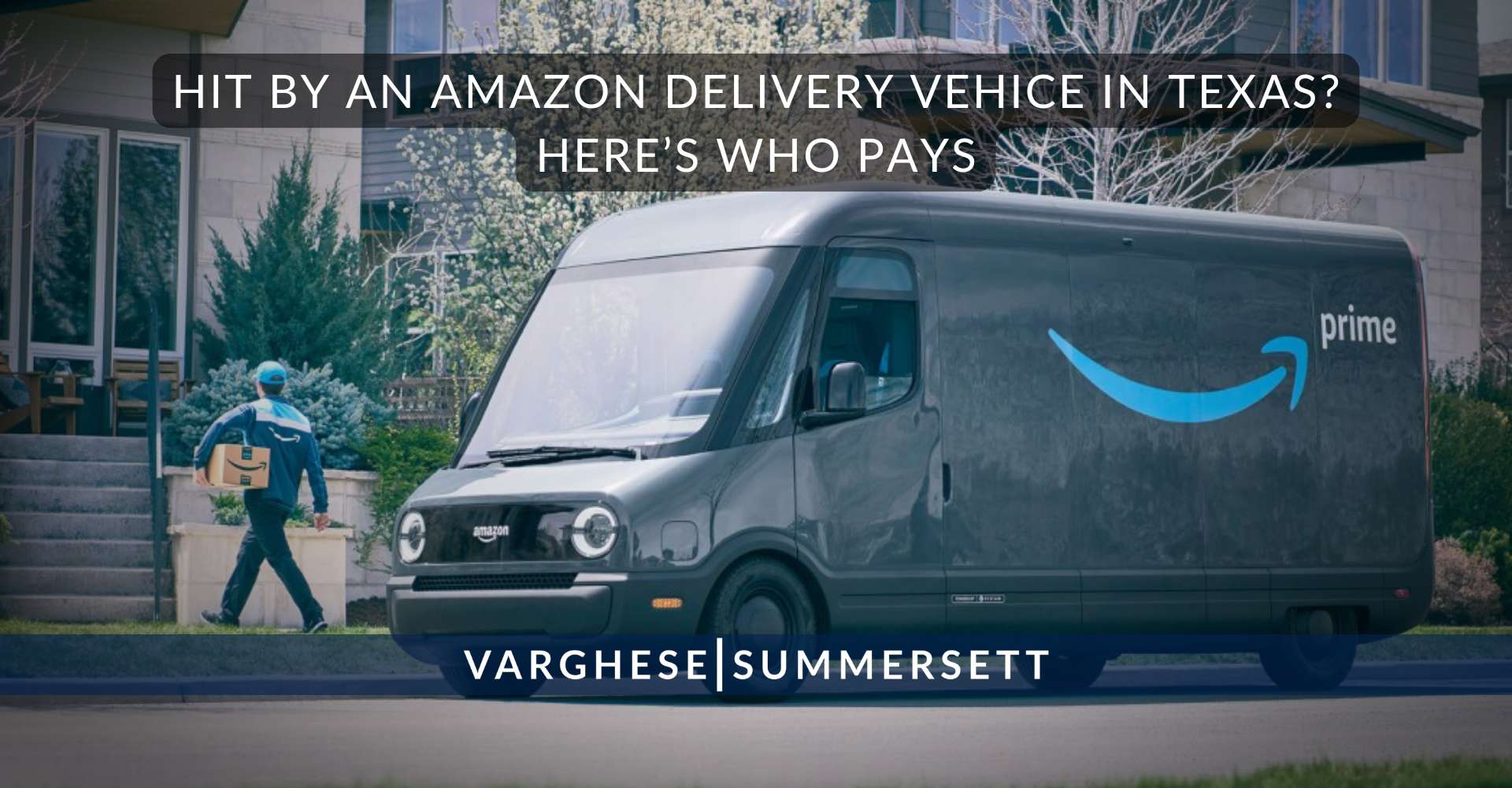
You were stopped at a light, merging onto the highway, or pulling out of a parking lot when a blue van or box truck with an Amazon smile logo hit you. Maybe the driver ran a red light. Maybe they were backing out of a neighborhood without looking. Either way, you are now injured, your car is damaged, and the driver is handing you a card for a company you have never heard of — not Amazon.
That moment of confusion is not an accident. It is the result of a deliberate corporate structure Amazon has built to distance itself from the trucks it controls, the drivers it directs, and the crashes those drivers cause. This article explains exactly how that structure works, why it does not fully protect Amazon from liability, and what an experienced Texas personal injury lawyer does to break through it.
Who You Are Actually Dealing With: Amazon’s Delivery Structure
Amazon does not employ most of the people who deliver its packages. Instead, it has created multiple layers of corporate separation between itself and the drivers on the road. Understanding each layer is the starting point for any serious claim.
Delivery Service Partners (DSPs)
The majority of Amazon’s “last-mile” deliveries — the final leg from a warehouse to your front door — are handled through a program Amazon calls Delivery Service Partners. A DSP is a small business, often a recently formed LLC or corporation, that Amazon has recruited and approved to operate delivery routes using Amazon-branded vans. Amazon provides the vans, the uniforms, the routing software, and the delivery equipment. The DSP hires the drivers, handles payroll, and is responsible for its drivers’ conduct on paper.
When a DSP driver hits you, the driver will identify the DSP employer — not Amazon. Amazon’s goal is for your lawyer to deal only with the DSP and its insurer, leaving Amazon out of the picture. A lawyer who accepts that framing will almost certainly undervalue the case. The DSP is a small company. Amazon is a $2 trillion corporation. The entire exercise of the claim is to get to Amazon.
Amazon Flex Independent Contractors
Amazon Flex is a separate program through which Amazon recruits individual drivers directly using a smartphone app. Flex drivers use their own personal vehicles to deliver Amazon packages. Amazon classifies them as independent contractors — not employees of Amazon and not employees of a DSP. Amazon controls route assignments, delivery windows, and performance standards entirely through the app. If a Flex driver hits you, there is no DSP in the middle. The only corporate entity is Amazon itself, and the only structure between Amazon and the crash is the “independent contractor” label.
Amazon Logistics and the Amazon Brand
The legal entity responsible for the delivery program is generally Amazon Logistics, Inc., a subsidiary of Amazon.com, Inc. Both entities are potential defendants. Amazon.com, Inc. is the parent corporation and ultimately the most creditworthy defendant. Identifying which Amazon entity to sue — and suing the right ones — is a threshold task. Suing only the DSP without naming the Amazon entities is a common and expensive mistake.
Third-Party Carriers
Amazon also contracts with traditional motor carriers and freight companies for certain delivery routes. Those carriers are subject to the full weight of federal motor carrier regulations, including requirements that do not apply to DSP vans on local routes. If the vehicle that hit you was a larger commercial truck operating under a USDOT number, the analysis expands to include Federal Motor Carrier Safety Administration regulations and the MCS-90 endorsement discussed below.
The $1 Million Commercial Auto Policy Most Lawyers Never Demand
This is the most important section of this article, and the one most people — including many lawyers — get wrong.
Amazon requires every DSP to maintain commercial auto insurance as a condition of the DSP agreement. Amazon also maintains its own commercial auto liability policy that covers DSP drivers operating Amazon-branded vehicles while making Amazon deliveries. That policy has limits of at least $1 million per occurrence.
Most injured people — and frankly, most personal injury lawyers who do not handle these cases regularly — deal only with the DSP’s insurer. They never ask whether Amazon’s own policy applies. The DSP’s policy alone may have limits of $1 million, but there is a second policy, Amazon’s own commercial auto coverage, that can apply on top of or alongside the DSP’s coverage depending on how the policies are structured and which “other insurance” clauses control.
Demanding both policies — the DSP’s commercial auto policy and Amazon’s commercial auto policy — and obtaining the full policy language (not just the declarations page) is a prerequisite to understanding the real coverage available. Settlement-volume firms that close cases without obtaining both policies leave significant money on the table.
Amazon Flex Coverage
For Flex drivers using their personal vehicles, the coverage structure is similar to the gig delivery platforms discussed in our DoorDash/Uber Eats article. The Flex driver’s personal auto policy almost certainly contains a commercial use exclusion that eliminates or limits coverage during active deliveries. Amazon provides commercial liability coverage for Flex drivers while they are on an active delivery block — packages are in the car and the driver is making deliveries. That coverage can reach $1 million per occurrence. The fight, as with other gig platforms, is over which period the driver was in at the moment of the crash and how Amazon’s coverage interacts with the driver’s personal policy.
Why the “Independent Contractor” Defense Does Not Hold Up
Amazon will tell you the driver was an independent contractor — either a DSP employee or a Flex driver — and therefore Amazon bears no responsibility for the crash. That argument has real limits under Texas law, and an experienced lawyer knows exactly where to attack it.
The Control Amazon Actually Exercises
Amazon’s DSP program is arguably the most tightly controlled “independent contractor” arrangement in American commerce. Consider what Amazon actually provides and directs:
Amazon owns or leases the vans and provides them to DSPs. Amazon installs its own routing and telematics software on those vans, which tracks real-time GPS location, speed, hard braking, and acceleration. Amazon’s Mentor app monitors driver behavior through the driver’s smartphone during every shift and generates safety scores that affect whether a driver stays on the route. Amazon sets the delivery window, the sequence of stops, and the performance standards. Amazon can and does direct DSPs to discipline or remove drivers based on the data Amazon collects. The DSP’s business exists entirely at Amazon’s direction — DSPs cannot take other delivery contracts and operate exclusively within the Amazon network.
Under the Texas right-to-control test, courts examine whether the company controls not just the end result of the work but the manner and means of performing it. The volume and specificity of Amazon’s control over DSP drivers — through technology, contractual requirements, and operational directives — creates a genuine fact question about whether the driver is functionally an employee of Amazon regardless of what the contract says. That fact question has to be developed through discovery, and it is a powerful lever in litigation.
Vicarious Liability: Actual Agency and Ostensible Agency
Texas recognizes two theories of agency that can make Amazon liable for a DSP driver’s negligence even if the contractor defense applies to traditional vicarious liability.
First, actual agency. If Amazon controls the driver’s work in sufficient detail under the right-to-control test, the contractor label does not insulate Amazon. The driver is Amazon’s agent in substance even if not in name. Discovery into Amazon’s operational contracts, Mentor data, telematics records, and DSP performance requirements builds this case.
Second, ostensible agency. The driver was wearing Amazon’s uniform. The van displayed Amazon’s logo and the Amazon smile. Any reasonable person would believe the driver was acting on Amazon’s behalf. Texas law recognizes ostensible or apparent agency as a basis for holding the apparent principal — Amazon — liable for the agent’s conduct when the injured party reasonably relied on that appearance. The branding alone creates a powerful ostensible agency argument that Amazon cannot contract away.
Negligent Hiring, Retention, and Supervision
Negligent hiring claims do not require an employment relationship. Amazon sets the qualification standards for DSP drivers and requires DSPs to use Amazon’s background check vendor. If a driver who caused your crash had a disqualifying driving record that a proper background check would have revealed, Amazon’s role in setting and enforcing those standards gives rise to a direct negligence claim against Amazon independent of vicarious liability. Similarly, if Amazon’s telematics data showed dangerous driving behavior before the crash and Amazon or the DSP failed to act on it, that failure supports a negligent retention and supervision claim against both entities.

If the Truck Was a Commercial Motor Carrier: Federal Regulations and the MCS-90
If the vehicle that hit you was not a DSP van but a larger commercial truck — a box truck or tractor-trailer operated by a carrier Amazon has contracted with — a separate and powerful layer of law applies.
The Federal Motor Carrier Safety Administration (FMCSA) regulates commercial motor carriers operating in interstate commerce. Carriers subject to FMCSA regulations are required to maintain minimum levels of financial responsibility and must attach an MCS-90 endorsement to their insurance policy. The MCS-90 is a federally mandated endorsement that makes the insurer directly responsible for judgments arising from the carrier’s operations, regardless of other policy exclusions. If the carrier’s policy would otherwise deny coverage — for example, because of a permissive use or policy exclusion — the MCS-90 overrides that denial and requires the insurer to pay up to the required minimum limits.
The MCS-90 is not a coverage expansion — it does not increase the policy limits — but it eliminates the insurer’s ability to dodge the claim on exclusion grounds. It also creates a direct right of action against the insurer itself. In cases involving Amazon-contracted carriers, identifying whether the carrier holds a USDOT number and whether its policy carries the MCS-90 endorsement is a threshold task that many lawyers miss entirely.
Beyond the MCS-90, FMCSA regulations impose specific duties on commercial carriers and their drivers: hours-of-service limits, drug and alcohol testing requirements, vehicle inspection and maintenance standards, and driver qualification standards. If the carrier or driver violated any of these regulations and that violation contributed to your crash, those violations are evidence of negligence and can support a negligent entrustment or negligent hiring claim against Amazon for selecting a non-compliant carrier.

Why Amazon Settles Fast — and How to Make That Work for You
Amazon is not a company that fights every case to verdict. In the personal injury context, Amazon has strong institutional reasons to settle cases before they produce public verdicts, public discovery records, and precedents that undercut the contractor structure it depends on. A case that goes to trial and produces a large verdict against Amazon — or a discovery record that reveals how tightly Amazon controls DSP drivers — is worth far more to Amazon in litigation costs and reputational damage than the individual settlement payment. Amazon’s legal team knows this calculus precisely.
But Amazon also settles fast only when it believes the other side knows what it is doing. A lawyer who deals only with the DSP’s insurer, never demands Amazon’s own commercial policy, never asserts ostensible agency or the right-to-control argument, and never develops the telematics data into a negligent supervision claim is not a threat. Amazon’s adjuster and defense counsel can recognize a settlement-volume firm within the first thirty days of a claim. Those firms settle cheap.
The levers that produce fast, adequate settlements from Amazon are the same things that make Amazon uncomfortable at trial: the ostensible agency argument based on uniform and branding, the right-to-control argument built from telematics data and the DSP agreement, the demand for Amazon’s own $1 million commercial policy alongside the DSP’s policy, and the threat of a public verdict that documents Amazon’s control over its drivers. When Amazon’s defense team believes a case is being built by a lawyer willing to take it to trial, the settlement dynamic changes.
The converse is also true. Amazon’s adjusters have watched thousands of these cases. They know which firms file suit and try cases, and which firms settle everything. Hiring a firm without trial capability in Amazon delivery cases is the single decision most likely to result in a settlement that leaves the majority of available compensation uncollected.
The Insurance Coverage That Actually Applies
Getting the right answer on coverage requires obtaining the actual policy documents — not just the declarations page and not just what an adjuster tells you over the phone. Here is the layered coverage structure in most Amazon delivery crashes:
DSP Driver in an Amazon Van (Most Common Scenario)
The DSP’s commercial auto policy is the first layer. DSPs are required to maintain commercial auto insurance as a condition of operating in the Amazon network, typically with limits of $1 million per occurrence. That policy covers the van and the driver while the driver is operating within the scope of employment for the DSP.
Amazon’s own commercial auto policy is the second layer. Amazon maintains a separate commercial auto liability policy covering DSP drivers operating Amazon-branded vans during deliveries. Whether Amazon’s policy is excess to the DSP’s policy or can be triggered alongside it depends on the “other insurance” clauses in each policy and the specific facts of the crash. Demanding both policies and having a lawyer analyze how they interact is not optional — it is the difference between a partial recovery and a full one.
Amazon Flex Driver in a Personal Vehicle
The Flex driver’s personal auto policy applies when the driver is not on an active delivery block. Most personal auto policies contain commercial use exclusions that apply once the driver is actively delivering packages. Amazon’s commercial liability coverage for Flex drivers applies during active delivery blocks. The coverage fight is over which period controlled at the moment of the crash — a question answered by Amazon’s app data, GPS records, and delivery timestamps.
Amazon-Contracted Commercial Carrier
The carrier’s commercial auto policy applies. If the carrier operates under a USDOT number, the MCS-90 endorsement prevents exclusion-based denials up to minimum federal financial responsibility limits. Amazon may also carry contingent cargo or contingent auto liability coverage for carriers in its network. Identifying every policy requires formal discovery.
Evidence That Disappears Within Days
Amazon telematics and Mentor data: Amazon’s vans are equipped with forward-facing cameras and internal cameras that record continuously. Amazon’s Mentor system captures speed, braking, and acceleration data for every second of the route. This data is the most powerful evidence in these cases — it can show exactly how fast the driver was going at the moment of impact, whether a hard braking event occurred, and whether the driver had a documented safety history. Amazon retains this data on its own servers. It will not be voluntarily produced. A preservation demand must go to Amazon’s legal department, not just the DSP, within the first days after hiring a lawyer. Amazon has been known to produce this data in litigation, and when it shows a driver with a documented safety record of dangerous behavior before the crash, it can dramatically change the value of the case.
DSP agreement and performance records: The contract between Amazon and the DSP is a key document for the right-to-control argument. It is not publicly available. Obtaining it requires either a demand letter or formal discovery. The performance records Amazon maintained on the DSP — compliance scores, driver scores, prior complaints — are equally critical and equally unavailable without a fight.
Van dashcam footage: Amazon vans are equipped with forward-facing and interior cameras. Footage from the cameras is uploaded to Amazon’s systems. After a crash, that footage can disappear quickly if a preservation demand does not go to the right place. Sending a demand to the DSP alone is insufficient — Amazon holds the data, and Amazon is the entity that must be required to preserve it.
Delivery timestamps and app data: Amazon’s delivery management system records every stop, every attempted delivery, and every GPS coordinate during the route. This data establishes what the driver was doing in the moments before the crash — whether they were running behind schedule, whether they had just departed a prior stop, and whether Amazon’s routing system had directed them to that location. Schedule pressure in Amazon’s delivery network is well-documented and directly relevant to a negligence claim.
Driver’s background check and qualification records: Amazon requires DSPs to use Amazon’s approved background check vendor. The records of that check, and what the check did or did not reveal, are relevant to a negligent hiring claim. These records are inside Amazon’s vendor system and require a formal demand or discovery to obtain.
Scene surveillance footage: Traffic cameras, business cameras, and residential cameras in the area of the crash may have captured the impact or the driver’s behavior immediately before it. Most commercial systems overwrite within 24 to 72 hours. An investigator needs to be dispatched within the first day or two.
Texas Law: What Governs Your Claim
Your claim is a Texas negligence case. Every driver on Texas roads owes everyone else a duty of ordinary care — to pay attention, follow traffic laws, and operate their vehicle safely. When a driver violates a Texas traffic safety statute in a way that causes exactly the kind of injury the statute was designed to prevent, that violation is evidence of negligence and may support a negligence per se theory.
Texas uses proportionate responsibility under Chapter 33 of the Texas Civil Practice and Remedies Code. You can recover as long as you are not more than 50% at fault. If a jury finds you 51% or more at fault, you recover nothing. Each percentage of fault assigned to you reduces your recovery dollar-for-dollar, which is why Amazon’s defense lawyers work hard in discovery to develop any evidence that you contributed to the crash.
Texas’s statute of limitations for personal injury claims is two years from the date of the crash under Section 16.003 of the Texas Civil Practice and Remedies Code. Missing that deadline almost always bars the claim entirely. Against Amazon and its related entities, that deadline is absolute. The two-year clock also affects the availability of evidence: the further from the crash date, the more data has been overwritten, deleted, or lost.
For DSP drivers and Amazon-contracted carriers operating as commercial motor carriers, the additional layer of FMCSA regulations creates duties above and beyond ordinary Texas negligence law. Violations of FMCSA hours-of-service rules, vehicle inspection requirements, or driver qualification standards are independent bases for liability on top of ordinary negligence.
Mistakes That Kill Amazon Delivery Cases
Dealing only with the DSP and its insurer. The DSP’s insurer will handle the claim as if it is a standard auto case between two private parties. That insurer has no obligation to tell you about Amazon’s separate commercial policy, and it will not. The DSP’s policy alone may produce a settlement that looks reasonable until you understand how much coverage was actually available.
Giving a recorded statement before speaking with a lawyer. Amazon’s claims team and the DSP’s insurer are experienced at taking statements that minimize liability and undercut injury claims. You are not required to give a recorded statement to any adverse insurer. Anything you say will be used to manage your claim downward.
Not demanding Amazon’s telematics data immediately. The Mentor data and dashcam footage from Amazon’s van systems are time-sensitive. Amazon’s data retention policies are not aligned with your litigation interests. Every day that passes without a formal preservation demand is a day that data may be lost. The preservation demand must go to Amazon directly — not just to the DSP.
Assuming the contractor defense ends the analysis. The “independent contractor” label is Amazon’s starting position, not the legal conclusion. It is a fact question, not an automatic outcome. Accepting it without investigation and discovery means leaving the right-to-control argument, the ostensible agency argument, the negligent hiring argument, and Amazon’s own commercial policy entirely unexplored.
Settling before understanding the full scope of injuries. Amazon’s adjusters are motivated to close files quickly, especially when they believe the claimant does not have sophisticated legal counsel. A fast settlement offer in the first weeks after a crash is almost always low relative to what the case will be worth once the full extent of injuries is understood. Once you sign a release, there is no going back — not even if your injuries require surgery six months later.
Posting on social media. Amazon’s defense team will monitor your social media throughout the case. A single photograph posted after the crash that suggests you are physically active or uninjured will appear in deposition. Lock every account on every platform immediately.

What an Experienced Lawyer Does Differently in Amazon Cases
First 48 Hours
- Send a formal litigation hold and spoliation letter directly to Amazon Logistics, Inc. and Amazon.com, Inc. — not just to the DSP — covering Mentor data, telematics records, dashcam footage, driver history, DSP performance records, and all internal communications about the crash.
- Send a separate spoliation letter to the DSP covering the same categories plus driver employment records and the DSP’s own insurance policy.
- Dispatch an investigator to identify and preserve scene surveillance footage before overwrite cycles run.
- Pull the driver’s public records: Texas driver’s license status, traffic violation history, and any relevant criminal history.
First Two Weeks
- Demand the DSP’s complete commercial auto policy and all endorsements — not just the declarations page.
- Demand Amazon’s commercial auto policy separately, identifying Amazon Logistics, Inc. as the policyholder and the DSP van as a covered vehicle.
- Identify whether any Amazon-contracted carrier involved holds a USDOT number and whether the MCS-90 endorsement applies.
- Obtain the police report and evaluate whether the officer correctly identified the driver’s employer and the Amazon program involved.
- Begin building the medical documentation chain from the day of the crash, linking injuries to the incident with the specificity needed to counter a pre-existing condition defense.
- Analyze the “other insurance” clauses in both the DSP’s policy and Amazon’s policy to determine how they interact and which is primary.
Before Filing Suit
- Obtain and analyze the DSP agreement through a records demand or early discovery — this is the document that most directly supports the right-to-control argument.
- Review Amazon’s Mentor data and telematics records for evidence of the driver’s behavior before the crash and for any documented prior safety violations.
- Evaluate whether the driver’s background check records support a negligent hiring or negligent retention claim against Amazon and the DSP.
- Retain an accident reconstruction expert if liability will be contested.
- Calculate full damages: past and future medical expenses, lost wages, loss of earning capacity, pain and suffering, and exemplary damages under Chapter 41 of the Texas Civil Practice and Remedies Code if the facts support gross negligence.
- File suit before settling if necessary to obtain Amazon’s internal records through formal discovery. Amazon settles differently once a prepared trial firm has an active case on file and deposition notices in the mail.

Qué hacer ahora mismo
- Get medical care immediately. Document every symptom, every visit, and every provider.
- Write down everything you remember: the driver’s name, the company on the van, the van’s markings and logo, the vehicle description and license plate, the time of day, what the driver said at the scene, and whether the driver mentioned Amazon or a delivery company.
- Photograph both vehicles, your injuries, the crash scene, and any Amazon branding visible on the van, uniform, or delivery equipment.
- Note the van’s USDOT number if visible on the side of the vehicle.
- Do not give a recorded statement to any insurance adjuster or claims representative — from the DSP’s insurer, Amazon’s insurer, or your own insurer — before speaking with a lawyer.
- Do not sign any document an insurer sends you, including medical authorizations or releases.
- Do not post about the crash, your injuries, or your activities on social media.
- Contact a Texas personal injury lawyer who has handled Amazon delivery cases. The evidence in these cases — particularly Amazon’s telematics data — disappears fast, and the window to preserve it is narrow.

How Varghese Summersett Handles These Cases
At Varghese Summersett, we handle personal injury cases as trial lawyers, not as settlement processors. When you are hit by an Amazon delivery vehicle, we begin by identifying every defendant and every available insurance policy — including Amazon’s own commercial auto policy, which most lawyers never demand. Spoliation letters go to Amazon Logistics, Inc. directly, not just to the DSP, within the first couple of days after you hire us. We demand the full DSP agreement and analyze it for the right-to-control argument that underpins the vicarious liability case against Amazon itself. We obtain Amazon’s Mentor telematics data and dashcam footage through formal litigation holds and, if necessary, emergency discovery motions. We evaluate every federal motor carrier regulation that may apply and identify whether the MCS-90 endorsement creates a direct right of action against an insurer that might otherwise deny the claim.
Amazon’s defense team knows the difference between a settlement-volume firm and a trial firm. That distinction determines the settlement Amazon offers. Firms that never file suit, never depose Amazon’s corporate representative, and never demand Amazon’s internal records receive offers calibrated to what they know — which is less than the full picture. We build these cases the way they need to be built if they go to trial, which means Amazon negotiates knowing we will try the case if the offer is inadequate.
We have offices in Fort Worth, Dallas, Southlake, and Houston. Personal injury cases are handled on a contingency fee basis — you pay nothing unless we recover for you. The consultation is free.
If you or a family member was hit by an Amazon delivery van, truck, or Flex driver in Texas, contact us today. The evidence in these cases starts disappearing within hours of the crash, and so does your leverage. Call 817-203-2220 to schedule your free consultation with an experienced Texas personal injury attorney today.